

Tax filing is due by midnight tonight.
(In almost all cases.)
If you're not filing your taxes today, file an automatic extension.
The tax burden in the United States is one of the lowest of any first world nation.
PAY YOUR TAXES.
(Yes, we posted the same post last year, plus some stuff about Bush.)

Showing posts with label Economy. Show all posts
Showing posts with label Economy. Show all posts
Wednesday, April 15, 2009
Tax Day
Wednesday, February 25, 2009
Obama: President's Address to Congress
The White House - Blog Post - The President's Address (photos, video, full remarks.)
(The White House link also has wide image and a button for full screen mode.)
Address to Joint Session of Congress
President Barack Obama
House Chamber, United States Capitol, Washington, D.C.
February 24, 2009
Remarks of President Barack Obama – As Prepared for Delivery
(en español)
Madame Speaker, Mr. Vice President, Members of Congress, and the First Lady of the United States:
I’ve come here tonight not only to address the distinguished men and women in this great chamber, but to speak frankly and directly to the men and women who sent us here.
I know that for many Americans watching right now, the state of our economy is a concern that rises above all others. And rightly so. If you haven’t been personally affected by this recession, you probably know someone who has – a friend; a neighbor; a member of your family. You don’t need to hear another list of statistics to know that our economy is in crisis, because you live it every day. It’s the worry you wake up with and the source of sleepless nights. It’s the job you thought you’d retire from but now have lost; the business you built your dreams upon that’s now hanging by a thread; the college acceptance letter your child had to put back in the envelope. The impact of this recession is real, and it is everywhere.
But while our economy may be weakened and our confidence shaken; though we are living through difficult and uncertain times, tonight I want every American to know this:
We will rebuild, we will recover, and the United States of America will emerge stronger than before.
The weight of this crisis will not determine the destiny of this nation. The answers to our problems don’t lie beyond our reach. They exist in our laboratories and universities; in our fields and our factories; in the imaginations of our entrepreneurs and the pride of the hardest-working people on Earth. Those qualities that have made America the greatest force of progress and prosperity in human history we still possess in ample measure. What is required now is for this country to pull together, confront boldly the challenges we face, and take responsibility for our future once more.
Now, if we’re honest with ourselves, we’ll admit that for too long, we have not always met these responsibilities – as a government or as a people. I say this not to lay blame or look backwards, but because it is only by understanding how we arrived at this moment that we’ll be able to lift ourselves out of this predicament.
The fact is, our economy did not fall into decline overnight. Nor did all of our problems begin when the housing market collapsed or the stock market sank. We have known for decades that our survival depends on finding new sources of energy. Yet we import more oil today than ever before. The cost of health care eats up more and more of our savings each year, yet we keep delaying reform. Our children will compete for jobs in a global economy that too many of our schools do not prepare them for. And though all these challenges went unsolved, we still managed to spend more money and pile up more debt, both as individuals and through our government, than ever before.
In other words, we have lived through an era where too often, short-term gains were prized over long-term prosperity; where we failed to look beyond the next payment, the next quarter, or the next election. A surplus became an excuse to transfer wealth to the wealthy instead of an opportunity to invest in our future. Regulations were gutted for the sake of a quick profit at the expense of a healthy market. People bought homes they knew they couldn’t afford from banks and lenders who pushed those bad loans anyway. And all the while, critical debates and difficult decisions were put off for some other time on some other day.
Well that day of reckoning has arrived, and the time to take charge of our future is here.
Now is the time to act boldly and wisely – to not only revive this economy, but to build a new foundation for lasting prosperity. Now is the time to jumpstart job creation, re-start lending, and invest in areas like energy, health care, and education that will grow our economy, even as we make hard choices to bring our deficit down. That is what my economic agenda is designed to do, and that’s what I’d like to talk to you about tonight.
It’s an agenda that begins with jobs.
As soon as I took office, I asked this Congress to send me a recovery plan by President’s Day that would put people back to work and put money in their pockets. Not because I believe in bigger government – I don’t. Not because I’m not mindful of the massive debt we’ve inherited – I am. I called for action because the failure to do so would have cost more jobs and caused more hardships. In fact, a failure to act would have worsened our long-term deficit by assuring weak economic growth for years. That’s why I pushed for quick action. And tonight, I am grateful that this Congress delivered, and pleased to say that the American Recovery and Reinvestment Act is now law.
Over the next two years, this plan will save or create 3.5 million jobs. More than 90% of these jobs will be in the private sector – jobs rebuilding our roads and bridges; constructing wind turbines and solar panels; laying broadband and expanding mass transit.
Because of this plan, there are teachers who can now keep their jobs and educate our kids. Health care professionals can continue caring for our sick. There are 57 police officers who are still on the streets of Minneapolis tonight because this plan prevented the layoffs their department was about to make.
Because of this plan, 95% of the working households in America will receive a tax cut – a tax cut that you will see in your paychecks beginning on April 1st.
Because of this plan, families who are struggling to pay tuition costs will receive a $2,500 tax credit for all four years of college. And Americans who have lost their jobs in this recession will be able to receive extended unemployment benefits and continued health care coverage to help them weather this storm.
I know there are some in this chamber and watching at home who are skeptical of whether this plan will work. I understand that skepticism. Here in Washington, we’ve all seen how quickly good intentions can turn into broken promises and wasteful spending. And with a plan of this scale comes enormous responsibility to get it right.
That is why I have asked Vice President Biden to lead a tough, unprecedented oversight effort – because nobody messes with Joe. I have told each member of my Cabinet as well as mayors and governors across the country that they will be held accountable by me and the American people for every dollar they spend. I have appointed a proven and aggressive Inspector General to ferret out any and all cases of waste and fraud. And we have created a new website called recovery.gov so that every American can find out how and where their money is being spent.
So the recovery plan we passed is the first step in getting our economy back on track. But it is just the first step. Because even if we manage this plan flawlessly, there will be no real recovery unless we clean up the credit crisis that has severely weakened our financial system.
I want to speak plainly and candidly about this issue tonight, because every American should know that it directly affects you and your family’s well-being. You should also know that the money you’ve deposited in banks across the country is safe; your insurance is secure; and you can rely on the continued operation of our financial system. That is not the source of concern.
The concern is that if we do not re-start lending in this country, our recovery will be choked off before it even begins.
You see, the flow of credit is the lifeblood of our economy. The ability to get a loan is how you finance the purchase of everything from a home to a car to a college education; how stores stock their shelves, farms buy equipment, and businesses make payroll.
But credit has stopped flowing the way it should. Too many bad loans from the housing crisis have made their way onto the books of too many banks. With so much debt and so little confidence, these banks are now fearful of lending out any more money to households, to businesses, or to each other. When there is no lending, families can’t afford to buy homes or cars. So businesses are forced to make layoffs. Our economy suffers even more, and credit dries up even further.
That is why this administration is moving swiftly and aggressively to break this destructive cycle, restore confidence, and re-start lending.
We will do so in several ways. First, we are creating a new lending fund that represents the largest effort ever to help provide auto loans, college loans, and small business loans to the consumers and entrepreneurs who keep this economy running.
Second, we have launched a housing plan that will help responsible families facing the threat of foreclosure lower their monthly payments and re-finance their mortgages. It’s a plan that won’t help speculators or that neighbor down the street who bought a house he could never hope to afford, but it will help millions of Americans who are struggling with declining home values – Americans who will now be able to take advantage of the lower interest rates that this plan has already helped bring about. In fact, the average family who re-finances today can save nearly $2000 per year on their mortgage.
Third, we will act with the full force of the federal government to ensure that the major banks that Americans depend on have enough confidence and enough money to lend even in more difficult times. And when we learn that a major bank has serious problems, we will hold accountable those responsible, force the necessary adjustments, provide the support to clean up their balance sheets, and assure the continuity of a strong, viable institution that can serve our people and our economy.
I understand that on any given day, Wall Street may be more comforted by an approach that gives banks bailouts with no strings attached, and that holds nobody accountable for their reckless decisions. But such an approach won’t solve the problem. And our goal is to quicken the day when we re-start lending to the American people and American business and end this crisis once and for all.
I intend to hold these banks fully accountable for the assistance they receive, and this time, they will have to clearly demonstrate how taxpayer dollars result in more lending for the American taxpayer. This time, CEOs won’t be able to use taxpayer money to pad their paychecks or buy fancy drapes or disappear on a private jet. Those days are over.
Still, this plan will require significant resources from the federal government – and yes, probably more than we’ve already set aside. But while the cost of action will be great, I can assure you that the cost of inaction will be far greater, for it could result in an economy that sputters along for not months or years, but perhaps a decade. That would be worse for our deficit, worse for business, worse for you, and worse for the next generation. And I refuse to let that happen.
I understand that when the last administration asked this Congress to provide assistance for struggling banks, Democrats and Republicans alike were infuriated by the mismanagement and results that followed. So were the American taxpayers. So was I.
So I know how unpopular it is to be seen as helping banks right now, especially when everyone is suffering in part from their bad decisions. I promise you – I get it.
But I also know that in a time of crisis, we cannot afford to govern out of anger, or yield to the politics of the moment. My job – our job – is to solve the problem. Our job is to govern with a sense of responsibility. I will not spend a single penny for the purpose of rewarding a single Wall Street executive, but I will do whatever it takes to help the small business that can’t pay its workers or the family that has saved and still can’t get a mortgage.
That’s what this is about. It’s not about helping banks – it’s about helping people. Because when credit is available again, that young family can finally buy a new home. And then some company will hire workers to build it. And then those workers will have money to spend, and if they can get a loan too, maybe they’ll finally buy that car, or open their own business. Investors will return to the market, and American families will see their retirement secured once more. Slowly, but surely, confidence will return, and our economy will recover.
So I ask this Congress to join me in doing whatever proves necessary. Because we cannot consign our nation to an open-ended recession. And to ensure that a crisis of this magnitude never happens again, I ask Congress to move quickly on legislation that will finally reform our outdated regulatory system. It is time to put in place tough, new common-sense rules of the road so that our financial market rewards drive and innovation, and punishes short-cuts and abuse.
The recovery plan and the financial stability plan are the immediate steps we’re taking to revive our economy in the short-term. But the only way to fully restore America’s economic strength is to make the long-term investments that will lead to new jobs, new industries, and a renewed ability to compete with the rest of the world. The only way this century will be another American century is if we confront at last the price of our dependence on oil and the high cost of health care; the schools that aren’t preparing our children and the mountain of debt they stand to inherit. That is our responsibility.
In the next few days, I will submit a budget to Congress. So often, we have come to view these documents as simply numbers on a page or laundry lists of programs. I see this document differently. I see it as a vision for America – as a blueprint for our future.
My budget does not attempt to solve every problem or address every issue. It reflects the stark reality of what we’ve inherited – a trillion dollar deficit, a financial crisis, and a costly recession.
Given these realities, everyone in this chamber – Democrats and Republicans – will have to sacrifice some worthy priorities for which there are no dollars. And that includes me.
But that does not mean we can afford to ignore our long-term challenges. I reject the view that says our problems will simply take care of themselves; that says government has no role in laying the foundation for our common prosperity.
For history tells a different story. History reminds us that at every moment of economic upheaval and transformation, this nation has responded with bold action and big ideas. In the midst of civil war, we laid railroad tracks from one coast to another that spurred commerce and industry. From the turmoil of the Industrial Revolution came a system of public high schools that prepared our citizens for a new age. In the wake of war and depression, the GI Bill sent a generation to college and created the largest middle-class in history. And a twilight struggle for freedom led to a nation of highways, an American on the moon, and an explosion of technology that still shapes our world.
In each case, government didn’t supplant private enterprise; it catalyzed private enterprise. It created the conditions for thousands of entrepreneurs and new businesses to adapt and to thrive.
We are a nation that has seen promise amid peril, and claimed opportunity from ordeal. Now we must be that nation again. That is why, even as it cuts back on the programs we don’t need, the budget I submit will invest in the three areas that are absolutely critical to our economic future: energy, health care, and education.
It begins with energy.
We know the country that harnesses the power of clean, renewable energy will lead the 21st century. And yet, it is China that has launched the largest effort in history to make their economy energy efficient. We invented solar technology, but we’ve fallen behind countries like Germany and Japan in producing it. New plug-in hybrids roll off our assembly lines, but they will run on batteries made in Korea.
Well I do not accept a future where the jobs and industries of tomorrow take root beyond our borders – and I know you don’t either. It is time for America to lead again.
Thanks to our recovery plan, we will double this nation’s supply of renewable energy in the next three years. We have also made the largest investment in basic research funding in American history – an investment that will spur not only new discoveries in energy, but breakthroughs in medicine, science, and technology.
We will soon lay down thousands of miles of power lines that can carry new energy to cities and towns across this country. And we will put Americans to work making our homes and buildings more efficient so that we can save billions of dollars on our energy bills.
But to truly transform our economy, protect our security, and save our planet from the ravages of climate change, we need to ultimately make clean, renewable energy the profitable kind of energy. So I ask this Congress to send me legislation that places a market-based cap on carbon pollution and drives the production of more renewable energy in America. And to support that innovation, we will invest fifteen billion dollars a year to develop technologies like wind power and solar power; advanced biofuels, clean coal, and more fuel-efficient cars and trucks built right here in America.
As for our auto industry, everyone recognizes that years of bad decision-making and a global recession have pushed our automakers to the brink. We should not, and will not, protect them from their own bad practices. But we are committed to the goal of a re-tooled, re-imagined auto industry that can compete and win. Millions of jobs depend on it. Scores of communities depend on it. And I believe the nation that invented the automobile cannot walk away from it.
None of this will come without cost, nor will it be easy. But this is America. We don’t do what’s easy. We do what is necessary to move this country forward.
For that same reason, we must also address the crushing cost of health care.
This is a cost that now causes a bankruptcy in America every thirty seconds. By the end of the year, it could cause 1.5 million Americans to lose their homes. In the last eight years, premiums have grown four times faster than wages. And in each of these years, one million more Americans have lost their health insurance. It is one of the major reasons why small businesses close their doors and corporations ship jobs overseas. And it’s one of the largest and fastest-growing parts of our budget.
Given these facts, we can no longer afford to put health care reform on hold.
Already, we have done more to advance the cause of health care reform in the last thirty days than we have in the last decade. When it was days old, this Congress passed a law to provide and protect health insurance for eleven million American children whose parents work full-time. Our recovery plan will invest in electronic health records and new technology that will reduce errors, bring down costs, ensure privacy, and save lives. It will launch a new effort to conquer a disease that has touched the life of nearly every American by seeking a cure for cancer in our time. And it makes the largest investment ever in preventive care, because that is one of the best ways to keep our people healthy and our costs under control.
This budget builds on these reforms. It includes an historic commitment to comprehensive health care reform – a down-payment on the principle that we must have quality, affordable health care for every American. It’s a commitment that’s paid for in part by efficiencies in our system that are long overdue. And it’s a step we must take if we hope to bring down our deficit in the years to come.
Now, there will be many different opinions and ideas about how to achieve reform, and that is why I’m bringing together businesses and workers, doctors and health care providers, Democrats and Republicans to begin work on this issue next week.
I suffer no illusions that this will be an easy process. It will be hard. But I also know that nearly a century after Teddy Roosevelt first called for reform, the cost of our health care has weighed down our economy and the conscience of our nation long enough. So let there be no doubt: health care reform cannot wait, it must not wait, and it will not wait another year.
The third challenge we must address is the urgent need to expand the promise of education in America.
In a global economy where the most valuable skill you can sell is your knowledge, a good education is no longer just a pathway to opportunity – it is a pre-requisite.
Right now, three-quarters of the fastest-growing occupations require more than a high school diploma. And yet, just over half of our citizens have that level of education. We have one of the highest high school dropout rates of any industrialized nation. And half of the students who begin college never finish.
This is a prescription for economic decline, because we know the countries that out-teach us today will out-compete us tomorrow. That is why it will be the goal of this administration to ensure that every child has access to a complete and competitive education – from the day they are born to the day they begin a career.
Already, we have made an historic investment in education through the economic recovery plan. We have dramatically expanded early childhood education and will continue to improve its quality, because we know that the most formative learning comes in those first years of life. We have made college affordable for nearly seven million more students. And we have provided the resources necessary to prevent painful cuts and teacher layoffs that would set back our children’s progress.
But we know that our schools don’t just need more resources. They need more reform. That is why this budget creates new incentives for teacher performance; pathways for advancement, and rewards for success. We’ll invest in innovative programs that are already helping schools meet high standards and close achievement gaps. And we will expand our commitment to charter schools.
It is our responsibility as lawmakers and educators to make this system work. But it is the responsibility of every citizen to participate in it. And so tonight, I ask every American to commit to at least one year or more of higher education or career training. This can be community college or a four-year school; vocational training or an apprenticeship. But whatever the training may be, every American will need to get more than a high school diploma. And dropping out of high school is no longer an option. It’s not just quitting on yourself, it’s quitting on your country – and this country needs and values the talents of every American. That is why we will provide the support necessary for you to complete college and meet a new goal: by 2020, America will once again have the highest proportion of college graduates in the world.
I know that the price of tuition is higher than ever, which is why if you are willing to volunteer in your neighborhood or give back to your community or serve your country, we will make sure that you can afford a higher education. And to encourage a renewed spirit of national service for this and future generations, I ask this Congress to send me the bipartisan legislation that bears the name of Senator Orrin Hatch as well as an American who has never stopped asking what he can do for his country – Senator Edward Kennedy.
These education policies will open the doors of opportunity for our children. But it is up to us to ensure they walk through them. In the end, there is no program or policy that can substitute for a mother or father who will attend those parent/teacher conferences, or help with homework after dinner, or turn off the TV, put away the video games, and read to their child. I speak to you not just as a President, but as a father when I say that responsibility for our children's education must begin at home.
There is, of course, another responsibility we have to our children. And that is the responsibility to ensure that we do not pass on to them a debt they cannot pay. With the deficit we inherited, the cost of the crisis we face, and the long-term challenges we must meet, it has never been more important to ensure that as our economy recovers, we do what it takes to bring this deficit down.
I’m proud that we passed the recovery plan free of earmarks, and I want to pass a budget next year that ensures that each dollar we spend reflects only our most important national priorities.
Yesterday, I held a fiscal summit where I pledged to cut the deficit in half by the end of my first term in office. My administration has also begun to go line by line through the federal budget in order to eliminate wasteful and ineffective programs. As you can imagine, this is a process that will take some time. But we’re starting with the biggest lines. We have already identified two trillion dollars in savings over the next decade.
In this budget, we will end education programs that don’t work and end direct payments to large agribusinesses that don’t need them. We’ll eliminate the no-bid contracts that have wasted billions in Iraq, and reform our defense budget so that we’re not paying for Cold War-era weapons systems we don’t use. We will root out the waste, fraud, and abuse in our Medicare program that doesn’t make our seniors any healthier, and we will restore a sense of fairness and balance to our tax code by finally ending the tax breaks for corporations that ship our jobs overseas.
In order to save our children from a future of debt, we will also end the tax breaks for the wealthiest 2% of Americans. But let me perfectly clear, because I know you’ll hear the same old claims that rolling back these tax breaks means a massive tax increase on the American people: if your family earns less than $250,000 a year, you will not see your taxes increased a single dime. I repeat: not one single dime. In fact, the recovery plan provides a tax cut – that’s right, a tax cut – for 95% of working families. And these checks are on the way.
To preserve our long-term fiscal health, we must also address the growing costs in Medicare and Social Security. Comprehensive health care reform is the best way to strengthen Medicare for years to come. And we must also begin a conversation on how to do the same for Social Security, while creating tax-free universal savings accounts for all Americans.
Finally, because we’re also suffering from a deficit of trust, I am committed to restoring a sense of honesty and accountability to our budget. That is why this budget looks ahead ten years and accounts for spending that was left out under the old rules – and for the first time, that includes the full cost of fighting in Iraq and Afghanistan. For seven years, we have been a nation at war. No longer will we hide its price.
We are now carefully reviewing our policies in both wars, and I will soon announce a way forward in Iraq that leaves Iraq to its people and responsibly ends this war.
And with our friends and allies, we will forge a new and comprehensive strategy for Afghanistan and Pakistan to defeat al Qaeda and combat extremism. Because I will not allow terrorists to plot against the American people from safe havens half a world away.
As we meet here tonight, our men and women in uniform stand watch abroad and more are readying to deploy. To each and every one of them, and to the families who bear the quiet burden of their absence, Americans are united in sending one message: we honor your service, we are inspired by your sacrifice, and you have our unyielding support. To relieve the strain on our forces, my budget increases the number of our soldiers and Marines. And to keep our sacred trust with those who serve, we will raise their pay, and give our veterans the expanded health care and benefits that they have earned.
To overcome extremism, we must also be vigilant in upholding the values our troops defend – because there is no force in the world more powerful than the example of America. That is why I have ordered the closing of the detention center at Guantanamo Bay, and will seek swift and certain justice for captured terrorists – because living our values doesn’t make us weaker, it makes us safer and it makes us stronger. And that is why I can stand here tonight and say without exception or equivocation that the United States of America does not torture.
In words and deeds, we are showing the world that a new era of engagement has begun. For we know that America cannot meet the threats of this century alone, but the world cannot meet them without America. We cannot shun the negotiating table, nor ignore the foes or forces that could do us harm. We are instead called to move forward with the sense of confidence and candor that serious times demand.
To seek progress toward a secure and lasting peace between Israel and her neighbors, we have appointed an envoy to sustain our effort. To meet the challenges of the 21st century – from terrorism to nuclear proliferation; from pandemic disease to cyber threats to crushing poverty – we will strengthen old alliances, forge new ones, and use all elements of our national power.
And to respond to an economic crisis that is global in scope, we are working with the nations of the G-20 to restore confidence in our financial system, avoid the possibility of escalating protectionism, and spur demand for American goods in markets across the globe. For the world depends on us to have a strong economy, just as our economy depends on the strength of the world’s.
As we stand at this crossroads of history, the eyes of all people in all nations are once again upon us – watching to see what we do with this moment; waiting for us to lead.
Those of us gathered here tonight have been called to govern in extraordinary times. It is a tremendous burden, but also a great privilege – one that has been entrusted to few generations of Americans. For in our hands lies the ability to shape our world for good or for ill.
I know that it is easy to lose sight of this truth – to become cynical and doubtful; consumed with the petty and the trivial.
But in my life, I have also learned that hope is found in unlikely places; that inspiration often comes not from those with the most power or celebrity, but from the dreams and aspirations of Americans who are anything but ordinary.
I think about Leonard Abess, the bank president from Miami who reportedly cashed out of his company, took a $60 million bonus, and gave it out to all 399 people who worked for him, plus another 72 who used to work for him. He didn’t tell anyone, but when the local newspaper found out, he simply said, ''I knew some of these people since I was 7 years old. I didn't feel right getting the money myself."
I think about Greensburg, Kansas, a town that was completely destroyed by a tornado, but is being rebuilt by its residents as a global example of how clean energy can power an entire community – how it can bring jobs and businesses to a place where piles of bricks and rubble once lay. "The tragedy was terrible," said one of the men who helped them rebuild. "But the folks here know that it also provided an incredible opportunity."
And I think about Ty’Sheoma Bethea, the young girl from that school I visited in Dillon, South Carolina – a place where the ceilings leak, the paint peels off the walls, and they have to stop teaching six times a day because the train barrels by their classroom. She has been told that her school is hopeless, but the other day after class she went to the public library and typed up a letter to the people sitting in this room. She even asked her principal for the money to buy a stamp. The letter asks us for help, and says, "We are just students trying to become lawyers, doctors, congressmen like yourself and one day president, so we can make a change to not just the state of South Carolina but also the world. We are not quitters."
We are not quitters.
These words and these stories tell us something about the spirit of the people who sent us here. They tell us that even in the most trying times, amid the most difficult circumstances, there is a generosity, a resilience, a decency, and a determination that perseveres; a willingness to take responsibility for our future and for posterity.
Their resolve must be our inspiration. Their concerns must be our cause. And we must show them and all our people that we are equal to the task before us.
I know that we haven’t agreed on every issue thus far, and there are surely times in the future when we will part ways. But I also know that every American who is sitting here tonight loves this country and wants it to succeed. That must be the starting point for every debate we have in the coming months, and where we return after those debates are done. That is the foundation on which the American people expect us to build common ground.
And if we do – if we come together and lift this nation from the depths of this crisis; if we put our people back to work and restart the engine of our prosperity; if we confront without fear the challenges of our time and summon that enduring spirit of an America that does not quit, then someday years from now our children can tell their children that this was the time when we performed, in the words that are carved into this very chamber, "something worthy to be remembered." Thank you, God Bless you, and may God Bless the United States of America.
Wednesday, December 3, 2008
What Condition Our Condition Is In
 (Photoillustration: "Big Red Letters on a Dead End Sign" by Evan Robinson, Group News Blog)
Here We Are
It's been seven months since I lasted addressed our condition. In the meantime we've finished a two-year campaign and election, with historic results. Those of you in America have survived the Thanksgiving Holiday (most of you), although not everyone overseas did, and there is much wailing and gnashing of teeth over Black Friday, even as sales seem to be going better than many feared.
So let's take a look at a few other elements of our condition...
That Devil's Madness -- War
Mumbai is on our minds. Asymmetric warfare is as much about media coverage as it is about inflicting military defeat, and it was genius (twisted, evil genius) to stage the attack during American Thanksgiving when much of the country is already in front of the television for traditional parades, specials, and both college and professional football.
While debate rages about the identity and backers of the Mumbai attacks, the NY Daily News says that as few as 10 attackers were involved:
The 60-hour Mumbai terror spree that killed at least 174 people was the brutal handiwork of just 10 Islamic militants who wanted to create a 9/11-caliber catastrophe, officials said Saturday.
The Guardian reports that the only surviving attacker, Pakistani Azam Amir Kasab, says the militants trained in Kashmir for five months:
Kasab reportedly said the mastermind of the plot briefed the militants to "target whites, preferably Americans and British".
He said the militants, who were highly trained in marine assault, had arrived in the city by boat. They planned to blow up the Taj Mahal Palace hotel after first executing British and American tourists and then taking hostages.
Police sources said Kasab told officers that he and his fellow terrorists trained in Pakistan-occupied Kashmir for five months before taking a month off before the attacks, the Daily Mail reported.
They left an isolated beach in Karachi for Mumbai on November 21 and were each given eight hand grenades, an AK-47 rifle, an automatic pistol and ammunition.
The Sidney Morning Herald reports that the targets were extensively scouted and attackers prepared with CQB training and memorisation of the target layouts. They hoped to kill more people than the 9/11 attacks:
The terrorist gang, thought to number as few as 10 gunmen, had planned to kill 5000 people and destroy the iconic Taj Mahal Palace hotel and the stock exchange. In the end, their murderous toll was closer to 200, and left the Taj Mahal and the Tident-Oberoi hotel badly charred and damaged.
Kasab had months of training before the attack where he was instructed in the use of military weapons and explosives. He and his fellow attackers, aged between 18 and 28, were also drilled in close quarter combat.
An Australian witness, Ray Lacey, who saw the attackers in the foyer of the Taj Mahal, said they were highly disciplined and did not waste bullets.
Kasab told investigators they were instructed to conserve their ammunition so they could sustain their attack for as long as possible. "I have done right. I have no regrets."
Kasab told interrogators that most of the volunteers for the suicide mission spoke Punjabi. They were given false identities and were discouraged from interacting with each other beyond what was barely necessary.
Regardless of the origin and backing of the attackers, Mumbai shows a new sophistication in media use, plotting attacks of a new and different kind apparently specifically to take advantage of American media viewing patterns: the timing of the attack, the sophistication of the targeting and planned duration of the attack, even down to one of the attackers being captured and talking freely to the media afterward.
As with most 4GW, the damage done was hugely disproportionate to the investment required by the attackers. The 9/11 attacks cost less than $500,000 to carry out, and bore a ginormous price tag. Since half of that $500,000 was in-US expenses and these attackers staged and trained in Kashmir, I wouldn't be surprised to find out that hte cost of putting this operation on was less than $100,000 -- and the damage to the Indian economy may already be $20 billion.
Arr, Matey!
Not too terribly far away, from an American point of view, Somali "pirates" have been very active, hijacking the Saudi-owned VLCC Sirius Star, a Ukranian vessel carrying Russian T-72 tanks and other weapons, a Yemeni steel carrier, and others.
Somalia has lacked a functioning central government since the early 1990s, and hasn't had a remotely democratic government since 1969. It's not much of a stretch to say it's never had a truly western-type democratic government. Regionalism and tribalism have led to breakaways (Somaliland), military rule, civil wars, and more or constant unrest.
One way to regard the Somali pirates is as disaffected and disadvantaged fishermen who can no longer operate in the current environment. With the officially recognized "government" of Somalia in control of less than half the country, the rule of law has disintegrated on a national level and local law is a mix of tribal law, Sharia, and old English common law left over from British Somaliland. Another way is to consider them regional terrorists or criminals. Which they are changes the long-term solution to the problem, but not the short-term one.
Regardless of their origins, Somali pirates (and their counterparts off Nigeria) are tightening the screws on the worldwide movement of goods, raising the risk of shipping and the price of goods, including oil. If they acquire the technology to threaten undersea cables, they could have the capability to dramatically disrupt electronic communication as well.
With American military forces stretched beyond their limits in Iraq and Afghanistan, the US doesn't have the muscle to maintain open sea lanes in the Gulf of Aden and off the Horn of Africa anymore. Many countries have been "free-riding" on the US Navy's ability to suppress piracy since WWII and especially once the US because the world's only hyperpower. As the limits to American power projection become clear, those nations are going to have to start stepping up with naval forces, on-vessel weapons and military personnel (or contractors like Blackwater), and money, which in the current economic environment may be the hardest to come by.
 (Chart: Dow Jones Industrial Average, Yahoo Finance)
Melty, Melty Cheese
Anyone who doesn't know about the global financial meltdown of 2008 hasn't been paying attention. As of today, the Dow is down about 33% for the year, but ten days ago the Dow was down more than 43% for the year. From 2007.10.12 to 2008.11.20, the Dow dropped 46% from its high. At 8829, the Dow is now about where it was in March 1998.
Gold has dropped 20% from its historic high of about $1000, and at 813, it's close to the previous peak of January 1980. Many other commodities have dropped to 1/2 or 1/3 of their peak values over the last year, including Aluminum, Appalachian Coal, Cobalt, Copper, Lead, Nickel, Palladium, Platinum, Ruthenium, Silver, Steel, Tin, Uranium, and Zinc. At least some of those commodities have returned to their "normal" values of 5-10 years ago.
While a barrel of oil has dropped to about 1/3 of its peak price (currently $53 compared with a July peak of $147), it is still 2 1/2 times the historic average price of just over $20/bbl.
US electrical power use is dropping.
Dick Kelly, chief executive of Xcel Energy Inc., Minneapolis, says his company, which has utilities in Colorado and Minnesota, saw home-energy use drop 3% in the period from August through September, "the first time in 40 years I've seen a decline in sales" to homes. He doesn't think foreclosures are responsible for the trend.
China's growth rate is slowing. Fast.
Why then is China slowing so sharply? Simple, real estate investment has hit a wall. After growing at 20% y/y for a long time, real estate investment stalled – with a y/y growth rate of around 0% (Figure 5). That means that China is in turn producing more steel and cement than it needs, and producers of steel and cement are cutting back. That in turns hurts iron ore exporters…
This though is very much a result of China’s own policy choices. Rather than allowing the real exchange rate to appreciate back when China was truly booming (05-late 07/ early 08), China’s policy makers opted to rely on administrative curbs on credit growth. That left China more exposed to global slump in demand – as it kept exports up by limiting real appreciation even as it credit curbs limited the amount of froth in the real estate market back when China was booming and real interest rates were negative. China invested a lot in real estate, but it is no Dubai. But China’s policy makers still look to have slammed the brakes on a bit too hard. Rather than slowing gradually, real estate investment fell off a cliff.
...
While real exports contributed positive to GDP growth in 2008, they won’t contribute in 09. The World Bank forecasts that for the first time in a long time, 2009 real import growth will exceed real export growth. In 2005, real exports grew about 10% faster than real imports (23.6% v 13.4%). Many economists remain – for reasons that to be honest elude me – reluctant to draw the obvious connection: the most likely explanation for China’s strong real export growth is the large depreciation the RMB in 2003 and 2004. That combined with administrative controls – which limited lending, investment and ultimately imports – to create China’s large current account surplus. Real export growth exceeded real import growth by 5 percentage points in 2006 and 2007 – and by 4 percentage points in 2008.
The positive contribution of net exports to GDP is forecast to end in 2009: real import growth will exceed real export growth by 3 percentage points.
Oh, and the US has been in a recession for just about a year now. U-6 (an alternative measure of unemployment maintained by the BLS since 1994 or so) has hit a seasonally adjusted 11.8%, the highest ever recorded. We've lost about 1.2 million jobs this year, an especially stunning figure when you remember that we need 1.8 million new jobs a year to keep up with population growth. So we're down 3 million employed people in 2008.
In an effort to stop the meltdown, the US government has already committed at least a trillion dollars to the financial sector, and central banks the world over are scrambling to avoid a disaster.
Peak Experience
The good news is that the average US price of a gallon of gas is down to $1.825 as of 2008.12.01, a 56% drop from the record high $4.114 set on 2008.07.17. Even better news is that global petroleum demand is down:
Worldwide demand will decline by 20,000 barrels per day (bpd) in both 2008 and 2009 to 86.03 and 86.01 million bpd respectively, according to a Reuters poll of 11 analysts, banks and industry groups.
The slight fall is a large shift from a Reuters poll of experts in August, which forecast demand would increase by nearly 1 million bpd next year. Demand has not declined since the early 1980s, following the 1979 oil crisis and a severe recession in the United States.
"Global GDP growth is the main driver of oil demand, and with the economic slowdown we see global GDP rising by just 1.2 percent next year," Michael Lewis, head of commodities research at Deutsche Bank, said.
The bad news, of course, is why demand is down. US demand is expected to drop about 1 million bpd, or about 5% (other reports say 6.7%). That drop will be accompanied by a 1.4% drop in GDP in 2009. World GDP growth is expected to drop from 4% to 2.5% this year and under 2% next year.
Some might seem to be overreacting:
Make no bones about it, every past civilisation has decayed into the dry leaves of history - why should this one be different?
All those past efforts outgrew their carrying capacity, be it the Mayans with corn, the Sumerians with irrigation, or the colonist economies with dwindling extractables.
Anthropologist Jared Diamond catalogues them in his insightful book Collapse.
Those partial to more easily-digested literary offerings should try The Lorax, by Dr Seuss.
The message is identical: the collapse is usually a decline over decades or centuries, and that zero growth does not signal zero activity, just its peak.
Meaning we have to plan for a long, permanent recession.
Our society has been able to do so much more that previous ones, thanks only to the one-off use of fossil fuels.
The International Energy Agency has now signalled that we are past the peak of global oil supply, citing a cumulative depletion rate of 6.8% per annum.
7% Depletion Annually!!!!!!!
Ouch. Especially when you consider that a 1% drop in supply of oil can cause as much as a 20% rise in price.
Where Do We Go From Here?
Forecasting is fraught with peril. So rather than promoting a future, let us talk about several futures.
1) Whoopsie!
It's possible that the central banks and government intervention to save the financial sector will fail. This is a dire scenario, because a free fall (or "hard landing") of the US dollar, the Japanese yen, and the euro could leave the world without a reliable reserve currency. While the Chinese yuan might seem like an option, a tightly controlled currency (one that does not float in value according to market forces) will be unacceptable to many.
Without a stable reserve currency, the current credit crisis is going to seem like a mild spring compared to the depths of winter. Global trade will slow dramatically. Investment may halt except for government programs. The Great Depression could be a fond memory. We could be mired in slow or negative growth for a generation.
On the other hand, even this dread scenario could be considerably shorter-lived than the Depression of the 30s. Modern Keynesians believe they have a better handle on the events of the 30s and that they understand the necessary monetary moves to avoid another Depression. If they're right, our present slowdown, even with a hard dollar landing, might be largely over in 18 - 36 months.
A likely ending of this unpleasant scenario includes the world ending up with a non-dollar reserve currency. Maybe the euro, maybe the yuan is allowed to float, maybe the Indian rupee, but most likely some combination of currencies replaces the dollar.
During the downturn, no matter how long or short, economic unrest and lack of opportunity will fuel bigotry, prejudice, and terrorism. The fragility of the economic system will make it an attractive target for non-state actors, and we can expect a significant upsurge in worldwide violence and terrorism.
2) Whew!
If the Keynesians get control quickly and prove that they know what they're doing, the Great Recession of 2008 could prove to be the catalyst for the Great Green Growth of 2010 on. Monetary stimulus packages will encourage research and infrastructure spending aimed directly at the middle class and climate change. New industries will spring up and the US auto industry (now owned by a mix of union and government money) will lead the development and production of lower-carbon transportation options. Energy efficiency and lower-carbon energy generation will be fast-growth industries, leading eventually to a "green bubble" and correction.
Widespread economic improvement (not limited to the global elites) will begin to lift the "bottom billion". Jeffrey Sachs will be confirmed US Secretary of Global Equity and by 2020 the 2.5 billion people living on $2 or less a day will be living on $5 or less a day. The resulting prosperity will start a sharp decline in birth rates. Economically driven violence will decline.
Using a law-enforcement paradigm for anti-terrorism will not be entirely successful, but a combination of successful intelligence gathering and the rising economic fortunes of the global underclass will reduce worldwide terror and violence.
3) Whatever...
a) Peak Oil remains a concern. Even as the global downturn reduces demand for almost all non-food commodities, it also prevents private investment in commodity production/extraction. We will stumble along at 85-95 billion bbl for a while and between 2020 and 2030 we'll begin to see a serious decline in petroleum availability. The resulting spikes in price will revive energy investment. Who wins the race (declining petroleum supplies or alternative energy sources) is up for grabs (and government backing).
b) Global Terrorism and Violence are driven by economic factors as well as political ones. As the global economy declines and we reduce the carrying capacity of the environment, violent responses are the only options left for some. As globalism brings competing values into insular communities, clashes are almost inevitable. Fear of cultural annhilation drives the political use of violence. Getting off this treadmill requires re-visioning globalism and global aid. Large portions of the developing world are running out of easy (cheap or free) fuel sources. Aiding the bottom billion requires local knowledge, not just global money. Jeffrey Sachs has laid out a plan (pre-meltdown) which could reduce global poverty by spending roughly the US defense budget annually. We ought to be listening. The ultimate fix for global terrorism isn't military or even law-enforcement, it's economic and cultural.
c) From a bipolar superpower world we've gone to a unipolar hyperpower, and now that hyperpower has shown feet, knees, and even thighs of clay. The BRIC (Brazil, Russia, India, China) nations have the potential to re-alter the nature of world power politics. China and India are modernizing at a fearful rate, but neither is going to become a carbon copy of the US or Europe. China's interesting mix of totalitarian politics and unbridled economic capitalism has expressed itself in 8-10% growth but is now slipping. How they respond and what their political system looks like in a decade will tell us much about the world in 2100. India and Pakistan are looking at each other over Kashmir and considering what it would take to use nuclear weapons. Mumbai provides an excuse for the Indians to berate Pakistan. The Afghani conflict spills into Pakistan, provding conflict between Pakistan and the US (technically NATO, but....). A major regional conflict, possible with nukes, can't be ruled out, and would shape future politics in ways that we can't yet guess. We might go all "one world" or we might go all "every nuke for itself". Convincing Pakistan to rein in the ISI in a very public way would help a lot, but it's going to take more than that to decide about Kashmir in a way that leaves everyone involved willing to try for peace.
China's economic imperialism, especially in Africa, suggests that resource conflict over declining commodities, is inevitable. Proxy conflict over resources isn't impossible, and may even be likely. Keeping the conflict economic may slow recovery, but it will make for a more peaceful world so long as the conflict remains between more developed nations and doesn't spill over to the bottom billion. We could see a return to the proxy wars of the 70s and 80s in sub Saharan Africa but between the Chinese and everyone else instead of Soviet/US conflict.
What Condition Our Condition Is In
(Video: "Gutterballs" from the Coen Brothers' 1998 The Big Lebowski, starring Jeff Bridges, Julianne Moore, and John Goodman)
Well, I'm sorry to say it isn't exactly rosy. But it's not all black. Downturns provide the opportunity to change course, like layoffs can promote entrepreneurship. We still have choices that can improve our situation, although the combination of delay on climate change and the acceleration of the process leaves us with little time to react on that front.
If we want to prosper, investment on infrastructure is the key in the US. The trillion-plus we've spent on Iraq isn't doing nearly the economic good that it would do if invested in the US. The trillion-plus we're spending on the financial sector isn't doing nearly the good that it would do if invested in actual building and repair in the US. Sooner or later the small government people have to be thrown under the bus so the adults can get back to fixing the problem. If the US pulls out of free fall, other nations have both a safe haven reserve currency and a consumer of last resort (hopefully not quite as enthusiastic a consumer as the last few years). Recovery will exacerbate our Peak Oil problem, but some of that investment should be going to lower-carbon transportation, power, and agriculture.
We Are All In This Together....
There's more...Saturday, October 4, 2008
Banana Republicans: Buddy, Can You Spare a Trillion Dollars?
According to WikiAnswers:
Banana republic is often used to imply gross inefficiency, corruption, and powerlessness, as well as oppression (government sponsored death squads).
Sounds increasingly like America, doesn't it? We don't seem to have the death squads yet, or if we do, they're operating overseas at black sites. The rest is a pretty good match.
As Republican campaigns around the country crash, burn, withdraw, and shatter, we all get a first hand look at the end result of 30 years of Reaganomics[1] and increasingly unfettered[4] "free-market"[2] capitalism[3]:
[1] The root of the problem can be traced back to the deregulation era that began during the Reagan administration. What George H.W. Bush once called "voodoo economics" fast became the biggest redistribution of wealth since the New Deal. The central article of faith in the "Reagan Revolution" was that money rerouted from the poor to the rich would produce a burst of productivity and economic growth. Give to the corporations and the wealthy, said the "supply side" economists, and they will invest the money in new factories, research and technology, and the country will be restored to greatness.
Did the theory work? Hardly. Rather than putting their money into jobs, research or equipment, the country’s biggest businesses went on the largest merger binge in history, buying up smaller companies in a trend that spelled less competition, less productivity, and more control of the economy in fewer hands. Multi-billion dollar corporate war chests were assembled to finance takeovers of large oil and coal companies, communications giants, and prestigious financial institutions.
[2] The financial meltdown on Wall Street is more than a cyclic correction brought on by a mismanaged business cycle. It is emblematic of a problem at the very foundation of the right wing economic philosophy that became conventional wisdom during the Bush years -- and would be continued in a McCain presidency.
The zealots of unfettered "free markets" cast aside the critical lesson that the world learned during the Great Depression: left to their own devices, unregulated financial markets do not necessarily function to benefit the society as a whole -- or, in the end, even many individual market participants.
[3] John McCain, the reborn populist, wants to divert your attention from the architects of our economic crisis: the Republican Party and its free market ideologues. It is an unconvincing posture, based on a distorted reading of American history.
Today's financial crisis is the predictable historical outcome of the policies enacted by the Republican Party since Ronald Reagan's presidency. The market fundamentalism dictating Republican policy has become so pervasive that most Americans are unaware of how we got here and how it could have been avoided.
[4] Many events in Washington, on Wall Street and elsewhere around the country have led to what has been called the most serious financial crisis since the 1930s. But decisions made at a brief meeting on April 28, 2004, explain why the problems could spin out of control. The agency’s failure to follow through on those decisions also explains why Washington regulators did not see what was coming.
On that bright spring afternoon, the five members of the Securities and Exchange Commission met in a basement hearing room to consider an urgent plea by the big investment banks.
They wanted an exemption for their brokerage units from an old regulation that limited the amount of debt they could take on. The exemption would unshackle billions of dollars held in reserve as a cushion against losses on their investments. Those funds could then flow up to the parent company, enabling it to invest in the fast-growing but opaque world of mortgage-backed securities; credit derivatives, a form of insurance for bond holders; and other exotic instruments.
The five investment banks led the charge, including Goldman Sachs, which was headed by Henry M. Paulson Jr. Two years later, he left to become Treasury secretary.
On top of all the joy coming out of
A survey of hiring managers by the Society for Human Resource Management, a professional association in Alexandria, Va., showed hiring expectations for October at their lowest in four years.* Update 20081004 4:30pm: That's 750,000 jobs lost, when we need to add 150,000 jobs per month (1,350,000 over 9 months) to keep up with population growth. So we're actually short about 2,100,000 jobs over the last 9 months. That's what unbridled capitalism does for you.
"The US economy is shrinking, and there will be many more awful [Labor Department] reports like this," said Ian Shepherdson, chief US economist at High Frequency Economics, Ltd. of Valhalla, N.Y., in a note to clients. "Payrolls were weak everywhere."
Unemployment including discouraged workers (those no longer looking for work) hit 11%. 9.5 million Americans are actively looking for work. 6.1 million workers are in part-time jobs because they cannot find full-time jobs. 1.6 million workers are not counted in the standard unemployment figures because they haven't looked for work in the last month. More than 5% of the workforce (7.7 million workers) are holding down multiple jobs. The average workweek has fallen to a bit under 34 hours.
In the "duh" news, we're approaching a recession:
"Anyone who's wondering if there's a recession should stop wondering," said Nigel Gault, U.S. economist for Global Insight, which will release its updated forecast on Monday. "The recent data were deteriorating sharply" even before factoring in the latest impact of the credit squeeze.
Global Insight doesn't think the recovery will be quick or powerful. The economy will likely contract for three quarters and then show weak growth in the second quarter next year.
If the recession lasts from December 2007 until April 2009, as Gault suspects it will, it would be the longest since the Great Depression. And the recovery, when it comes, won't feel anything like a boom.
There's more...
Obama Ad: “Can't Explain”
Hard-hitting Health Care Ad Released by Obama Campaign
or
Duct-Taping the Economy to Bush/McCain and the Republicans
On Friday, the Obama Campaign released a health care spot using footage from the Vice Presidential debate, less than 24 hours previously.
This says to me the Obama camp believes the voters they are most trying to reach -- independents in the middle class in the middle of the country as they finish nailing down Ohio, Hispanics in Texas, folks in New Hampshire, and people in Florida and the south as the campaign really starts to move strongly into the south, states which the Democratic party hasn't made serious attempts on since Bill Clinton was President...
This spot says to me that the Obama campaign believes the ECONOMY is the core issue for all Americans, and HEALTH CARE is THE issue which most clearly expresses people's fears about the economy.
The spot DUCT-TAPES those fears to Bush/McCain and the Republicans.
Well done.
h/t MyDD.
Tuesday, September 23, 2008
Breaking: New York Times Calls McCain a LIAR

John McCain and Rick Davis (left). 2007. Stephan Savoia/Associated Press.
“Never pick a fight with a man who buys his ink by the barrel.”
Mark Twain
Yesterday McCain and his campaign attacked The New York Times, claiming McCain's campaign manager, Rick Davis, had not been a consultant to Freddie Mac or paid by them in years, and that The New York Times was in the tank -- liberal paper -- for Obama.
Big mistake. HUGE.
Not only is The Times running the story of Mr. Davis' firm taking $30,000 a month on Page 1 AND running the NEWS ALERT so EVERYONE will see the story, The Times also on Page 1 is running how Freddie Mac and Fannie Mae are being investigated by the Federal Bureau of Investigation.
Translated NYT:
McCain is a LIAR. Remember the Keating Five? We do. Rick Davis, McCain's campaign manager got $30,000 a month till weeks ago for helping destroy the U.S. economy and steal YOUR MONEY, HOME, PENSION, 401K, and REAL ESTATE PORTFOLIO.
Then McCain and Davis LIED and tried blaming the press because they have nothing else left (they won't even let television cameras in the room when Palin meets with U.N. ambassadors, she's so incompetent; so CNN walked away.) The FBI are investigating Davis for his actions. We'd call both McCain and Davis assholes if we didn't have too much class.
Speaking of class, McCain has 13 cars, three of which aren't even American. (How many cars do you have?)
Call us liars will you? BITE ME.
We've been journalists almost as long as you've been alive, old man. If you weren't dying of cancer which you're also lying about, you might have remembered that, before being so stupid and short-tempered as to lie and attack us and think you had even a remote chance in hell of pulling it off.
Also, speaking of pulling it off... where IS Vicki Iseman?
The New York TimesLet me give you that again, BOLD added...
McCain Aide’s Firm Was Paid by Freddie Mac Through August
WASHINGTON — One of the giant mortgage companies at the heart of the credit crisis paid $15,000 a month from the end of 2005 through last month to a firm owned by Senator John McCain’s campaign manager, according to two people with direct knowledge of the arrangement.
The disclosure undercuts a remark by Mr. McCain on Sunday night that the campaign manager, Rick Davis, had had no involvement with the company for the last several years.
Mr. Davis’s firm received the payments from the company, Freddie Mac, until it was taken over by the government this month along with Fannie Mae, the other big mortgage lender whose deteriorating finances helped precipitate the cascading problems on Wall Street, the two people said.
They said they did not recall Mr. Davis’s doing much substantive work for the company in return for the money, other than to speak to a political action committee of high-ranking employees in October 2006 on the approaching midterm Congressional elections. They said Mr. Davis’s firm, Davis Manafort, had been kept on the payroll because of his close ties to Mr. McCain, the Republican presidential nominee, who by 2006 was widely expected to run again for the White House.
Mr. Davis took a leave from Davis Manafort for the presidential campaign, but as an equity holder continues to benefit from its income. No one at Davis Manafort other than Mr. Davis was involved in efforts on Freddie Mac’s behalf, the people familiar with the arrangement said.
A Freddie Mac spokeswoman said the company would not comment.
Jill Hazelbaker, a spokeswoman for the McCain campaign, did not dispute the payments to Mr. Davis’s firm. But she said that Mr. Davis had stopped taking a salary from the firm by the end of 2006 and that his work did not affect Mr. McCain.
“Senator McCain’s positions on policy matters are based upon what he believes to be in the public interest,” Ms. Hazelbaker said in a written statement.
The disclosure comes at a time when Mr. McCain and his Democratic rival, Senator Barack Obama, are sparring over ties to lobbyists and special interests, seeking political advantage in a campaign being reshaped by the financial crisis and the plan to bail out investment firms.
Mr. McCain’s campaign has been attacking Mr. Obama for ties to former officials of the mortgage giants, both of which have a long history of cultivating Democratic and Republican allies alike to fend off efforts to restrict their activities. Mr. McCain has been running a television advertisement suggesting that Mr. Obama takes advice on housing issues from Franklin D. Raines, former chief executive of Fannie Mae, a contention denied by Mr. Raines and the Obama campaign.
Freddie Mac’s payments of roughly $500,000 to Davis Manafort, the people familiar with the arrangement said, began in late 2005, immediately after Freddie Mac and Fannie Mae disbanded an advocacy coalition that they had set up and hired Mr. Davis to run.
From 2000 to the end of 2005, Mr. Davis received nearly $2 million [ed: bold added] as president of the coalition, the Homeownership Alliance, which the companies created to help them oppose new regulations and protect their status as federally chartered companies with implicit government backing. That status let them borrow cheaply, helping to fuel rapid growth but also their increased purchases of the risky mortgage securities that proved to be their downfall.
The payments that Mr. Davis received for leading the Homeownership Alliance were reported in Monday’s issue of The New York Times. On Sunday, in an interview with CNBC and The Times, Mr. McCain responded to a question about that tie between Mr. Davis and the two mortgage companies by saying that he “has had nothing to do with it since, and I’ll be glad to have his record examined by anybody who wants to look at it.”
Such assertions, along with McCain campaign television advertisements tying Mr. Obama to former Fannie Mae chiefs, have riled current and former officials of the two companies and provoked them to volunteer rebuttals.
The two people with direct knowledge of Freddie Mac’s post-2005 contract with Mr. Davis spoke on condition of anonymity. Four outside consultants — three Democrats and a Republican, also speaking on condition of anonymity — said the arrangement was widely known among people involved in Freddie Mac’s efforts to influence policy makers.
There's more...
From 2000 to the end of 2005, Mr. Davis received nearly $2 million [ed: bold added] as president of the coalition, the Homeownership Alliance, which the companies created to help them oppose new regulations and protect their status as federally chartered companies with implicit government backing. That status let them borrow cheaply, helping to fuel rapid growth but also their increased purchases of the risky mortgage securities that proved to be their downfall.Again, short...
On Sunday, in an interview with CNBC and The Times, Mr. McCain responded to a question about that tie between Mr. Davis and the two mortgage companies by saying that he “has had nothing to do with it since, and I’ll be glad to have his record examined by anybody who wants to look at it.”
Four outside consultants — three Democrats and a Republican, also speaking on condition of anonymity — said the arrangement was widely known among people involved in Freddie Mac’s efforts to influence policy makers.
Mr. Davis received nearly $2 million to help them oppose new regulations and protect their status. That status let them borrow cheaply, helping to fuel rapid growth.
Mr. McCain [said Davis] “has had nothing to do with it since.”
Four outside consultants said the arrangement was widely known.
McCain IS A RECKLESS PATHOLOGICAL LIAR.
McCain lives purely right now, now, now.
- He fails to remember previous lies,
- what really happened
- let alone what other people's opinions are.
- his staff lies also. Lies lies lies.
- McCain says ANYTHING to get people off his back NOW.
Imagine McCain doing ANYTHING to get those fucking
- Russians.
- Iranians.
- Pakistanis.
- Indians.
Or anyone in the Southern Cone, someone with dignity who will not be pushed around. (There are at least two nations in the Southern Cone who have nuclear devices; we don't talk about it much. And two more who could build them within a few months if pushed. McCain will push them; Obama will not.)
McCain will do ANYTHING, say anything, promise anything, lie about anything.
John McCain is not trustworthy.
The New York Times called Senator John McCain (R-AZ) a LIAR.
Page 1 above the fold.
Give it a read. There's more...
SIMPLE ANSWERS: Why is the Economy Bailout Needed?
Jesse's Mom (Promoted from Comments)My mother, a noted bankruptcy lawyer said, "This isn't so darn complicated as our leaders would have us believe."
There's serious shit going on out there that needs addressing. This bailout needs to be tough and punitive for the "big boys." They had a grand time fleecing us all, they must pay. And Paulson (to whom Bush wants to give a blank check) surely should have seen it coming.
Hemingway reportedly said when asked how his bankruptcy happened, "Well, gradually, and then suddenly."
Do not forget: One week ago today, on October 15, McCain told us the economy was "sound." Sure, now....
PS. I was a bankruptcy lawyer for 25 years. This isn't so darn complicated as our leaders would have us believe.
She's got that right.
- Knock the top 15-30% off home mortgages.
- Give Bankruptcy Judges power to handle mortgages
- Don't give CEOs a break or a way out. If they run, jail them.
- The Government buys the distressed notes/lands, sets fair prices, and either
- lets current principle owners stay in their homes, or sells secondary homes. Either way, a market price gets set, and not by the crooks who fleeced everyone already.
We did this once already, during the S&L bailout. This is a larger, deeper round.
To the people who ask, WHY must this be done.
It must be done because CHINA & JAPAN (and Germany and Europe) hold our paper. If we do not act, they will stop loaning us $2 billion, that's BILLION dollars with a "B" per day, and the United States will -- because of who our Federal Reserve Chairman is -- try and print enough bad money, to try and make up the difference.
That is called hyper-inflation. As if you had a pocket of $100 bills, and it couldn't buy a loaf of bread. And by this afternoon, literally, a pocket of $1,000 bills couldn't buy a loaf of bread. ANY cash, paper money, anyone gets their hands on, they RUN, actually physically RUN to the nearest store, to spend it on something, anything, right now, because an hour later, it will be worth 25-50% less.
There is at least one country in the world right this very moment -- can't remember the name -- in the grip of a hyper-inflation.
Should China or Japan -- but it's really China -- stop loaning us money, we will simply be fucked without lube. The Great Depression will look like six year olds playing tea. When Russia when through a full devaluation of the Ruble, it took them (I believe) close to ten years before they started to return towards normal.
Just as one example as how bad life got in Russia, their were sex tours set up to Russia from all over the world (including from the United States) for whatever your kink is. Underage was nothing. The one I remember is Professor sex. People flew in to Moscow on special tours in order to have sex with Ph.D's. These educated women, these women with doctorates in their late 20s, provided for their entire extended families and turning tricks with C students who got off on doing it to Professors. Because $50 USD was worth more than $10,000 rubles. (And if I'm off a bit in my precise numbers, I'm making a point, not trying to be precise. What I'm saying, happened in Russia. It has happened in many other places when the money has gone ka-Zam. It could happen here also. As it did in the South after the Civil War.)
Do I think it will get that bad? Am I encouraging panic?
No. And no. Although as we've said at GNB many times, you bet your ass I believe everyone should store six months to a year of food -- and yes, this is a class thing; poor and working class can not afford this I regret to say -- and medicines, several water purifiers, and about 100-200 other critical items (eyeglasses.) Plus a jump kit for each family member. Plus a jump kit in your car for each family member and spares, you betcha.
Do I think worst case (or almost worst case; other cases are even uglier) is likely? No. I do not. Really I don't. Do I think it is a possibility? Yes.
I don't think it will happen. China would have to, in the vernacular, piss on its own boot.
China's central bank -- every central bank in the world -- owns LOTS of dollars. The reserve clearing currency of the world is the United States dollar. Said differently, it is the Dollar in which all international debts, loans, and transactions, ESPECIALLY OIL TRANSACTIONS, are cleared. And everyone needs energy.
Every central bank in the world owns BILLIONS of dollars, good old U.S. of A. greenbacks, specifically in order to clear loans with other central banks, and even more importantly, in order to clear its OIL AND NATURAL GAS accounts, which with very rare and not important exceptions, are denominated exclusively in the U.S. Dollar.
Therefore... if ANYONE, including China, which owns a massive amount of dollars, were to make a move on the dollar, they'd be pissing on their own boot. Said differently, if China were to fuck over the United States, which it could, simply be refusing to loan us more money. If it did, it would be hurting its OWN dollars at the same time it hurt the U.S. dollars.
However, if China did make a move on the U.S. dollar supply, all of a sudden the U.S. would need lots and lots of money, real.damn.quick. But because we suddenly needed money, and no one is lending it to us easily, the interest rate we'd have to pay to get it would go through the roof. (When a thing is scare, it costs more. Economics 101.) And as the interest rate the US Government pays on money it borrows is, by definition, the LOWEST interest rate around, then every other interest rate in the US would skyrocket. (Every interest rate in the world is tied to the Fed Discount Rate.)
Skyrocketing interest rates... businesses can't borrow money. They can't buy stuff they need. No operating capital. Layoffs happen. People are out of work. Depression.
Why wouldn't China do this? Looks like a great way to take out the U.S., a serious rivel for control of the world's remaining energy supplies, and the only remaining super-power. If they take us out, China takes over the world.
Why not?
Because China hold TRILLIONS of dollars in their central bank. They keep lending us money. We loan then dollars, at the rate of $2 billion a day. If China makes a move on the dollar, China would be in effect, destroying all of the money they've loaned us, that is, their own economy -- and the rest of the worlds -- right along with ours. Furthermore, China needs not only their own economy, but that of the rest of the world in order to export goods.
Under what circumstances WOULD China stops loaning us money? How could it get SO bad China would wreck everything, bring the whole world down?
- If we become unreliable, not paying back what we owe, skimming off the money for the benefit of the rich defaulting on the rest. Oops.
- If we become a genuine military threat. Then they just fuck our economy and take the hit. Their rural economy can handle the hit better than our technological/oil economy. Plus too bad if 100-200 million starve there. Here... not so good.
- If we threaten to destroy the market to the point it is too dangerous for them to have their money in dollars.
Hmmmmm.
And I notice I haven't even talked about the dangers of China's own 9-10% inflation. Which it can NOT sustain. Which may result, er, is likely to result, er, WILL result in its stopping loaning the United States billions of dollars daily, sometime in the next one to five years, with all of the above consequences. Hopefully not all at once. A slow landing, not a sudden crash. But China will have at least a recession, if not a depression, lasting five to fifteen years as it completes its transition from a rural to an industrial (and perhaps even a technological society.) If China does have a depression, so will the United States and the world.
Be that as it may...
This is why the U.S. MUST make the market safe now.
China and Japan have sent clear and unmistakable signals that we WILL fix this problem. Now. They are not stupid. No one commits global suicide. Yet at some point, retrenchment inside the Middle Kingdom must look better than allowing the foolish Americans to continue burning through the wealth of the world.
Therefore, we return to what I have said before.
- Call your Senators. Tell them to HOLD THE LINE.
- Or work as slaves literally the rest of your lives.
- Your children and grandchildren as well.
Yep... there are other ways this could be done.
Make the amount MUCH less for now. Revisit it after the election.
The point is simply to reassure the Street help is coming. All the help does not have to arrive now. The Street simply needs to know it will get there.
Anything short of Holding the Line is too much. The REPUBLICANS blew this. They don't get a voice.
Make the call. There's more...
Tuesday, May 6, 2008
Econ 101: Supply, Demand, and the Gas Tax Holiday
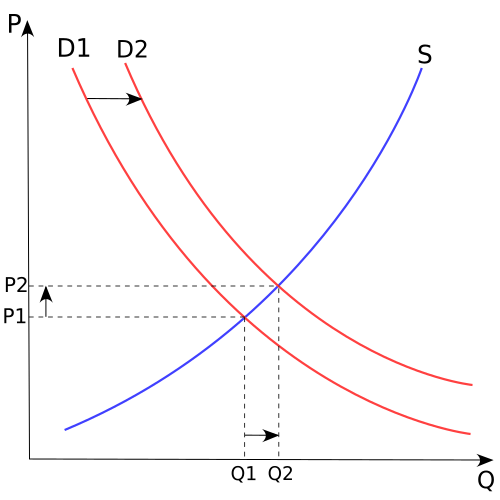
Basics of Supply and Demand
Anyone who has taken a survey econ course has seen diagrams like the one above, commonly called a supply and demand diagram or supply and demand curves.
The horizontal axis (Q) is Quantity supplied of a product. Q2 is a larger quantity (greater supply) than Q1. The vertical axis (P) is Price to purchase the product. P2 is a larger price than P1.
The blue line labeled S is a supply curve for our product. As with most supply curves, it increases monotonically and tells us that, as the price P rises, the quantity Q of the product supplied also rises. This makes intuitive sense: if someone will pay a lot more for a hamburger, more people go into business selling hamburgers and the supply increases.
The red line labeled D1 is a demand curve for our product. As with most demand curves, it decreases monotonically and tells us that, as the price P falls, the quantity Q of the product demanded rises. This also makes intuitive sense: if the price of hamburgers drops, more people buy them.
These are typical supply and demand curves. There are others. These are representative supply and demand curves, they do not represent any specific product and market. It is possible (given the right sort of data) to generate actual supply and demand curves for actual products.
The point where S crosses D1 is a market equilibrium, where the supply of and demand for our product are equal. At this point, the market price is P1 and the quantity supplied is Q1. Equilibrium indicates that the price and supply will stay there once they are there. If the price is below the equilibrium, less of the product will be supplied (a shortage) and the price will be bid up. The higher price will encourage entry of other suppliers (or current suppliers will increase production if possible), the quantity supplied will increase and the price will drop toward the equilibrium.
The red curve labeled D2 is an alternate demand curve. Suppose that our product is made available to a new market: at any given price, more people want to buy our product, and the demand curve is shifted right, representing an increase in demand. With this increase in demand comes a new equilibrium, where D2 crosses S. Notice that both the price and quantity produced have increased at this new equilibrium: price from P1 to P2 and quantity from Q1 to Q2.
Markets
"Free markets" are amazing things. Left to themselves, they establish price and production amounts magically, without human intervention. Or do they?
"Free" market sounds like something that is unfettered, unconstrained, unregulated, and well, unreal. Markets are unable to operate without certain preconditions: good governance, stable currencies, security, confidence, etc. Without security and stability, markets fail. Without contract enforcement mechanisms, markets fail. Without producer and consumer confidence, markets fail.
Free marketeers often complain about government regulation. Economists (and remember, there's a reason why economics is called "the dismal science") will use supply and demand curves to show you that almost any government intervention (taxation, price supports or caps, etc.) distorts the free market and generates inefficiencies. And according to the theory, they are correct. However, honest economists will also admit that there are good reasons for governments to regulate markets (pdf), reasons which may go beyond economics.
Market Failures
One of the biggest reasons for government to regulate markets is "market failure". We've just seen an enormous one in the US, the so-called "subprime meltdown". The Long-Term Capital Management fiasco of the late 1990s also comes to mind.
Market failures include things like:
- Monopoly: where a producer has market power
- Monopsony: where a consumer has market power
- Externalities: where a producer or consumer doesn't pay the "real" cost of a good
- Public Goods: where a producer can't be properly compensated for the real benefit of a good
- Asymmetric Information: where one side of a transaction lacks relevant information
McCain's Gas Tax Holiday Proposal
John McCain wants to suspend federal gasoline taxes for the three months of the summer holiday. Specifically:
McCain urged Congress to institute a "gas-tax holiday" by suspending the 18.4 cent federal gas tax and 24.4 cent diesel tax from Memorial Day to Labor Day. By some estimates, the government would lose about $10 billion in revenue. He also renewed his call for the United States to stop adding to the Strategic Petroleum Reserve and thus lessen to some extent the worldwide demand for oil.
Combined, he said, the two proposals would reduce gas prices, which would have a trickle-down effect, and "help to spread relief across the American economy."
What would such a "gas-tax holiday" actually do, economically, to supply and demand? Since economists aren't physicists, it's impossible to say for sure, but here are a couple of the more believable scenarios:
- Assuming we are currently at a market equilibrium (a questionable assumption, considering the constant change in gas prices), reducing the price of a gallon of gas by 18.4 cents to the consumer would increase demand for gas. Increased demand should increase supply, but the summertime supply of gasoline in the US is relatively fixed, so the supply cannot increase. As a result, the price will resume the starting equilibrium -- and the total value of the tax reduction will accrue to the oil companies.
- The tax reduction will be split between the producers and the consumers, as apparently happened in Illinois in 2000, when gas hit $2/gallon for the first time. In the case of a real reduction in price to consumers, demand for gas will rise, raising the price of gasoline, but not as much as in the first scenario. However, gasoline usage will also rise, increasing the US carbon footprint.
Realistically, the gas-tax holiday will have little effect upon the average American. The price of gas might go down, but if it does, the amount of gasoline used will go up, pushing prices back up and increasing the flow of carbon into the atmosphere.
Sounds like a losing proposition to me, on the merits.
But it does appear to be pretty good political theatre.
NOTE: Nothing in this post should be construed as an endorsement of any Democratic candidate for president. It is an article with facts and opinions about politics. I have not made up my mind, and GNB is not endorsing any candidate prior to there being a clear nominee.
Subscribe to:
Comment Feed (RSS)


