Showing posts with label Economics. Show all posts

Wednesday, February 3, 2010

Econ 101: Cost, Price, Value

Hoisted from the comments on my most recent Economics 101:

Why should Anyone (me) pay virtually the same price for an e-book as for a paperback? I get less in terms of ownership rights, ie resale, or lending to friends and family, and apparently Amazon can take the damn thing back at any time without permission. I do have an e-reader , not a Kindle and I love it, I don't love the way publishers have diminished my rights of ownership.
I believe that this comment demonstrates a common conflation: value, price, and (covertly) cost. Let's unpack it and see.

Value is an intangible, subjective thing. It is the judgement, by an individual, of what something (an iPad, say) is worth to them. Market value is an accumulation of individual judgements of value.

Price is a tangible, objective thing. It is the statement, by the owner of a thing, of how much it would cost to purchase that thing (from them).

Cost is a tangible, objective (but different to calculate) thing. It is the accumulation of what had to be spent to create or acquire a thing. In a value chain, the cost of an item will vary as it passes through the chain. If we imagine a physical book, for example:
  • The cost of the book to the publisher includes: cost to acquire the book rights; cost to have each copy of the book printed; cost to store and ship those books; pro-rata overhead costs attributed to the book; etc...
  • The cost of the book to a wholesaler who purchases the book directly from the publisher is whatever the publisher charges them per book plus: accumulated costs to store and ship the books; cost to advertise the book in trade publications and sales/marketing materials; pro-rata overhead costs attributed to the book; and so on...
  • The cost of the book to a medium-sized chain bookstore that purchases directly from the wholesaler above is whatever the wholesaler charges them per book plus: costs to store and ship the books; cost to advertise the book in local publications; print and place signage in and around their stores; pro-rata overhead costs attributed to the book; etc...
  • The cost of the book to an end-user who buys it from the medium-sized chain is whatever the chain charged them plus: cost to drive to the chain store and park; cost of the coffee and cookie they bought because they were in the bookstore; etc...
As demonstrated above, there are many possible definitions for cost. Whenever you use the term cost you have to be careful to make sure to specify what cost you're dealing with.

In order to make a profit and stay in business over the long term, price has to be higher then cost. At each step of the value chain, the buyer is going to spend more for the item than the seller paid for it. Ultimately, each buyer must decide that the value of the item is higher than its cost. For anyone who is planning to re-sell an item, the value is easily set as the price for which it will be sold (with some allowance for shrinkage and the reality that not all of something will sell).

Economists assume that users make internally consistent and rational choices about the value of items. They don't, but economists like to assume that. So in any transaction, the buyer has decided that the value of the item is more than its cost (which is the price plus attendant costs to acquire), while the seller has decided that the value of the item is less than its price. Mathematically:

Which clearly shows that there must be a difference between Vb (value to the buyer) and Vs (value to the seller).

This is the essence of a market transaction.

With respect to physical books and eBooks, the question arises: is the price set according to the cost or the value? From a publishing/warehousing/distribution/retail perspective, costs set a floor on price. From a consumer's perspective, value sets a ceiling on price. If a book producer cannot create a book which has sufficient (average) value which is higher than the cost to produce, they can't stay in business.

The question a consumer asks themselves isn't "do you feel lucky?", it's what is the relative value to me of an eBook and a physical book? Some people say an eBook has lower value because of DRM (if we're talking about a Kindle book), limited capability to lend the book, requirement for batteries to read, or inability to recoup residual value (i.e. re-sell the book). Some people say an eBook has higher value because it occupies less volume, has less mass, or can be read in the dark. The point is that eBook value is idiosyncratic. Just like value is for everything.

Personally, I value the virtual volume and mass of eBooks. I have 100 banker's boxes of books in the garage. I buy eBooks and keep them on hard drives -- even Kindle books, which can be downloaded onto the computer and transferred to the Kindle via USB. I have several thousand eBooks (in various formats). I love the fact that they fit onto a hard drive instead of requiring more boxes in the garage (where they are inaccessible), more bookshelves, more house to hold those bookshelves and boxes (perhaps 20% of my house is dedicated to books and other media which could be reduced to bits upon hard drives).

That's a conscious decision on my part, that virtual mass and volume has value. I recognize the potential for losing a subset of my eBooks to: DRM; format changes; hard drive failure; or unforeseen issues. Just as I recognize the potential for losing a subset of my physical books to: theft; flood; vermin; physical loss; shrinkage; or unforeseen issues.
There's more...

Tuesday, February 2, 2010

Econ 101: Capital vs. Consumable


Amazon currently charges $9.99 for most books, which, according to AppleInsider, means that Amazon is losing $4.50 per book to keep its leadership position in the eBook market and keep Kindles selling. This strategy is similar to the loss-leader marketing popularized by Gillette who sold razors at a loss in the hopes of more than making up for it in the sales of blades.
Uh, no. That strategy is, in some sense, the opposite of selling razors at a loss and making it up in the sale of blades.

In order to understand this apparently complex system, you need to understand one way of dividing objects into two categories: capital, or consumable.

Capital is something which makes value, or enables making value. As a rule, it is a relatively fixed cost which is paid regardless of the amount of production. For example: manufacturing equipment is capital. The Gillette razor is, conceptually, capital -- because its cost does not vary with the number of shaves.

The opposite of Capital (in this simplistic view) is Consumable. Consumables are used (and generally used up) in the creation of value. The raw materials converted by Capital into value (and used up in the process) are Consumables. In the Gillette example, blades are consumables because the total cost of blades varies directly with the number of shaves. EBooks are a Consumable.

So let's go back and take a look at that quote again, with my inserts in italics:
Amazon currently charges $9.99 for most books (consumables), which, according to AppleInsider, means that Amazon is losing $4.50 per book to keep its leadership position in the eBook market and keep Kindles (capital) selling. This strategy is similar to the loss-leader marketing popularized by Gillette who sold razors (capital) at a loss in the hopes of more than making up for it in the sales of blades (consumables).
In other words, selling consumables at a loss to keep selling capital is the same as selling capital at a loss in order to sell consumables.

Riiiiiiiight.

Let's start again: what Amazon does, presumably, is price the consumables (eBooks) low so that it will drive sales of the capital device (Kindle). What Gillette did was price the capital device (the razor) low to lock users into purchases of relatively expensive consumables (blades).

Those are not the same thing. Amazon is (probably) trying to gain market share for the Kindle regardless of profitability so they can sell eBooks at a loss in hopes that they can seize the market and make it profitable later. Gillette was trying to gain market share for the razor so they could sell blades at a tremendous markup and be profitable now.

Clear?

There's more...

Tuesday, February 3, 2009

Republicans say Soldiers, Teachers, Cops and Firefighters "not jobs"


(Video: Michael Steele, newly chosen chairman of the RNC, on The Situation Room, 2009 January 2)

Yes, it's true. Michael Steele, the new head of the Republican Party, said on 2 January this year:
Not in the history of mankind has the government ever created a job.

While we might wish that George W. Bush had not had a job for the previous eight years, this statement that our soldiers, sailors, and airmen, whether overseas or here at home; the cops and firefighters who keep our streets safe; the teachers who determine "is our children learning"; and all the doctors, nurses, and nurses aides who work in public hospitals aren't jobs is just stunning.

Having a job means working for a living, right? So that means that, according to the Republican party, all these people don't work for a living. You can't say that about our armed forces, or our teachers, or our police and firefighters. You just don't. It's appalling.

This quote should be put over pictures of the rescue workers at Ground Zero, planes taking off from aircraft carriers, soldiers in Iraq and Afghanistan, and cops on the beat. It's unbelievable.

There's more...

Tuesday, December 16, 2008

Where Has All The Money Gone?

Stone stairs between tulip beds
I am not an economist, nor do I play one on TV. Having thus made my disclaimer, I do have a few thoughts to share about the current economic crisis, as it is called.

First, I like it when Letterman says "All the money is gone. My question is, where did it go?" I think that's an excellent question, and I have not yet heard a simple, believable answer except the one in my gut which says "Well, a lot of it must not have been there to begin with." As in: The emperor's clothes didn't suddenly just vanish, he was walking around buck nekkid the whole time.

Since the advent of Reaganomics, we've been increasingly a culture operating on credit. And in the last decade, the best way to make money was not to produce goods or even concrete services, but to play around with imaginary concepts which had to do with credit. That illusion has finally collapsed, and I simply don't believe it is coming back. It looks to me like a lot of other people don't believe it's coming back, either. Banks are not loaning unless the loans are iron-clad, investors want something else to put their money into, and credit-based businesses are increasingly finding other ways to bleed us if they can.

Some commentator on the national news tonight said "People are simply not spending their money." I wondered what fucking universe she lives in. EVERYBODY I know is spending their money, every last cent of it, on groceries, fuel, housing, and maybe health care. There are ballooning numbers of people out there who have spent every cent and now are losing their homes or having to go to food banks to eat. The majority of people in this country -- that majority which is working class, no matter how much they and the politicians pretend they are middle class -- are not sitting on unspent money. What they/we are no longer spending is money we didn't have. Living on credit is coming to an end.

Which means the same amount of money that ever existed is still around, but decisions about how it spent are changing, must change. And its distribution must return to being a collective decision.

Some of us are capable of making decisions about spending that takes into account, primarily, the common good. Some of us are not. Those who are not will not disappear quietly. They are, as we speak, trying to bust unions, shove more worker-hating legislation quietly through the pipeline, and hiding the footprints of their fellow thieves.

There is no recovery from this, because the term "recovery" implies a return to basic principles and function as it was. What we are facing is reinvention. Which, even as I personally face being swept away, is still a hopeful idea to me. It's time, it's more than time, and working people know how to retool. When you believe you EARN your paycheck each week, reorganization and learning how to do things a different way does not threaten exposure and exile: We know we can handle it, we handle everything else, right?

The risk we're facing is revealed by something Einstein said: "We can't solve problems by using the same kind of thinking we used when we created them."

So, stop listening to people who don't make sense, who you think maybe you shouldn't trust, and quit worrying. Especially quit worrying. I know how hard that is to do when things are so bad, believe me, I do. I've gone without a lot of meals in the last month, and there's nothing like hunger to mess with brain chemistry. But worry does not prepare you for reality, it does not foster flexibility or humor. It's a dead end, because it is another name for fear. There are a thousand ways to outwit fear, and by golly, if we have not become experts in those techniques since Bush sashayed into the White House, we're no longer drawing breath.

I'll see you on the soup line, sister. Breathe deep and finger what luck you have. It'll be all right in the end, I do believe.

There's more...

Wednesday, December 3, 2008

What Condition Our Condition Is In

(Photoillustration: "Big Red Letters on a Dead End Sign" by Evan Robinson, Group News Blog)

Here We Are

It's been seven months since I lasted addressed our condition. In the meantime we've finished a two-year campaign and election, with historic results. Those of you in America have survived the Thanksgiving Holiday (most of you), although not everyone overseas did, and there is much wailing and gnashing of teeth over Black Friday, even as sales seem to be going better than many feared.

So let's take a look at a few other elements of our condition...

That Devil's Madness -- War

Mumbai is on our minds. Asymmetric warfare is as much about media coverage as it is about inflicting military defeat, and it was genius (twisted, evil genius) to stage the attack during American Thanksgiving when much of the country is already in front of the television for traditional parades, specials, and both college and professional football.

While debate rages about the identity and backers of the Mumbai attacks, the NY Daily News says that as few as 10 attackers were involved:

The 60-hour Mumbai terror spree that killed at least 174 people was the brutal handiwork of just 10 Islamic militants who wanted to create a 9/11-caliber catastrophe, officials said Saturday.

The Guardian reports that the only surviving attacker, Pakistani Azam Amir Kasab, says the militants trained in Kashmir for five months:

Kasab reportedly said the mastermind of the plot briefed the militants to "target whites, preferably Americans and British".

He said the militants, who were highly trained in marine assault, had arrived in the city by boat. They planned to blow up the Taj Mahal Palace hotel after first executing British and American tourists and then taking hostages.

Police sources said Kasab told officers that he and his fellow terrorists trained in Pakistan-occupied Kashmir for five months before taking a month off before the attacks, the Daily Mail reported.

They left an isolated beach in Karachi for Mumbai on November 21 and were each given eight hand grenades, an AK-47 rifle, an automatic pistol and ammunition.

The Sidney Morning Herald reports that the targets were extensively scouted and attackers prepared with CQB training and memorisation of the target layouts. They hoped to kill more people than the 9/11 attacks:

The terrorist gang, thought to number as few as 10 gunmen, had planned to kill 5000 people and destroy the iconic Taj Mahal Palace hotel and the stock exchange. In the end, their murderous toll was closer to 200, and left the Taj Mahal and the Tident-Oberoi hotel badly charred and damaged.

Kasab had months of training before the attack where he was instructed in the use of military weapons and explosives. He and his fellow attackers, aged between 18 and 28, were also drilled in close quarter combat.

An Australian witness, Ray Lacey, who saw the attackers in the foyer of the Taj Mahal, said they were highly disciplined and did not waste bullets.

Kasab told investigators they were instructed to conserve their ammunition so they could sustain their attack for as long as possible. "I have done right. I have no regrets."

Kasab told interrogators that most of the volunteers for the suicide mission spoke Punjabi. They were given false identities and were discouraged from interacting with each other beyond what was barely necessary.

Regardless of the origin and backing of the attackers, Mumbai shows a new sophistication in media use, plotting attacks of a new and different kind apparently specifically to take advantage of American media viewing patterns: the timing of the attack, the sophistication of the targeting and planned duration of the attack, even down to one of the attackers being captured and talking freely to the media afterward.

As with most 4GW, the damage done was hugely disproportionate to the investment required by the attackers. The 9/11 attacks cost less than $500,000 to carry out, and bore a ginormous price tag. Since half of that $500,000 was in-US expenses and these attackers staged and trained in Kashmir, I wouldn't be surprised to find out that hte cost of putting this operation on was less than $100,000 -- and the damage to the Indian economy may already be $20 billion.

Arr, Matey!

Not too terribly far away, from an American point of view, Somali "pirates" have been very active, hijacking the Saudi-owned VLCC Sirius Star, a Ukranian vessel carrying Russian T-72 tanks and other weapons, a Yemeni steel carrier, and others.

Somalia has lacked a functioning central government since the early 1990s, and hasn't had a remotely democratic government since 1969. It's not much of a stretch to say it's never had a truly western-type democratic government. Regionalism and tribalism have led to breakaways (Somaliland), military rule, civil wars, and more or constant unrest.

One way to regard the Somali pirates is as disaffected and disadvantaged fishermen who can no longer operate in the current environment. With the officially recognized "government" of Somalia in control of less than half the country, the rule of law has disintegrated on a national level and local law is a mix of tribal law, Sharia, and old English common law left over from British Somaliland. Another way is to consider them regional terrorists or criminals. Which they are changes the long-term solution to the problem, but not the short-term one.

Regardless of their origins, Somali pirates (and their counterparts off Nigeria) are tightening the screws on the worldwide movement of goods, raising the risk of shipping and the price of goods, including oil. If they acquire the technology to threaten undersea cables, they could have the capability to dramatically disrupt electronic communication as well.

With American military forces stretched beyond their limits in Iraq and Afghanistan, the US doesn't have the muscle to maintain open sea lanes in the Gulf of Aden and off the Horn of Africa anymore. Many countries have been "free-riding" on the US Navy's ability to suppress piracy since WWII and especially once the US because the world's only hyperpower. As the limits to American power projection become clear, those nations are going to have to start stepping up with naval forces, on-vessel weapons and military personnel (or contractors like Blackwater), and money, which in the current economic environment may be the hardest to come by.

(Chart: Dow Jones Industrial Average, Yahoo Finance)

Melty, Melty Cheese

Anyone who doesn't know about the global financial meltdown of 2008 hasn't been paying attention. As of today, the Dow is down about 33% for the year, but ten days ago the Dow was down more than 43% for the year. From 2007.10.12 to 2008.11.20, the Dow dropped 46% from its high. At 8829, the Dow is now about where it was in March 1998.

Gold has dropped 20% from its historic high of about $1000, and at 813, it's close to the previous peak of January 1980. Many other commodities have dropped to 1/2 or 1/3 of their peak values over the last year, including Aluminum, Appalachian Coal, Cobalt, Copper, Lead, Nickel, Palladium, Platinum, Ruthenium, Silver, Steel, Tin, Uranium, and Zinc. At least some of those commodities have returned to their "normal" values of 5-10 years ago.

While a barrel of oil has dropped to about 1/3 of its peak price (currently $53 compared with a July peak of $147), it is still 2 1/2 times the historic average price of just over $20/bbl.

US electrical power use is dropping.

Dick Kelly, chief executive of Xcel Energy Inc., Minneapolis, says his company, which has utilities in Colorado and Minnesota, saw home-energy use drop 3% in the period from August through September, "the first time in 40 years I've seen a decline in sales" to homes. He doesn't think foreclosures are responsible for the trend.

China's growth rate is slowing. Fast.

Why then is China slowing so sharply? Simple, real estate investment has hit a wall. After growing at 20% y/y for a long time, real estate investment stalled – with a y/y growth rate of around 0% (Figure 5). That means that China is in turn producing more steel and cement than it needs, and producers of steel and cement are cutting back. That in turns hurts iron ore exporters…

This though is very much a result of China’s own policy choices. Rather than allowing the real exchange rate to appreciate back when China was truly booming (05-late 07/ early 08), China’s policy makers opted to rely on administrative curbs on credit growth. That left China more exposed to global slump in demand – as it kept exports up by limiting real appreciation even as it credit curbs limited the amount of froth in the real estate market back when China was booming and real interest rates were negative. China invested a lot in real estate, but it is no Dubai. But China’s policy makers still look to have slammed the brakes on a bit too hard. Rather than slowing gradually, real estate investment fell off a cliff.
...
While real exports contributed positive to GDP growth in 2008, they won’t contribute in 09. The World Bank forecasts that for the first time in a long time, 2009 real import growth will exceed real export growth. In 2005, real exports grew about 10% faster than real imports (23.6% v 13.4%). Many economists remain – for reasons that to be honest elude me – reluctant to draw the obvious connection: the most likely explanation for China’s strong real export growth is the large depreciation the RMB in 2003 and 2004. That combined with administrative controls – which limited lending, investment and ultimately imports – to create China’s large current account surplus. Real export growth exceeded real import growth by 5 percentage points in 2006 and 2007 – and by 4 percentage points in 2008.

The positive contribution of net exports to GDP is forecast to end in 2009: real import growth will exceed real export growth by 3 percentage points.

Oh, and the US has been in a recession for just about a year now. U-6 (an alternative measure of unemployment maintained by the BLS since 1994 or so) has hit a seasonally adjusted 11.8%, the highest ever recorded. We've lost about 1.2 million jobs this year, an especially stunning figure when you remember that we need 1.8 million new jobs a year to keep up with population growth. So we're down 3 million employed people in 2008.

In an effort to stop the meltdown, the US government has already committed at least a trillion dollars to the financial sector, and central banks the world over are scrambling to avoid a disaster.

Peak Experience

The good news is that the average US price of a gallon of gas is down to $1.825 as of 2008.12.01, a 56% drop from the record high $4.114 set on 2008.07.17. Even better news is that global petroleum demand is down:

Worldwide demand will decline by 20,000 barrels per day (bpd) in both 2008 and 2009 to 86.03 and 86.01 million bpd respectively, according to a Reuters poll of 11 analysts, banks and industry groups.

The slight fall is a large shift from a Reuters poll of experts in August, which forecast demand would increase by nearly 1 million bpd next year. Demand has not declined since the early 1980s, following the 1979 oil crisis and a severe recession in the United States.

"Global GDP growth is the main driver of oil demand, and with the economic slowdown we see global GDP rising by just 1.2 percent next year," Michael Lewis, head of commodities research at Deutsche Bank, said.

The bad news, of course, is why demand is down. US demand is expected to drop about 1 million bpd, or about 5% (other reports say 6.7%). That drop will be accompanied by a 1.4% drop in GDP in 2009. World GDP growth is expected to drop from 4% to 2.5% this year and under 2% next year.

Some might seem to be overreacting:

Make no bones about it, every past civilisation has decayed into the dry leaves of history - why should this one be different?

All those past efforts outgrew their carrying capacity, be it the Mayans with corn, the Sumerians with irrigation, or the colonist economies with dwindling extractables.

Anthropologist Jared Diamond catalogues them in his insightful book Collapse.

Those partial to more easily-digested literary offerings should try The Lorax, by Dr Seuss.

The message is identical: the collapse is usually a decline over decades or centuries, and that zero growth does not signal zero activity, just its peak.

Meaning we have to plan for a long, permanent recession.

Our society has been able to do so much more that previous ones, thanks only to the one-off use of fossil fuels.

The International Energy Agency has now signalled that we are past the peak of global oil supply, citing a cumulative depletion rate of 6.8% per annum.

7% Depletion Annually!!!!!!!

Ouch. Especially when you consider that a 1% drop in supply of oil can cause as much as a 20% rise in price.

Where Do We Go From Here?

Forecasting is fraught with peril. So rather than promoting a future, let us talk about several futures.

1) Whoopsie!

It's possible that the central banks and government intervention to save the financial sector will fail. This is a dire scenario, because a free fall (or "hard landing") of the US dollar, the Japanese yen, and the euro could leave the world without a reliable reserve currency. While the Chinese yuan might seem like an option, a tightly controlled currency (one that does not float in value according to market forces) will be unacceptable to many.

Without a stable reserve currency, the current credit crisis is going to seem like a mild spring compared to the depths of winter. Global trade will slow dramatically. Investment may halt except for government programs. The Great Depression could be a fond memory. We could be mired in slow or negative growth for a generation.

On the other hand, even this dread scenario could be considerably shorter-lived than the Depression of the 30s. Modern Keynesians believe they have a better handle on the events of the 30s and that they understand the necessary monetary moves to avoid another Depression. If they're right, our present slowdown, even with a hard dollar landing, might be largely over in 18 - 36 months.

A likely ending of this unpleasant scenario includes the world ending up with a non-dollar reserve currency. Maybe the euro, maybe the yuan is allowed to float, maybe the Indian rupee, but most likely some combination of currencies replaces the dollar.

During the downturn, no matter how long or short, economic unrest and lack of opportunity will fuel bigotry, prejudice, and terrorism. The fragility of the economic system will make it an attractive target for non-state actors, and we can expect a significant upsurge in worldwide violence and terrorism.

2) Whew!

If the Keynesians get control quickly and prove that they know what they're doing, the Great Recession of 2008 could prove to be the catalyst for the Great Green Growth of 2010 on. Monetary stimulus packages will encourage research and infrastructure spending aimed directly at the middle class and climate change. New industries will spring up and the US auto industry (now owned by a mix of union and government money) will lead the development and production of lower-carbon transportation options. Energy efficiency and lower-carbon energy generation will be fast-growth industries, leading eventually to a "green bubble" and correction.

Widespread economic improvement (not limited to the global elites) will begin to lift the "bottom billion". Jeffrey Sachs will be confirmed US Secretary of Global Equity and by 2020 the 2.5 billion people living on $2 or less a day will be living on $5 or less a day. The resulting prosperity will start a sharp decline in birth rates. Economically driven violence will decline.

Using a law-enforcement paradigm for anti-terrorism will not be entirely successful, but a combination of successful intelligence gathering and the rising economic fortunes of the global underclass will reduce worldwide terror and violence.

3) Whatever...

a) Peak Oil remains a concern. Even as the global downturn reduces demand for almost all non-food commodities, it also prevents private investment in commodity production/extraction. We will stumble along at 85-95 billion bbl for a while and between 2020 and 2030 we'll begin to see a serious decline in petroleum availability. The resulting spikes in price will revive energy investment. Who wins the race (declining petroleum supplies or alternative energy sources) is up for grabs (and government backing).

b) Global Terrorism and Violence are driven by economic factors as well as political ones. As the global economy declines and we reduce the carrying capacity of the environment, violent responses are the only options left for some. As globalism brings competing values into insular communities, clashes are almost inevitable. Fear of cultural annhilation drives the political use of violence. Getting off this treadmill requires re-visioning globalism and global aid. Large portions of the developing world are running out of easy (cheap or free) fuel sources. Aiding the bottom billion requires local knowledge, not just global money. Jeffrey Sachs has laid out a plan (pre-meltdown) which could reduce global poverty by spending roughly the US defense budget annually. We ought to be listening. The ultimate fix for global terrorism isn't military or even law-enforcement, it's economic and cultural.

c) From a bipolar superpower world we've gone to a unipolar hyperpower, and now that hyperpower has shown feet, knees, and even thighs of clay. The BRIC (Brazil, Russia, India, China) nations have the potential to re-alter the nature of world power politics. China and India are modernizing at a fearful rate, but neither is going to become a carbon copy of the US or Europe. China's interesting mix of totalitarian politics and unbridled economic capitalism has expressed itself in 8-10% growth but is now slipping. How they respond and what their political system looks like in a decade will tell us much about the world in 2100. India and Pakistan are looking at each other over Kashmir and considering what it would take to use nuclear weapons. Mumbai provides an excuse for the Indians to berate Pakistan. The Afghani conflict spills into Pakistan, provding conflict between Pakistan and the US (technically NATO, but....). A major regional conflict, possible with nukes, can't be ruled out, and would shape future politics in ways that we can't yet guess. We might go all "one world" or we might go all "every nuke for itself". Convincing Pakistan to rein in the ISI in a very public way would help a lot, but it's going to take more than that to decide about Kashmir in a way that leaves everyone involved willing to try for peace.

China's economic imperialism, especially in Africa, suggests that resource conflict over declining commodities, is inevitable. Proxy conflict over resources isn't impossible, and may even be likely. Keeping the conflict economic may slow recovery, but it will make for a more peaceful world so long as the conflict remains between more developed nations and doesn't spill over to the bottom billion. We could see a return to the proxy wars of the 70s and 80s in sub Saharan Africa but between the Chinese and everyone else instead of Soviet/US conflict.


What Condition Our Condition Is In


(Video: "Gutterballs" from the Coen Brothers' 1998 The Big Lebowski, starring Jeff Bridges, Julianne Moore, and John Goodman)

Well, I'm sorry to say it isn't exactly rosy. But it's not all black. Downturns provide the opportunity to change course, like layoffs can promote entrepreneurship. We still have choices that can improve our situation, although the combination of delay on climate change and the acceleration of the process leaves us with little time to react on that front.

If we want to prosper, investment on infrastructure is the key in the US. The trillion-plus we've spent on Iraq isn't doing nearly the economic good that it would do if invested in the US. The trillion-plus we're spending on the financial sector isn't doing nearly the good that it would do if invested in actual building and repair in the US. Sooner or later the small government people have to be thrown under the bus so the adults can get back to fixing the problem. If the US pulls out of free fall, other nations have both a safe haven reserve currency and a consumer of last resort (hopefully not quite as enthusiastic a consumer as the last few years). Recovery will exacerbate our Peak Oil problem, but some of that investment should be going to lower-carbon transportation, power, and agriculture.

We Are All In This Together....

There's more...

Sunday, November 23, 2008

View From Ground Zero


Tip O' The Tinfoil Hat to My Friends at Blondesense

They had a very good thread the other day around this beautiful song, by Paul Simon. I've been lucky enough to work for him a few times. Not enough on account of he's a New York City type to the bone, and I'm allergic to the entire east coast, but the times we've been together have been incredible.

I was able to tell him about how he completely disrupted my world when he released Graceland. I had to walk into my house full of instruments and shake my head in amazement and tell them "OK folks, we're starting over." The injection of the African players and arrangements, using the bass guitar as a melody instrument, placing the rhythm chops on the accordian, the astonishing rythmic nuance and harmony, all changed the way I approached my own playing.

Over and over in the music business I have heard the old refrain of "It's all over, because they invented. . ." The stuff they have said about Napster and Peer to Peer systems destroying music is the same stuff they said about CD recorders, Cassette tapes, Reel to Reel tape systems for the home, vinyl records, and even the wax and foil cylinders of Edison. Everything that advanced the technology was going to "end music as a business or profession." None of it did. Things changed, that's all.

I'm in the middle of change myself. I'm having to do some serious financial reorganization. It galls me. Not because I am opposed to change. My life is better because I made the decision to change not only my life, but the fundamental ways that I look at and approach my life. I did it by getting clean and sober through AA almost seventeen years ago. Not only do I know how to change and adapt, I know that it is something that often must be done.

What galls me is that this is being forced upon me because I played by the rules. The foundation of my investment is in commercial real estate. Most of that around San Diego. I wasn't one of the wild eyed speculators who leveraged and mortgaged myself to the hilt. I did it slow and steady. I invested in viable properties, with solid businesses in them. When profits were high I would do things like resurface the parking lot, or put in greener infrastructure like solar panels and things to make the place more sustainable and profitable.

The foundation of the whole system was in equity and sound business. That equity has disappeared. Poof! Vanished. Gone. Maybe forever. Nobody knows. What is certain is that value and worth that I invested in believing it to be conservative, prudent, and sound has evaporated as surely as the blips and pixels of the wildest crackhead Wall Street suits. Gone. All. Gone.

Normally, in a situation of temporary downturn it would be a simple thing to take some of that equity, use it to raise some temporary cash and weather the storm. That's changed. Not only has the majority share of the equity been magicked away, nobody's lending on the weather the storm basis. They don't know how bad this storm is going to be yet.

Frankly, if instead of trying to be a good steward who built wealth on a solid, stable and enduring platform, I had instead flashed blips and pixels around the internet on wild ass schemes that made the dot.com boom look sedate I would have been better off. If I had been a grasping gimme it now greedy son of a bitch who cashed out at every opportunity and stashed the loot offshore I would be in fine shape right now.

That's the galling thing, I'm in trouble because I believed and followed the rules. There's another front that taking place too. San Diego is trying to reconstitute its government after nearly a decade of corruption and looting. Yes, it was done by a series of republican mayors and city council members. They wrote in hefty, rich pensions for themselves and their cronies that were vested in as short as three months. Then, they all cashed out bigtime. At one point the city bonds of San Diego (and normally munis are another investment that is considered to be sound and safe) were downgraded to nearly junk levels. They stole so much upsteam that there was barely enough flow to make mud in the delta. Just like our national, and world economy, the bills came due and there wasn't anything left to pay them with. After wild fantasy games of the rich and famous, reality came to call, and reality is hungry and has teeth.

Now San Diego is having to raise cash for day to day operations. Properties like mine are ripe for governmental takings. I'm not mortgaged to the hilt so there is a strong profit motive to the takers. If my property was taken the takers wouldn't have to share with mortgage bankers and investment types. The margin of say, yet one more property assessment or another increase in trash, and other utility services would be small compared to the value of the siezed property. The very good and sound practices that made me vulnerable to this, are also what make it even more attractive to the vultures. There's a lot of flesh on the bones, all they have to do is manage the death of a thousands cuts and then all the scavengers get to feed.

I'm in the process of writing a long series about Afghanistan. I intend to focus on Alexander the Great and his three year campaign there. We'll start with Epaminondas, because he was the general who, more than anyone else, taught Philip of Macedon. Then, we'll talk about Philip, because without him and the innovations he brought one really cannot understand the revolutionary innovations of Alexander. We'll also talk about Darius and Cyrus of Persia, we'll spend some time with "Chinese" Gordon, Kublai Khan and the Russians. What I hope to demonstrate with this is that we are about to barge into making the exact same mistakes that conquerors and invaders have met in Afghanistan for the last 2,500 years.

Here's the lyrics to Paul's great song. I've been singing it a lot lately.

Words & music by Paul Simon


Many's the time I've been mistaken
And many times confused
Yes, and I've often felt forsaken
And certainly misused
Oh, but I'm all right, I'm all right
I'm just weary to my bones
Still, you don't expect to be
Bright and bon vivant
So far away from home, so far away from home

And I don't know a soul who's not been battered
I don't have a friend who feels at ease
I don't know a dream that's not been shattered
or driven to its knees
but it's all right, it's all right
for we lived so well so long
Still, when I think of the
road we're traveling on
I wonder what's gone wrong
I can't help it, I wonder what's gone wrong

And I dreamed I was dying
I dreamed that my soul rose unexpectedly
And looking back down at me
Smiled reassuringly
And I dreamed I was flying
And high up above my eyes could clearly see
The Statue of Liberty
Sailing away to sea
And I dreamed I was flying

We come on the ship they call the Mayflower
We come on the ship that sailed the moon
We come in the age's most uncertain hours
and sing an American tune
Oh, and it's alright, it's all right, it's all right
You can't be forever blessed
Still, tomorrow's going to be another working day
And I'm trying to get some rest
That's all I'm trying to get some rest


It's alright, I'm alright.

How 'bout you? Commence the open thread.
There's more...

Monday, October 13, 2008

Paul Krugman Wins Nobel Prize for Economics

F.R. Conrad for the New York Times

Paul Krugman wins the Nobel Prize for Economics
.


It is a well deserved honor, the $1.4 million award will buy him three or four tanks of gas, maybe heat his home this winter. . .
There's more...

Saturday, October 4, 2008

Banana Republicans: Buddy, Can You Spare a Trillion Dollars?


According to WikiAnswers:

Banana republic is often used to imply gross inefficiency, corruption, and powerlessness, as well as oppression (government sponsored death squads).

Sounds increasingly like America, doesn't it? We don't seem to have the death squads yet, or if we do, they're operating overseas at black sites. The rest is a pretty good match.

As Republican campaigns around the country crash, burn, withdraw, and shatter, we all get a first hand look at the end result of 30 years of Reaganomics[1] and increasingly unfettered[4] "free-market"[2] capitalism[3]:
[1] The root of the problem can be traced back to the deregulation era that began during the Reagan administration. What George H.W. Bush once called "voodoo economics" fast became the biggest redistribution of wealth since the New Deal. The central article of faith in the "Reagan Revolution" was that money rerouted from the poor to the rich would produce a burst of productivity and economic growth. Give to the corporations and the wealthy, said the "supply side" economists, and they will invest the money in new factories, research and technology, and the country will be restored to greatness.

Did the theory work? Hardly. Rather than putting their money into jobs, research or equipment, the country’s biggest businesses went on the largest merger binge in history, buying up smaller companies in a trend that spelled less competition, less productivity, and more control of the economy in fewer hands. Multi-billion dollar corporate war chests were assembled to finance takeovers of large oil and coal companies, communications giants, and prestigious financial institutions.

[2] The financial meltdown on Wall Street is more than a cyclic correction brought on by a mismanaged business cycle. It is emblematic of a problem at the very foundation of the right wing economic philosophy that became conventional wisdom during the Bush years -- and would be continued in a McCain presidency.

The zealots of unfettered "free markets" cast aside the critical lesson that the world learned during the Great Depression: left to their own devices, unregulated financial markets do not necessarily function to benefit the society as a whole -- or, in the end, even many individual market participants.

[3] John McCain, the reborn populist, wants to divert your attention from the architects of our economic crisis: the Republican Party and its free market ideologues. It is an unconvincing posture, based on a distorted reading of American history.

Today's financial crisis is the predictable historical outcome of the policies enacted by the Republican Party since Ronald Reagan's presidency. The market fundamentalism dictating Republican policy has become so pervasive that most Americans are unaware of how we got here and how it could have been avoided.

[4] Many events in Washington, on Wall Street and elsewhere around the country have led to what has been called the most serious financial crisis since the 1930s. But decisions made at a brief meeting on April 28, 2004, explain why the problems could spin out of control. The agency’s failure to follow through on those decisions also explains why Washington regulators did not see what was coming.

On that bright spring afternoon, the five members of the Securities and Exchange Commission met in a basement hearing room to consider an urgent plea by the big investment banks.

They wanted an exemption for their brokerage units from an old regulation that limited the amount of debt they could take on. The exemption would unshackle billions of dollars held in reserve as a cushion against losses on their investments. Those funds could then flow up to the parent company, enabling it to invest in the fast-growing but opaque world of mortgage-backed securities; credit derivatives, a form of insurance for bond holders; and other exotic instruments.

The five investment banks led the charge, including Goldman Sachs, which was headed by Henry M. Paulson Jr. Two years later, he left to become Treasury secretary.

On top of all the joy coming out of Mudville Wall Street, we've just suffered the 9th straight month of job losses, totaling more than 750,000 jobs lost this year alone*. Worse is coming:
A survey of hiring managers by the Society for Human Resource Management, a professional association in Alexandria, Va., showed hiring expectations for October at their lowest in four years.

"The US economy is shrinking, and there will be many more awful [Labor Department] reports like this," said Ian Shepherdson, chief US economist at High Frequency Economics, Ltd. of Valhalla, N.Y., in a note to clients. "Payrolls were weak everywhere."
* Update 20081004 4:30pm: That's 750,000 jobs lost, when we need to add 150,000 jobs per month (1,350,000 over 9 months) to keep up with population growth. So we're actually short about 2,100,000 jobs over the last 9 months. That's what unbridled capitalism does for you.

Unemployment including discouraged workers (those no longer looking for work) hit 11%. 9.5 million Americans are actively looking for work. 6.1 million workers are in part-time jobs because they cannot find full-time jobs. 1.6 million workers are not counted in the standard unemployment figures because they haven't looked for work in the last month. More than 5% of the workforce (7.7 million workers) are holding down multiple jobs. The average workweek has fallen to a bit under 34 hours.

In the "duh" news, we're approaching a recession:
"Anyone who's wondering if there's a recession should stop wondering," said Nigel Gault, U.S. economist for Global Insight, which will release its updated forecast on Monday. "The recent data were deteriorating sharply" even before factoring in the latest impact of the credit squeeze.

Global Insight doesn't think the recovery will be quick or powerful. The economy will likely contract for three quarters and then show weak growth in the second quarter next year.

If the recession lasts from December 2007 until April 2009, as Gault suspects it will, it would be the longest since the Great Depression. And the recovery, when it comes, won't feel anything like a boom.


There's more...

Friday, July 11, 2008

We Fact Check the Left, Too!

CounterPunch describes itself:

Here at CounterPunch we have many friends and all the right enemies. And, guaranteed, you'll never see any of us on the pundit line up at MSNBC. We try to stay beyond the pale.

Someone I know described CounterPunch's Cockburn (that's pronounced "coe-burn" for those of you who are still stuck in the locker room) as 'fallen off the far left edge'. We here at GNB have a tendency to, shall we say, concentrate upon the peccadilloes of "The Right" or "The GOP", or "The NeoCons". But this post is presented as evidence that we write about the knuckle-dragging-left-my-brain-at-home-stupidity of "The Left" as well.


At CounterPunch, Ismael Hossein-Zadeh writes about problems with the theory of Peak Oil. Interestingly, he gets it pretty much all wrong. Let's see how!
Peak oil theory is based on a number of assumptions and omissions that make it less than reliable. To begin with, it discounts or disregards the fact that energy-saving technologies have drastically improved (and will continue to further improve) the efficiency of oil consumption. Evidence shows that, for example, “over a period of five years (1994-99), U.S. GDP expanded over 20 percent while oil usage rose by only nine percent. Before the 1973 oil shock, the ratio was about one to one.”[4]

This is absolutely irrelevant to Peak Oil theory. Peak Oil says nothing about oil consumption.


Second, Peak Oil theory pays scant attention to the drastically enabling new technologies that have made (and will continue to make) possible discovery and extraction of oil reserves that were inaccessible only a short time ago. One of the results of the more efficient means of research and development has been a far higher success rate in finding new oil fields. The success rate has risen in twenty years from less than 70 percent to over 80 percent. Computers have helped to reduce the number of dry holes. Horizontal drilling has boosted extraction. Another important development has been deep-water offshore drilling, which the new technologies now permit. Good examples are the North Sea, the Gulf of Mexico, and more recently, the promising offshore oil fields of West Africa.[5]

Also irrelevant to Peak Oil theory. Peak Oil talks about the rate of extraction and how it follows a normal curve. Peak Oil theory says nothing about exploration.


Third, Peak Oil theory also pays short shrift to what is sometimes called non-conventional oil. These include Canada's giant reserves of extra-heavy bitumen that can be processed to produce conventional oil. Although this was originally considered cost inefficient, experts working in this area now claim that they have brought down the cost from over $20 a barrel to $8 per barrel. Similar developments are taking place in Venezuela. It is thanks to developments like these that since 1970, world oil reserves have more than doubled, despite the extraction of hundreds of millions of barrels.[6]

Irrelevant to Peak Oil theory. Peak Oil theory is about the rate of extraction, not about the form of the oil. If unconventional fields like tar sands and oil shale become a significant part of the actual extraction market, then we'll have more data (and more oil). In the meantime, Peak Oil theory talks about what it knows: extraction of oil from any given field follows a generally normal distribution over time.


Fourth, Peak Oil thesis pays insufficient attention to energy sources other than oil. These include solar, wind, non-food bio-fuel, and nuclear energies. They also include natural gas. Gas is now about 25 percent of energy demand worldwide. It is estimated that by 2050 it will be the main source of energy in the world. A number of American, European, and Japanese firms have and are investing heavily in developing fuel cells for cars and other vehicles that would significantly reduce gasoline consumption.[7]

Irrelevant to Peak Oil theory. Peak Oil theory is about the extraction of oil. It says nothing about alternative forms of energy. It also says nothing about the rate of consumption of energy or even oil.


Fifth, proponents of Peak Oil tend to exaggerate the impact of the increased oil demand coming from China and India on both the amount and the price of oil in global markets. The alleged disparity between supply and demand is said to be due to the rapidly growing demand coming from China and India. But that rapid growth in demand is largely offset by a number of counterbalancing factors. These include slower growth in U.S. demand due to its slower economic growth, efficient energy utilization in industrially advanced countries, and increases in oil production by OPEC, Russia, and other oil producing countries.

What any proponents of Peak Oil theory say about demand has nothing to do with Peak Oil. Demand has nothing to do with Peak Oil. Peak Oil has to do with the available rate of extraction of oil from known fields.

At this point, one wonders why we're bothering to continue reading Mr. Hossein-Zadeh, since he either:

  1. knows nothing about Peak Oil theory; or
  2. knows but is willing to deceive his readers

Peak Oil is about the extraction of oil from known fields. It takes advantage of the observation that oil extraction volume from a field follows a known distribution: low at the beginning to high in the middle and low at the end. By looking at known volume of extraction of fields, it's possible to predict where/when the peak (maximum) extraction value will occur. It's not quite exact, and large new finds would make a difference, but the essential correctness of the idea was established when King Hubbert accurately predicted peak flow in the US. His 1956 paper offered two scenarios for US production, the second of which came true when US extraction peaked in 1970.


Peak Oil is not about oil consumption, oil exploration, or oil alternatives. If oil extraction technology improves, generally it allows us access to new oil supplies not previously economically extractable. If that happens, Peak Oil theory allows for a modification of the expected peak. Peak Oil is about adding together the know profiles of extraction for existing known sources of oil and getting a realistic picture of when oil extraction will peak. It worked for US fields, it will work for the rest of the world as well.


...
This has led to a steady rise in crude oil inventories over the last two years, “resulting in US crude oil inventories that are now higher than at any time in the previous eight years. The large influx of speculative investment into oil futures has led to a situation where we have both high supplies of crude oil and high crude oil prices. . . . In fact, during this period global supplies have exceeded demand, according to the US Department of Energy.”[10]

This appears to be flat-out wrong. A "not-so". This Week In Petroleum (Crude Oil Section) at the EIA has something to say about that:
This graph shows US Crude Oil stocks over roughly the last year. The blue band is the average range, and you'll notice that the weekly run over the last couple of months has been sharply down toward the bottom of the band. It's quite clear that last August, US crude oil stocks were considerably higher (above 325M bbls) than they are now (below 300M bbls). According to the data table, on 2008.07.04 the US has 293.9M bbls, and that on 2007.07.07, the US had 352.6M bbls.
This graph tells us that we currently have about 19 days of oil, down from about 23 days in 2007.


The fact that the skyrocketing oil prices of late have been accompanied by a surplus in global oil markets was also brought to the attention of President George W. Bush by Saudi officials when he asked them during a recent trip to the kingdom to increase production in order to stem the rising prices. Saudi officials reminded the President that “there is plenty of oil on the market. Iran has put some 30 million barrels of oil that it can't sell into floating storage. ‘If we produced more oil, it wouldn't find buyers,’ says the Saudi source. It wouldn't affect the price at all."[11]

This one's interesting. It's almost certainly a real quote (although, given the truthiness of the rest of the article, who knows?), but the fact of the matter is that most Saudi excess capacity is "sour" oil -- petroleum with a whole lot of sulfur in it. Prices quoted for oil are almost always for the most desirable variety, generally "light, sweet crude". Sour crude goes for less and is less desired. As Time tells us:

The extra 500,000 barrels they plan to start shipping next month will likely be heavy, "sour" (sulphur-rich) crude, which most Saudi fields produce. Sour crude is far more difficult to market globally than light, sweet crude, because it needs a lot more refining to meet the environmental standards of the industrialized world."The Saudis would discount it further, because refiners don't want it," says Harry Tchilinguirian, senior oil analyst in London for BNP Paribas.

In other words, the Saudis could extract more oil, but that oil would be undesirable because of its sulfur content. So the quote is probably right -- if you want milk, and a store without milk offers to sell you motor oil, you probably won't buy it.


Mr. Hossein-Zadeh "teaches economics at Drake University, Des Moines, Iowa." I hope he's more professional as a professor then he is as a Peak Oil critic.


And I worry about his students.


[20080711 11:21 PDT Updated to correct misspelling of 'sulfur' as 'sulpher'. My bad.]
There's more...

Wednesday, July 2, 2008

Where Can we Go for our Cup-a-Joe?

Starbucks to close 600 stores in response to world wide slow down.


This is not new news, but pretty big news, especially if you are like me and work in the business. The thing is-- when people start worrying about gas prices and even worse home foreclosures-- one of the first things to go when tightening the belt is discretionary food and beverage spending. That $4.00 cup of coffee starts to look a bit too needlessly extravagant. This slow down in F&B has been world wide and started to really take root just after Feb. 1st as the depth and breadth of the subprime market crisis started to become more clear.

Sadly people who work in and run most food and beverage establishments are among the hardest working, lowest paid people you are going to find. Many people were probably working part time jobs in these Starbucks outlets to pay their rent or go to school. This 600 store closure is going to be equal to approximately 12,000 jobs minimum. And industry analysts say we are just beginning to see the slow down. It will get far worse before it gets better. No restaurants or cafe owners will be spared.

On top of fewer customers basic food costs are going up. Most estimates put the rise in food costs for basic ingredients between 20-40% in the last 18 mons. Base costs rising, customer count falling... going to be a bumpy ride, mostly downhill.

There's more...

Tuesday, May 20, 2008

Her Earth Laid Open, Appalachia Reveals Her Soul

More Than A Simple Issue Of Black And White

It was a week ago when the heated “discussion” over Appalachia's Democratic primary voting patterns went from orange ember to white-hot flame. The decidedly revealing exit polling from the West Virginia primary set things off in a huge way, sending MSNBC's Pat Buchanan into paroxysms of red-faced keening that made more than a few viewers (like my stunned kids who were watching) actually fear for his health.

But it was his crazed words about what the West Virginia results “meant” that gave many pause. If you looked past the “guy-on-meth-from-an-episode-of-Cops” yelling, the point he was desperately trying to hammer home was one about Obama being in deep trouble with “hard-working, White” Americans because of the state's demographic breakdown post-the vote. The breakdown went nearly 70%/30% in a 95% White state, going against the prevailing trends—numbers that should indeed concern Obama, but can not be forced into the general election template Buchanan nearly stroked-out trying to cram it into.

It also doesn't help when allegedly more cosmopolitan states try to cast that primary in dumb, lowest-common denominator bolierplate, as shown in the following day's New York Daily News front page and main spread.


But that is the world we live in, where the three-word tag is king. The sound-bite, the five-second run-down...with no consideration of history or a desire to actually look with a discerning eye at why some things are the way they are. Consider this: West Virginia and Kentucky, and virtually everyplace else in that chain of states that form Appalalchia proper are not simply the short-hand, Cliff Notes™ snapshots we're force-fed the appearance of. Not the hard-core bastion of retrograde hate and susceptibility to the worst impulses of jingo-tastic, faux-American disregard for forward-thinking we are led to believe they are. I could see how that mask is mistaken for the region's face, thanks to people like Buchanan...

...but even cursory look at the region and what it has gone through tells the real story of why things are.

There is the very nature of the land itself. Rugged in its raw form, and rougher still through what has been done to it by man and moguls, this is a place where large corporations make mega-fortunes on ripping the very heart out of the earth and cleaving off its scalp. The coal mining industry, while not employing the huge numbers it once did, is still a major economic force in the area. With upwards of 600 open and active mines in the region, pulling out close to 300 million tons of coal every year, pitting and scarring the land as the dark manna is hauled out on the cheap, the region's workers average a paltry $25,000 per year in pay for this back-breaking hollowing out of the earth beneath them. You add in the mills that have taken up the slack, where every fiber-filled, right-to-work breath steals a little bit of a person every day, and then stir in the “legacy” economy that pays to keep alive the people who gave of their bodies for decades—pensions and stratospheric late-in-life health care costs, and you have a population dangling by its economic short and curlies. And the moguls who own and ioperate these cash-cow companies have a vested interest in keeping the area's population ill-educated (which lessens the opportunity to gain work beyond home), financially on eggshells and “American Dream”-starved. Were these folks to in large numbers move beyond the necessity to work in these life-stealing industiries, where-oh-where would the cheap labor come from? There simply isn't enough of an incentive for “illegals” to descend upon the mountains and snatch these jobs up. For that low level of pay (and it'd be lowered still for brown-skinned folks) and body-busting work, there would have to be more of a secondary, benign payoff than Appalachia-as-it-stands can provide. Things that many take for granted, like ease of inexpensive travel and access to the culturally familiar would work against a replacement, outsider workforce. So you have in effect, a group almost permanently chained to the corporations that call the shots in the area. That is what is called “a captive workforce”.

This is the main reason why the young leave there in droves—the limited opportunities for success compared to the rest of America. Sadly, Appalachia is not a place you think of when thoughts of making the most of the “American Dream” come to mind. And that's the way the region's controlling interests want it. Born poor, keep them poor, and said poverty keeps enough there to be used as fuel for the money machine. It's also why the voting populace skews so heavily older. These are the folks tied to home—be it by duty to family who needs them, or an inability to escape. They will be born there, live there, work there, and yes—die there.

Now, this is not to say that they are terminally morose, or constantly unhappy...or dare I say it—bitter. They most certainly are those things when times are at their hardest, as would anyone who feel the weight of clouds limiting their sight of prosperity's sky. But they get by. It doesn't consume them. They live their lives as fully as things allow. And they no doubt know that the country outside of where they are experiences life differently—maybe with the odds stacked in a less-high pile against them. It's only human for there to be some envy, and even some antagonism.

Here's where race creeps into the picture. When you take into account the relative scarcity of Black folk in the region, racism's spectre seems odd in that it would appear hard to hate people who aren't there to be hated. Racism though, is a chameleon, changing pattern and texture depending on environment and situational catalysts. It manifests itself in Appalachia as an outgrowth in large part from socio-economic pressures and good, old self-esteem issues. This is also in the interests of the “bosses” whose businesses so dominate the region, and further, the local politicians in their pockets. As a distracting straw man, they unsubtly perpetuate the dusky, but actualy unseen “other” as a factor in their doing so poorly. And since time immemorial, no group wants to be regarded as the low man on the totem pole (The irony of using a Native American metaphor should give us all pause.), and in America, regardless of social station, African Americans can never truly escape that position.

You may be bad off. You may be under-educated, or ill-housed...but as long as you ARE NOT a n*gg*r, you ARE NOT at the bottom.

For some people—for a LOT of people, that's more than enough to make them feel a little bit better about themselves. And anything that enables that is hunky dory when you're effectively parked in what America deems its sweaty regional armpit.

This is why plays to race as a subtle “feel-good” mechanism work in Appalachia—never mind that the person cast as the “one you should consider below you and thus unworthy of your trust” might actually help them. It's that gut play to emotion and self-esteem that is fertile ground for the evil's seed to take root. It clouds reason and common sense. It allows people to instantly believe the worst of Black folks—never mind the ridiculousness of a specific claim. Someone must be at the bottom and as long as it's a n*gg*r and not them, a sigh of relief can be breathed. It is much more of a tool than a belief system in a place where the overwhelmingly White population is so hopelessly beaten down, ironically worse off than a lot of their African American comrades in poverty.

It is why a Harvard educated Black man scans there as an other to be rejected out-of-hand as a potential leader...or more simply, a boss. (And “the boss” already doesn't play well in their circles, understandably) The “Harvard” hurts, but the color of his skin is the true dividing line here, and the one that ultimately wounded him in his primary battle against the equally well-educated, but demographically different in other unmistakable ways, Senator Hillary Clinton. On the whole, these people are not garden-variety racist in the practice of their day-to-day lives. In fact, considering their isolation from Black folks, racism is probably quite the non-factor in everyday life. Fighting to survive in the face of a constant economic strangulation is. There is the chance that in a general election that these folk could be swayed by strong economic revival messaging should Obama win what seems like a near-certain nomination. Their issue isn't so much about hatred of people like him as it is a desperate boosting of the wounded self-esteem of folks like themselves.

And there is the nub of it—a wounding. Wounding the vast bulk of the country America never sees when it thinks of those of us in dire straits. A wounding with the mocking “Soooooey!” calls and barbs on incest being a norm instead of a taboo. The day-in/day-out wounding that is the direct result of the social, cultural and economic armpit-ization of a mountainous swath of 21st century America encompassing some 25 million people. Starved of opportunity and resources to make better not by chance, but by design, because somebody more powerful wants it that way. When you back a bunch of folks into a corner and kick them about like trapped rats, you really can't be surprised at what they'll do to make a point. Silly, spiteful and self-defeating as it may seem.

Looking down our noses at Appalachia is what's at the root of this. Looking askance at them as the Daily News and other opinion-makers did is what perpetuates it. But it's going to take looking at them eye-to-eye as fellow human beings the way a Bobby Kennedy did in 1968 and trying to understand their problems, to finally help these people, and remove the stigmas that have been put in place to specifically keep them where they are—physically and socio-economically. It means actually doing things to fix their situations—not cheap pandering and playing to the short-term “gains” brought by emotions and dog-whistles. It's easy to hate on them, and even easier to simply dismiss. Greater America has been utterly guilty of this in its treatment of Appalachia to this very day, simultaneously ignoring and faux-courting them, and in the end giving them nothing.

What we saw there wasn't quite your boilerplate systemic racism—there is endemic prejudice involved in the voting pattern, but looking at the facts—and the true demographics, it's also a lot of conditioned response. Conditioned negative response—to their own very real oppression. It doesn't make it right or fair. But it is what it is.

“Writing these people off” isn't the thing to do, though. as it only continues the status quo that keeps them reacting as they do. Appalachia's race problem is more of a symptom than a disease. It can be fixed. But it is going to take an honest effort to make America “work” better for them. Effort. Care. Pressure. And time.

It's almost miraculous what those things can do. And if you don't think so, hell...just ask a former lump of coal.

There's more...

Doctors Learn to Say “I'm Sorry”


X-ray of an electrode left inside a patient during a C-Section.
Photo: University of Illinois Medical Center. Published in The New York Times, May 18, 2008.


Transparency From Doctors Results in Less Lawsuits
Better Overall Results


Gee Gidge, you think?

Transparency damn near always works.

Hospitals which expose their mistakes to patients, are discovering their malpractice costs drop dramatically.

The New York Times

By promptly disclosing medical errors and offering earnest apologies and fair compensation, they hope to restore integrity to dealings with patients, make it easier to learn from mistakes and dilute anger that often fuels lawsuits.

Malpractice lawyers say that what often transforms a reasonable patient into an indignant plaintiff is less an error than its concealment, and the victim’s concern that it will happen again.

Despite some projections that disclosure would prompt a flood of lawsuits, hospitals are reporting decreases in their caseloads and savings in legal costs. Malpractice premiums have declined in some instances, though market forces may be partly responsible.

At the University of Michigan Health System, one of the first to experiment with full disclosure, existing claims and lawsuits dropped to 83 in August 2007 from 262 in August 2001, said Richard C. Boothman, the medical center’s chief risk officer.

“Improving patient safety and patient communication is more likely to cure the malpractice crisis than defensiveness and denial,” Mr. Boothman said.

Mr. Boothman emphasized that he could not know whether the decline was due to disclosure or safer medicine, or both. But the hospital’s legal defense costs and the money it must set aside to pay claims have each been cut by two-thirds, he said. The time taken to dispose of cases has been halved.

The number of malpractice filings against the University of Illinois has dropped by half since it started its program just over two years ago, said Dr. Timothy B. McDonald, the hospital’s chief safety and risk officer. In the 37 cases where the hospital acknowledged a preventable error and apologized, only one patient has filed suit. Only six settlements have exceeded the hospital’s medical and related expenses.

I had a major malpractice lawsuit against a physician once.

The outcome is sealed, as is often the case. According to the terms, I'm forbidden to talk about how it turned out.

I will say, a large part of what drove the case, is how ANGRY I was at what I saw as brutal malpractice on the doctor's part. A genuine apology... I don't know what it would have done. I'm someone who believes in authentic apologies. At the same time, I had (and still have) permanent long-term damage, so I probably would have felt some compensation was appropriate.

But that's the point. When a mistake is made, admit it, clean up the mess, and move on. When there isn't a legitimate mess, fight it with everything you have.
The New York Times

There also has been an attitudinal shift among plaintiff’s lawyers who recognize that injured clients benefit when they are compensated quickly, even if for less. That is particularly true now that most states have placed limits on non-economic damages.

In Michigan, trial lawyers have come to understand that Mr. Boothman will offer prompt and fair compensation for real negligence but will give no quarter in defending doctors when the hospital believes that the care was appropriate.

“The filing of a lawsuit at the University of Michigan is now the last option, whereas with other hospitals it tends to be the first and only option,” said Norman D. Tucker, a trial lawyer in Southfield, Mich. “We might give cases a second look before filing because if it’s not going to settle quickly, tighten up your cinch. It’s probably going to be a long ride.”
If you know that you'll be fairly compensated for genuine negligence, the adversarial relationship begins to shift between the trial bar and hospital staff.

Transparency -- telling the truth -- benefits everyone. Financially, in terms of time it takes to reach a settlement, in putting systems in place to correct problems, and emotionally both to the medical staff and the patients.

Medical staff from Day One of their training are raised with “First do no harm.” Transparency allows them to tell the truth about what happened, fix the problem, and know that their patients get treated fairly. And the medical staff know that patient outcomes benefit, while they are not held to blame for honest mistakes.

Patients know that in a system built around transparency, if something does go wrong, there is an institutional commitment to telling the truth, and making certain they as patients find out what happened, while simultaneously fixing the underlying problem in the system. And as patients they know, they will be fairly compensated for any damage.

All that is needed is trust, and a commitment to tell the truth.

Transparency is good for everyone.
There's more...

Tuesday, May 6, 2008

Econ 101: Supply, Demand, and the Gas Tax Holiday


Basics of Supply and Demand
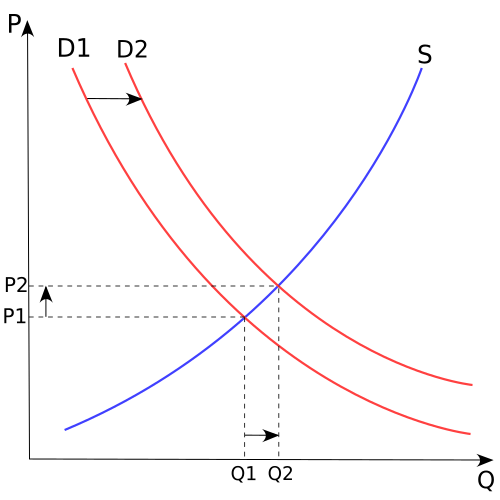
Anyone who has taken a survey econ course has seen diagrams like the one above, commonly called a supply and demand diagram or supply and demand curves.

The horizontal axis (Q) is Quantity supplied of a product. Q2 is a larger quantity (greater supply) than Q1. The vertical axis (P) is Price to purchase the product. P2 is a larger price than P1.

The blue line labeled S is a supply curve for our product. As with most supply curves, it increases monotonically and tells us that, as the price P rises, the quantity Q of the product supplied also rises. This makes intuitive sense: if someone will pay a lot more for a hamburger, more people go into business selling hamburgers and the supply increases.

The red line labeled D1 is a demand curve for our product. As with most demand curves, it decreases monotonically and tells us that, as the price P falls, the quantity Q of the product demanded rises. This also makes intuitive sense: if the price of hamburgers drops, more people buy them.

These are typical supply and demand curves. There are others. These are representative supply and demand curves, they do not represent any specific product and market. It is possible (given the right sort of data) to generate actual supply and demand curves for actual products.

The point where S crosses D1 is a market equilibrium, where the supply of and demand for our product are equal. At this point, the market price is P1 and the quantity supplied is Q1. Equilibrium indicates that the price and supply will stay there once they are there. If the price is below the equilibrium, less of the product will be supplied (a shortage) and the price will be bid up. The higher price will encourage entry of other suppliers (or current suppliers will increase production if possible), the quantity supplied will increase and the price will drop toward the equilibrium.

The red curve labeled D2 is an alternate demand curve. Suppose that our product is made available to a new market: at any given price, more people want to buy our product, and the demand curve is shifted right, representing an increase in demand. With this increase in demand comes a new equilibrium, where D2 crosses S. Notice that both the price and quantity produced have increased at this new equilibrium: price from P1 to P2 and quantity from Q1 to Q2.


Markets
"Free markets" are amazing things. Left to themselves, they establish price and production amounts magically, without human intervention. Or do they?

"Free" market sounds like something that is unfettered, unconstrained, unregulated, and well, unreal. Markets are unable to operate without certain preconditions: good governance, stable currencies, security, confidence, etc. Without security and stability, markets fail. Without contract enforcement mechanisms, markets fail. Without producer and consumer confidence, markets fail.

Free marketeers often complain about government regulation. Economists (and remember, there's a reason why economics is called "the dismal science") will use supply and demand curves to show you that almost any government intervention (taxation, price supports or caps, etc.) distorts the free market and generates inefficiencies. And according to the theory, they are correct. However, honest economists will also admit that there are good reasons for governments to regulate markets (pdf), reasons which may go beyond economics.

Market Failures
One of the biggest reasons for government to regulate markets is "market failure". We've just seen an enormous one in the US, the so-called "subprime meltdown". The Long-Term Capital Management fiasco of the late 1990s also comes to mind.

Market failures include things like:

  • Monopoly: where a producer has market power
  • Monopsony: where a consumer has market power
  • Externalities: where a producer or consumer doesn't pay the "real" cost of a good
  • Public Goods: where a producer can't be properly compensated for the real benefit of a good
  • Asymmetric Information: where one side of a transaction lacks relevant information


McCain's Gas Tax Holiday Proposal

John McCain wants to suspend federal gasoline taxes for the three months of the summer holiday. Specifically:

McCain urged Congress to institute a "gas-tax holiday" by suspending the 18.4 cent federal gas tax and 24.4 cent diesel tax from Memorial Day to Labor Day. By some estimates, the government would lose about $10 billion in revenue. He also renewed his call for the United States to stop adding to the Strategic Petroleum Reserve and thus lessen to some extent the worldwide demand for oil.
Combined, he said, the two proposals would reduce gas prices, which would have a trickle-down effect, and "help to spread relief across the American economy."

What would such a "gas-tax holiday" actually do, economically, to supply and demand? Since economists aren't physicists, it's impossible to say for sure, but here are a couple of the more believable scenarios:

  • Assuming we are currently at a market equilibrium (a questionable assumption, considering the constant change in gas prices), reducing the price of a gallon of gas by 18.4 cents to the consumer would increase demand for gas. Increased demand should increase supply, but the summertime supply of gasoline in the US is relatively fixed, so the supply cannot increase. As a result, the price will resume the starting equilibrium -- and the total value of the tax reduction will accrue to the oil companies.
  • The tax reduction will be split between the producers and the consumers, as apparently happened in Illinois in 2000, when gas hit $2/gallon for the first time. In the case of a real reduction in price to consumers, demand for gas will rise, raising the price of gasoline, but not as much as in the first scenario. However, gasoline usage will also rise, increasing the US carbon footprint.

Realistically, the gas-tax holiday will have little effect upon the average American. The price of gas might go down, but if it does, the amount of gasoline used will go up, pushing prices back up and increasing the flow of carbon into the atmosphere.

Sounds like a losing proposition to me, on the merits.

But it does appear to be pretty good political theatre.

NOTE: Nothing in this post should be construed as an endorsement of any Democratic candidate for president. It is an article with facts and opinions about politics. I have not made up my mind, and GNB is not endorsing any candidate prior to there being a clear nominee.

There's more...