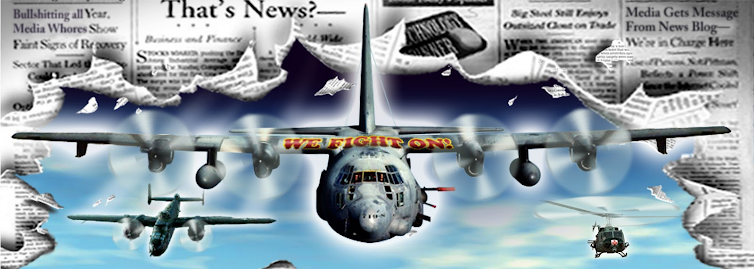

 (Photoillustration: "Big Red Letters on a Dead End Sign" by Evan Robinson, Group News Blog)
Here We Are
It's been seven months since I lasted addressed our condition. In the meantime we've finished a two-year campaign and election, with historic results. Those of you in America have survived the Thanksgiving Holiday (most of you), although not everyone overseas did, and there is much wailing and gnashing of teeth over Black Friday, even as sales seem to be going better than many feared.
So let's take a look at a few other elements of our condition...
That Devil's Madness -- War
Mumbai is on our minds. Asymmetric warfare is as much about media coverage as it is about inflicting military defeat, and it was genius (twisted, evil genius) to stage the attack during American Thanksgiving when much of the country is already in front of the television for traditional parades, specials, and both college and professional football.
While debate rages about the identity and backers of the Mumbai attacks, the NY Daily News says that as few as 10 attackers were involved:
The 60-hour Mumbai terror spree that killed at least 174 people was the brutal handiwork of just 10 Islamic militants who wanted to create a 9/11-caliber catastrophe, officials said Saturday.
The Guardian reports that the only surviving attacker, Pakistani Azam Amir Kasab, says the militants trained in Kashmir for five months:
Kasab reportedly said the mastermind of the plot briefed the militants to "target whites, preferably Americans and British".
He said the militants, who were highly trained in marine assault, had arrived in the city by boat. They planned to blow up the Taj Mahal Palace hotel after first executing British and American tourists and then taking hostages.
Police sources said Kasab told officers that he and his fellow terrorists trained in Pakistan-occupied Kashmir for five months before taking a month off before the attacks, the Daily Mail reported.
They left an isolated beach in Karachi for Mumbai on November 21 and were each given eight hand grenades, an AK-47 rifle, an automatic pistol and ammunition.
The Sidney Morning Herald reports that the targets were extensively scouted and attackers prepared with CQB training and memorisation of the target layouts. They hoped to kill more people than the 9/11 attacks:
The terrorist gang, thought to number as few as 10 gunmen, had planned to kill 5000 people and destroy the iconic Taj Mahal Palace hotel and the stock exchange. In the end, their murderous toll was closer to 200, and left the Taj Mahal and the Tident-Oberoi hotel badly charred and damaged.
Kasab had months of training before the attack where he was instructed in the use of military weapons and explosives. He and his fellow attackers, aged between 18 and 28, were also drilled in close quarter combat.
An Australian witness, Ray Lacey, who saw the attackers in the foyer of the Taj Mahal, said they were highly disciplined and did not waste bullets.
Kasab told investigators they were instructed to conserve their ammunition so they could sustain their attack for as long as possible. "I have done right. I have no regrets."
Kasab told interrogators that most of the volunteers for the suicide mission spoke Punjabi. They were given false identities and were discouraged from interacting with each other beyond what was barely necessary.
Regardless of the origin and backing of the attackers, Mumbai shows a new sophistication in media use, plotting attacks of a new and different kind apparently specifically to take advantage of American media viewing patterns: the timing of the attack, the sophistication of the targeting and planned duration of the attack, even down to one of the attackers being captured and talking freely to the media afterward.
As with most 4GW, the damage done was hugely disproportionate to the investment required by the attackers. The 9/11 attacks cost less than $500,000 to carry out, and bore a ginormous price tag. Since half of that $500,000 was in-US expenses and these attackers staged and trained in Kashmir, I wouldn't be surprised to find out that hte cost of putting this operation on was less than $100,000 -- and the damage to the Indian economy may already be $20 billion.
Arr, Matey!
Not too terribly far away, from an American point of view, Somali "pirates" have been very active, hijacking the Saudi-owned VLCC Sirius Star, a Ukranian vessel carrying Russian T-72 tanks and other weapons, a Yemeni steel carrier, and others.
Somalia has lacked a functioning central government since the early 1990s, and hasn't had a remotely democratic government since 1969. It's not much of a stretch to say it's never had a truly western-type democratic government. Regionalism and tribalism have led to breakaways (Somaliland), military rule, civil wars, and more or constant unrest.
One way to regard the Somali pirates is as disaffected and disadvantaged fishermen who can no longer operate in the current environment. With the officially recognized "government" of Somalia in control of less than half the country, the rule of law has disintegrated on a national level and local law is a mix of tribal law, Sharia, and old English common law left over from British Somaliland. Another way is to consider them regional terrorists or criminals. Which they are changes the long-term solution to the problem, but not the short-term one.
Regardless of their origins, Somali pirates (and their counterparts off Nigeria) are tightening the screws on the worldwide movement of goods, raising the risk of shipping and the price of goods, including oil. If they acquire the technology to threaten undersea cables, they could have the capability to dramatically disrupt electronic communication as well.
With American military forces stretched beyond their limits in Iraq and Afghanistan, the US doesn't have the muscle to maintain open sea lanes in the Gulf of Aden and off the Horn of Africa anymore. Many countries have been "free-riding" on the US Navy's ability to suppress piracy since WWII and especially once the US because the world's only hyperpower. As the limits to American power projection become clear, those nations are going to have to start stepping up with naval forces, on-vessel weapons and military personnel (or contractors like Blackwater), and money, which in the current economic environment may be the hardest to come by.
 (Chart: Dow Jones Industrial Average, Yahoo Finance)
Melty, Melty Cheese
Anyone who doesn't know about the global financial meltdown of 2008 hasn't been paying attention. As of today, the Dow is down about 33% for the year, but ten days ago the Dow was down more than 43% for the year. From 2007.10.12 to 2008.11.20, the Dow dropped 46% from its high. At 8829, the Dow is now about where it was in March 1998.
Gold has dropped 20% from its historic high of about $1000, and at 813, it's close to the previous peak of January 1980. Many other commodities have dropped to 1/2 or 1/3 of their peak values over the last year, including Aluminum, Appalachian Coal, Cobalt, Copper, Lead, Nickel, Palladium, Platinum, Ruthenium, Silver, Steel, Tin, Uranium, and Zinc. At least some of those commodities have returned to their "normal" values of 5-10 years ago.
While a barrel of oil has dropped to about 1/3 of its peak price (currently $53 compared with a July peak of $147), it is still 2 1/2 times the historic average price of just over $20/bbl.
US electrical power use is dropping.
Dick Kelly, chief executive of Xcel Energy Inc., Minneapolis, says his company, which has utilities in Colorado and Minnesota, saw home-energy use drop 3% in the period from August through September, "the first time in 40 years I've seen a decline in sales" to homes. He doesn't think foreclosures are responsible for the trend.
China's growth rate is slowing. Fast.
Why then is China slowing so sharply? Simple, real estate investment has hit a wall. After growing at 20% y/y for a long time, real estate investment stalled – with a y/y growth rate of around 0% (Figure 5). That means that China is in turn producing more steel and cement than it needs, and producers of steel and cement are cutting back. That in turns hurts iron ore exporters…
This though is very much a result of China’s own policy choices. Rather than allowing the real exchange rate to appreciate back when China was truly booming (05-late 07/ early 08), China’s policy makers opted to rely on administrative curbs on credit growth. That left China more exposed to global slump in demand – as it kept exports up by limiting real appreciation even as it credit curbs limited the amount of froth in the real estate market back when China was booming and real interest rates were negative. China invested a lot in real estate, but it is no Dubai. But China’s policy makers still look to have slammed the brakes on a bit too hard. Rather than slowing gradually, real estate investment fell off a cliff.
...
While real exports contributed positive to GDP growth in 2008, they won’t contribute in 09. The World Bank forecasts that for the first time in a long time, 2009 real import growth will exceed real export growth. In 2005, real exports grew about 10% faster than real imports (23.6% v 13.4%). Many economists remain – for reasons that to be honest elude me – reluctant to draw the obvious connection: the most likely explanation for China’s strong real export growth is the large depreciation the RMB in 2003 and 2004. That combined with administrative controls – which limited lending, investment and ultimately imports – to create China’s large current account surplus. Real export growth exceeded real import growth by 5 percentage points in 2006 and 2007 – and by 4 percentage points in 2008.
The positive contribution of net exports to GDP is forecast to end in 2009: real import growth will exceed real export growth by 3 percentage points.
Oh, and the US has been in a recession for just about a year now. U-6 (an alternative measure of unemployment maintained by the BLS since 1994 or so) has hit a seasonally adjusted 11.8%, the highest ever recorded. We've lost about 1.2 million jobs this year, an especially stunning figure when you remember that we need 1.8 million new jobs a year to keep up with population growth. So we're down 3 million employed people in 2008.
In an effort to stop the meltdown, the US government has already committed at least a trillion dollars to the financial sector, and central banks the world over are scrambling to avoid a disaster.
Peak Experience
The good news is that the average US price of a gallon of gas is down to $1.825 as of 2008.12.01, a 56% drop from the record high $4.114 set on 2008.07.17. Even better news is that global petroleum demand is down:
Worldwide demand will decline by 20,000 barrels per day (bpd) in both 2008 and 2009 to 86.03 and 86.01 million bpd respectively, according to a Reuters poll of 11 analysts, banks and industry groups.
The slight fall is a large shift from a Reuters poll of experts in August, which forecast demand would increase by nearly 1 million bpd next year. Demand has not declined since the early 1980s, following the 1979 oil crisis and a severe recession in the United States.
"Global GDP growth is the main driver of oil demand, and with the economic slowdown we see global GDP rising by just 1.2 percent next year," Michael Lewis, head of commodities research at Deutsche Bank, said.
The bad news, of course, is why demand is down. US demand is expected to drop about 1 million bpd, or about 5% (other reports say 6.7%). That drop will be accompanied by a 1.4% drop in GDP in 2009. World GDP growth is expected to drop from 4% to 2.5% this year and under 2% next year.
Some might seem to be overreacting:
Make no bones about it, every past civilisation has decayed into the dry leaves of history - why should this one be different?
All those past efforts outgrew their carrying capacity, be it the Mayans with corn, the Sumerians with irrigation, or the colonist economies with dwindling extractables.
Anthropologist Jared Diamond catalogues them in his insightful book Collapse.
Those partial to more easily-digested literary offerings should try The Lorax, by Dr Seuss.
The message is identical: the collapse is usually a decline over decades or centuries, and that zero growth does not signal zero activity, just its peak.
Meaning we have to plan for a long, permanent recession.
Our society has been able to do so much more that previous ones, thanks only to the one-off use of fossil fuels.
The International Energy Agency has now signalled that we are past the peak of global oil supply, citing a cumulative depletion rate of 6.8% per annum.
7% Depletion Annually!!!!!!!
Ouch. Especially when you consider that a 1% drop in supply of oil can cause as much as a 20% rise in price.
Where Do We Go From Here?
Forecasting is fraught with peril. So rather than promoting a future, let us talk about several futures.
1) Whoopsie!
It's possible that the central banks and government intervention to save the financial sector will fail. This is a dire scenario, because a free fall (or "hard landing") of the US dollar, the Japanese yen, and the euro could leave the world without a reliable reserve currency. While the Chinese yuan might seem like an option, a tightly controlled currency (one that does not float in value according to market forces) will be unacceptable to many.
Without a stable reserve currency, the current credit crisis is going to seem like a mild spring compared to the depths of winter. Global trade will slow dramatically. Investment may halt except for government programs. The Great Depression could be a fond memory. We could be mired in slow or negative growth for a generation.
On the other hand, even this dread scenario could be considerably shorter-lived than the Depression of the 30s. Modern Keynesians believe they have a better handle on the events of the 30s and that they understand the necessary monetary moves to avoid another Depression. If they're right, our present slowdown, even with a hard dollar landing, might be largely over in 18 - 36 months.
A likely ending of this unpleasant scenario includes the world ending up with a non-dollar reserve currency. Maybe the euro, maybe the yuan is allowed to float, maybe the Indian rupee, but most likely some combination of currencies replaces the dollar.
During the downturn, no matter how long or short, economic unrest and lack of opportunity will fuel bigotry, prejudice, and terrorism. The fragility of the economic system will make it an attractive target for non-state actors, and we can expect a significant upsurge in worldwide violence and terrorism.
2) Whew!
If the Keynesians get control quickly and prove that they know what they're doing, the Great Recession of 2008 could prove to be the catalyst for the Great Green Growth of 2010 on. Monetary stimulus packages will encourage research and infrastructure spending aimed directly at the middle class and climate change. New industries will spring up and the US auto industry (now owned by a mix of union and government money) will lead the development and production of lower-carbon transportation options. Energy efficiency and lower-carbon energy generation will be fast-growth industries, leading eventually to a "green bubble" and correction.
Widespread economic improvement (not limited to the global elites) will begin to lift the "bottom billion". Jeffrey Sachs will be confirmed US Secretary of Global Equity and by 2020 the 2.5 billion people living on $2 or less a day will be living on $5 or less a day. The resulting prosperity will start a sharp decline in birth rates. Economically driven violence will decline.
Using a law-enforcement paradigm for anti-terrorism will not be entirely successful, but a combination of successful intelligence gathering and the rising economic fortunes of the global underclass will reduce worldwide terror and violence.
3) Whatever...
a) Peak Oil remains a concern. Even as the global downturn reduces demand for almost all non-food commodities, it also prevents private investment in commodity production/extraction. We will stumble along at 85-95 billion bbl for a while and between 2020 and 2030 we'll begin to see a serious decline in petroleum availability. The resulting spikes in price will revive energy investment. Who wins the race (declining petroleum supplies or alternative energy sources) is up for grabs (and government backing).
b) Global Terrorism and Violence are driven by economic factors as well as political ones. As the global economy declines and we reduce the carrying capacity of the environment, violent responses are the only options left for some. As globalism brings competing values into insular communities, clashes are almost inevitable. Fear of cultural annhilation drives the political use of violence. Getting off this treadmill requires re-visioning globalism and global aid. Large portions of the developing world are running out of easy (cheap or free) fuel sources. Aiding the bottom billion requires local knowledge, not just global money. Jeffrey Sachs has laid out a plan (pre-meltdown) which could reduce global poverty by spending roughly the US defense budget annually. We ought to be listening. The ultimate fix for global terrorism isn't military or even law-enforcement, it's economic and cultural.
c) From a bipolar superpower world we've gone to a unipolar hyperpower, and now that hyperpower has shown feet, knees, and even thighs of clay. The BRIC (Brazil, Russia, India, China) nations have the potential to re-alter the nature of world power politics. China and India are modernizing at a fearful rate, but neither is going to become a carbon copy of the US or Europe. China's interesting mix of totalitarian politics and unbridled economic capitalism has expressed itself in 8-10% growth but is now slipping. How they respond and what their political system looks like in a decade will tell us much about the world in 2100. India and Pakistan are looking at each other over Kashmir and considering what it would take to use nuclear weapons. Mumbai provides an excuse for the Indians to berate Pakistan. The Afghani conflict spills into Pakistan, provding conflict between Pakistan and the US (technically NATO, but....). A major regional conflict, possible with nukes, can't be ruled out, and would shape future politics in ways that we can't yet guess. We might go all "one world" or we might go all "every nuke for itself". Convincing Pakistan to rein in the ISI in a very public way would help a lot, but it's going to take more than that to decide about Kashmir in a way that leaves everyone involved willing to try for peace.
China's economic imperialism, especially in Africa, suggests that resource conflict over declining commodities, is inevitable. Proxy conflict over resources isn't impossible, and may even be likely. Keeping the conflict economic may slow recovery, but it will make for a more peaceful world so long as the conflict remains between more developed nations and doesn't spill over to the bottom billion. We could see a return to the proxy wars of the 70s and 80s in sub Saharan Africa but between the Chinese and everyone else instead of Soviet/US conflict.
What Condition Our Condition Is In
(Video: "Gutterballs" from the Coen Brothers' 1998 The Big Lebowski, starring Jeff Bridges, Julianne Moore, and John Goodman)
Well, I'm sorry to say it isn't exactly rosy. But it's not all black. Downturns provide the opportunity to change course, like layoffs can promote entrepreneurship. We still have choices that can improve our situation, although the combination of delay on climate change and the acceleration of the process leaves us with little time to react on that front.
If we want to prosper, investment on infrastructure is the key in the US. The trillion-plus we've spent on Iraq isn't doing nearly the economic good that it would do if invested in the US. The trillion-plus we're spending on the financial sector isn't doing nearly the good that it would do if invested in actual building and repair in the US. Sooner or later the small government people have to be thrown under the bus so the adults can get back to fixing the problem. If the US pulls out of free fall, other nations have both a safe haven reserve currency and a consumer of last resort (hopefully not quite as enthusiastic a consumer as the last few years). Recovery will exacerbate our Peak Oil problem, but some of that investment should be going to lower-carbon transportation, power, and agriculture.
We Are All In This Together....
There's more...


