
Monday, August 4, 2008
John "Big Oil" McCain
Hubris Sonic 3:26 PM |
Labels: Corporate America, John McCain, Oil
Tuesday, July 1, 2008
Oil: Less Speculation, $200/bbl, Risk Premium, and Sources.

In my previous entry "Drill Here. Drill Now. Pay Less." More Conservative Bullshit., I discussed some of the basic memes that are out there about our current relationship with petrochemicals, including the idea that speculation was at the root of the current price shock, whether the price shock is directly related to "liberal politicians" (as Newt Gingrich has suggested), oil and food, oil supply and demand, and alternatives.
Because I have a family history in the 'awl bidness' and a couple of groups I'm involved with, and because any rational person wants to understand why the world is the way it is, I try to keep up with current ideas and trends in the petrochemical world and how they effect the rest of the world.
Here are a few of the sources I read. If you are interested in what's happening, you should read them too:
Dedicated Oil Sources
The Oil Drum: Discussions about Energy and Our Future
Royal Dutch Shell plc.com
Vancouver Peak Oil Executive
Generalized Economics Sources
Paul Krugman
Brad Delong
Marginal Revolution
Paul Kedrosky
What's Changed Recently?
One thing that has changed is that the generalized economics blogosphere appears to be coming down even harder against the idea that oil is a bubble or that speculation is responsible for much of the price shock. Part of that is because "a bubble" is very poorly defined (and usually after the fact) and that "speculation" is so incredibly vague as to be almost meaningless. Technically, anyone who buys a stock or currency or any commodity in order to make money selling it later is a speculator.
Another thing that has changed is that the meme of $200/bbl oil seems to be gaining traction. A quick Google turns up more than 12 million hits. Goldman Sachs suggested the idea in March, but there were other* mentions before that. Now the conversations are happening everywhere. Deutsche Bank is warning that $200 oil would "break the back of the global economy". Call options on oil at $200 (December) are up almost 40% since the end of April.
Risk Premium
And a third thing is the risk premium. Risk premium is the amount of the price of oil attributable to various risks around the world. For our purposes, the risk premium is the rise in oil price attributable to the possibility of disruption in oil supply.
We know from previous experience that world events can have significant impacts upon oil prices. The first Gulf War was associated with nearly a doubling of oil prices. The Iranian revolution and accompanying OPEC price increase raised oil prices 20%. The 1973 embargo raised prices 187%, according to the EIA.
Several major possibilities are in the front of people's minds: Nigeria, Iran, Russia.
In Nigeria, MEND has successfully attacked (for the first time) one of the distant offshore platforms. They've also cut pipelines onshore, cutting off 120K bpd. Nigeria supplies about 2400K bpd, so that is only .5%, but the capability begins to worry one.
Iran supplies about 4100K bpd. If the US military becomes more active there, everyone expects at least part of that supply to be cut off (as a significant amount of Iraq's oil extraction capacity has been off the market since the US invasion).
Russia is the second largest extracter of oil after Saudi Arabia at almost 9700K bpd. Their extraction is declining and they are showing signs of resource nationalism, especially in natural gas.
The way risk premiums work is that each oil buyer (consciously or unconsciously) calculates an expected value (EV) for oil in the future. They incorporate their beliefs about the likelihood of a disruption event and the resulting price into that EV, and that informs the price they are willing to pay for an oil futures contract. Various sources suggest that the risk premium right now is between $20 and $50 per barrel, or between 14% and 35% of the price.
Of these, I consider the Iran scenario to be the most worrisome because of volume, but the Nigeria scenario most likely and overall, scariest. In fact, I fear that MEND is showing others how to make significant strikes against the developed nations by disrupting oil supplies. The map at the top of the post links to a dynamic map at NewScientist. Click around. Look at the "Oil pinch points" portion and the Straits of Hormuz and Malacca. It's easy to see Iran disrupting travel through Hormuz, which is only 21 miles wide. Malacca is perhaps of more concern. At 500 miles long, Malacca narrows to only 1.5 nautical miles wide and portions are only 82 feet deep -- shallow enough that some supertankers must use other passages. Despite that, roughly 1/4 of world oil travels through Malacca. In 2003, 1/3 of global piracy attacks were in the strait of Malacca (I note that Wikipedia is not the greatest source).
I can easily see effective disruption of oil transport happening in either Hormuz or Malacca. If 1/4 of world extraction were to be destroyed, embargoed, or even just threatened for a few days, there could be a price spike the likes of which the world has never seen. Sam Bodman, US energy secretary, has indicated that every 1% rise in oil demand means a 20% rise in price. Taking 25% of supply out of the equation would (by his numbers) raise the price of a barrel of oil 500%, or to about $700. I don't see it being quite that bad, but I can easily see a doubling to $280 or even $300. And I have no doubt that re-routing would happen quickly to drop prices back, and that the US Navy would be patrolling the Strait as soon as possible.
But for a few days, we'd find out what Peak Oil really means.
So that's the news. Nothing** suggests that prices are going to drop anytime soon. Conventional wisdom is against it, which may be the only argument for lower prices :-). If political worries smooth over (which seems unlikely while Bush is in office or if McCain is elected), we could see the risk premium drop. That might get us back to $100 oil, but I doubt any better than that. IMO, the most effective weapon we have against high oil prices right now is diplomacy, and I mean that in the archaic sense of talking, not the neocon sense of preparing to attack.
* Yes, I consider that link a joke.
** Actually, I just read one thing. Gasoline usage is dropping in the US, and as a result, oil stocks are rising (that is, the amount of oil stored). We had a bit of a dip in prices last week as a result before they shot back up again. We've seen the basic scenario before: oil price shock lowers economic output, which lowers oil demand, which reduces oil price. But with multiple growing economies in the world demanding oil, it's going to be harder to make this scenario work this time.
Disclosure: I am passively invested in the extraction side of petrochemicals. I do not own stock in or have any active (decision-making) relationship with any company mentioned in the post.
[Updated: 2008.07.01 14:03 PDT to add final ** paragraph about reduced demand in the US possibly lowering prices.]
Thursday, June 19, 2008
"Drill Here. Drill Now. Pay Less." More Conservative Bullshit.
Newt Gingrich, primary beneficiary of the 1994 "Contract with on America", has started a "Drill Here. Drill Now. Pay Less." ad campaign in conjunction with last year's book, A Contract with the Earth. In classic Newtian fashion, DHDNPL breaks down into a small set of bullet points:
- We have problems:
- Dictators controlling US energy supplies
- Billions of US dollars going overseas
- Airline industry in trouble
- Trucking industry in trouble
- Food prices up
- This is "a politician's energy crisis":
- Liberal politicians deny us:
- nuclear power
- clean coal
- shale oil
- offshore drilling
- We need to get the price of gasoline down in the short term
- We need to increase alternative sources of fuel in the long term:
- Hydrogen
- Nuclear Power
- Solar Energy
- Wind Power
Let's look at them one by one and then overall, shall we?
We Have Problems
Absolutely, we do. No one paying $4 or more for a gallon of gas can deny that. And every one of Newt's bullet points is at least arguably true, even if his explanations for them are sometimes not so.
The US imported between 12.75 and 14 million barrels per day (Mbpd) during the month of May 2008 against a monthly average usage during Q1 2008 of between 19.75 and 20.8 Mbpd. That translates to importing about 2/3 of our petrochemical usage at a daily cost of $1.7 billion (assume 13.33 Mbpd @ $130) or about $630 trillion annually.
The Top Ten countries of origin for US petrochemical imports are (in kbpd, March 2008): Canada (2542), Saudi Arabia (1542), Mexico (1358), Nigeria (1174), Venezuela (1033), Iraq (772), Algeria (441), Russia (402), Angola (388), Virgin Islands (290). I think it's reasonable to consider that Canada, Mexico, Venezuela, and the Virgin Islands (about 5.2 Mpbd between them) are not ruled by dictators (although reasonable people can disagree) vs. 4.7 Mbpd that are. That still leaves 2.8 to 4 Mpbd unaccounted for, and countries like Libya and Azerbaijan on that list are certainly dictatorships, but I just can't put the Bahamas, Belgium, France, and Germany on that list.
Not All Problems are Energy Related
The Airline industry is certainly in trouble. But that's nothing new. In the 30 years since US deregulation of the airline industry, losses top gains by $13 billion, largely caused by overcapacity and the resulting downward price pressure. Energy prices don't help, but the industry wasn't making money when oil was cheap, either.
The Trucking industry is also suffering, but for different reasons. The average long-haul truck gets about 6 mpg in the US (other sources say 4.5 to 7.5), whereas Canada averaged 7.15 mpg in 1999. I read an article (can't find a source) suggesting that 10 mpg was within reach. In 2003, it was suggested that $1.40 diesel would drive truckers to improve their aerodynamics, tires, and transmissions. High speed raises fuel usage, and up to 50% of engine hours are spent idling. There are huge gains to be made by simple procedural efficiencies.
There is a lot of press about worldwide food prices. Some suggest that biofuels are causing the rise. But world coarse grain production peaked in 1996-1997 at 907 million tons and declined to 860 million tons in 2000-2001. Inconsistency in crop yields has reduced grain inventories worldwide. The cost of petrochemicals has unquestionably transferred some grain from food use to fuel use, but the essential problem of grain supply was with us before the current oil price rise. We have relied upon the "Green Revolution" to increase global food production and in doing so have outstripped our available carrying capacity.
Liberal Politicians Have Nothing to do With These Problems
In Newt's reality, we don't have infinite nuclear power, clean coal, oil shale derived petrochemicals, and energy independence because of offshore drilling because of "liberal politicians".
Aside from the fact that conservatives controlled the entire executive and legislative branches of government for several years there, Newt's blamefest for liberal boogiemen lacks foundation in other ways.
Both Congress and President George H. W. Bush have prevented offshore drilling: the 97th US Congress (House controlled by the Democratic Party 244 - 191, Senate by the Republican Party 53 - 46 - 1) banned offshore oil drilling in 1981; the first President Bush's executive order banned coastal oil exploration in 1990. It's hard to see how a split Congress and Bush 41 can be considered "liberal politicians".
Nuclear power has been stalled in the US since the Three Mile Island accident in 1979. No new plants have been built since 1973, although there are now multiple applications for nuclear plants before the NRC (pdf). Environmental concerns undoubtedly played a part in the unofficial moratorium, but low petroleum prices and an institutional switch to natural gas were almost certainly more important factors.
Clean coal has been a priority of the DoE during the present Bush administration. And isn't it funny how lack of action by energy companies becomes "liberal politicians locking us out of clean coal" while the Chinese work on it? Free marketeers like Newt always say that government incentives are distorting the market until they want incentives for their pet projects, and then the lack of those incentives is suddenly the fault of "liberal politicians". Clean coal is a wonderful idea if it can be done, but the fact that it's not happening is not about liberal politicians blocking it, it's about technical difficulty.
Oil shale? Like the Canadian tar sands, oil shale is tremendously dirty and difficult to extract economically. In Alberta, two-thirds of the extracted energy goes into the extraction process, along with huge volumes of water. It's not clear yet that the tar sands are energy positive and the ecological impact is enormous and obvious. Oil shale will be the same way in the US. We are not ready yet to safely and economically extract that energy, and we may never be ready. Liberal policies have nothing to do with it.
Gas Prices in the Short Term
The price of gas in the short term is driven by supply and demand, with additional complicating factors. Oil production* worldwide is about 86 Mbpd and closely matches demand. However, excess extraction capacity in the OPEC nations has dropped precipitously in the last few years. According to J. L. Williams at wtrg.com, OPEC spare capacity has dropped from 6 million bpd to under 2 million:
In mid 2002, there was over 6 million barrels per day of excess production capacity and by mid-2003 the excess was below 2 million. During much of 2004 and 2005 the spare capacity to produce oil was under a million barrels per day. A million barrels per day is not enough spare capacity to cover an interruption of supply from most OPEC producers.
In a world that consumes over 80 million barrels per day of petroleum products that added a significant risk premium to crude oil price and is largely responsible for prices in excess of $40-$50 per barrel
Without significant spare capacity, we lack extraction buffers against short-term supply interruptions like those happening in Nigeria or the 2006 pipeline shutdown in Alaska. Instead, we must rely upon post-extraction storage buffers like the US Strategic Petroleum Reserve.
*Oil "production" is more properly termed "extraction" because the process does not "produce" anything but merely "extracts" existing petrochemicals from one reservoir (presumably a natural one) into another (presumably an artificial one). I prefer the more correct term "extraction" not only because it properly explains the process, but because it reminds us that we are dealing with a fixed existing supply of material instead of the expandable output of a production line.In the short term, supply and demand fundamentals explain a great deal about oil and gas prices. Concerns about future supply include militarism, nationalism, activism, accidents, weather, and resource nationalism. Some believe that these non-supply factors may account for $50/bbl of cost. Others believe that fundamentals adequately explain oil at $150 or even more. Others think we have plenty of oil and this is all some sort of speculator-driven conspiracy.
Alternatives in the Long Term
The best way to encourage alternative energy development is a combination of high energy prices and public policy. If public policy says that government will subsidize or prefer clean or renewable energy, then the market should respond relatively quickly. It is the very cheapness of petrochemicals (and the widespread externalization of pollution and other negatives) which has prevented the development of alternatives to this point. If we are in favor of non-petrochemical energy sources, we should be pleased about high petrochemical prices. I know it's hard, but that's why they call economics "the dismal science."
As for specific alternatives Newt likes, hydrogen isn't an energy source, it's just a storage medium. One of the major problems facing us is that petrochemicals are very energy dense. We can't build batteries that store energy nearly as well as gasoline does. Hydrogen (possibly in some kind of aerogel frame) is pretty promising in that regard.
Nuclear power has a definite place in our future, especially if pebble-bed reactors pan out. If so, we add 85 years of uranium (at current usage levels) to our energy supplies. Nuclear fission power is thus a bridging technology, which is exactly what we need while we finish developing long-term sustainable systems.
Solar, hydro, and wind power are true renewable technologies, and the high price of petrochemicals is encouraging development and deployment around the world. Subsidies would speed up deployment, but the market is taking care of that so long as the cost of oil remains high.
Typical Conservative Bullshit Posturing
"Drill Here. Drill Now. Pay Less." is a typical piece of bullshit Conservative posturing. Most of Newt's supporting points aren't, but that's not the worst of it. The solution won't solve any of the problems. Studies of ANWR show that drilling there will yield maybe $.01/gallon improvement in gas prices. In 2025. ANWR would deliver 875 Kbpd at peak and a total of about 10.4 billion barrels. Bush's plan for offshore drilling alleges 18 billion barrels, so we might suggest that the offshore flow would be double ANWR or about 1.7 Mbpd and so we might get another 3 - 5 cents off each gallon of gas.
In return for that 4 - 6 cents off a gallon of gas, this is what we get:
Oil spills. This is the 1979 Ixtoc I spill -- the largest accidental oil spill in history (only the deliberate release of oil during Gulf War 1 was larger) -- 140 million gallons spilled over at least six months. Despite Newt's lie that Hurricane Katrina couldn't knock out modern oil platforms, Katrina destroyed at least 46 platforms. And let me remind you that Exxon has still not paid their fine for the 1989 Exxon Valdez spill in Prince William Sound.
What DHDNPL will do is enrich American oil companies. As resource nationalism denies them access to major fields in Russia, Venezuela, and the Middle East, the non-national oil companies like ExxonMobil, RoyalDutchShell, and Chevron are trying to ensure their access to other sources. I'm sure that if politicians were to arrange for offshore drilling to be allowed in the US, they'd be richly rewarded.
Oh. I guess they already are.
Disclosure: I am passively invested in the extraction side of petrochemicals. I do not own stock in or have any active (decision-making) relationship with any company mentioned in the post.
[Updated 2008.06.19 0825 to remove reference to Argentina as a dictatorship. Guess I'm still living in the past :-)]
There's more...
Evan Robinson 12:30 AM |
Labels: gas price, John McCain, newt gingrich, Oil, oil price
Wednesday, June 18, 2008
John "Big Oil" McCain
There's more...
Hubris Sonic 6:38 AM |
Labels: John McCain, Lobbyists, Oil
Tuesday, June 17, 2008
Alaska = Strategic Petroleum Reserves
The president believes Congress shouldn't waste any more time," White House press secretary Dana Perino told The Associated Press on Tuesday.
"He will explicitly call on Congress to ... pass legislation lifting the congressional ban on safe, environmentally friendly offshore oil drilling," Perino said. "He wants to work with states to determine where offshore drilling should occur."
Bush also will reiterate his call for development of oil in the Arctic National Wildlife Refuge in Alaska, Perino said. McCain has opposed drilling in the refuge, maintaining that the pristine areas in northeastern Alaska should be protected from energy development.
On Monday, McCain made lifting the federal ban on offshore oil and gas development a key part of his energy plan. The Arizona senator said states should be allowed to pursue energy exploration in waters near their coasts and receive some of the royalty revenue. -- AP
Drilling in Alaska, due to it's small size and the small volume of oil is equivalent to tapping into our Strategic Petroleum Reserves and is more plunder of America's treasure by this short-sighted Bush/Cheney administration and will leave America without a strategic reserve and less capable to respond in the future to any emergency situation that might arise.
Yet another thoughtless, and risky plan from the man with the reverse midas touch. Is there any doubt this will profit his oil buddies and not the American people, leaving America weaker and less secure.
We should be thinking of real solutions and not recycled political stunts from the 70's There's more...
Hubris Sonic 8:52 PM |
Labels: Bush Administration, Oil, Strategic Petroleum Reserve
Sunday, May 18, 2008
Monday, May 12, 2008
Plantagenetry

I wasn't going to mention the festivities but this picture needed reposting, with some minor photoshoppery.
Hubris Sonic 10:37 PM |
Labels: Bush Administration, Oil
Tuesday, May 6, 2008
Econ 101: Supply, Demand, and the Gas Tax Holiday
![]()
Basics of Supply and Demand
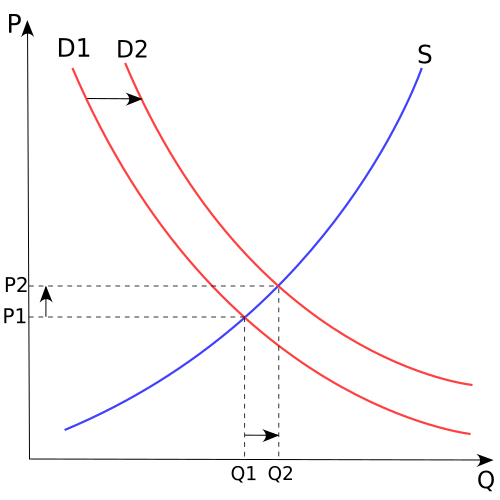
Anyone who has taken a survey econ course has seen diagrams like the one above, commonly called a supply and demand diagram or supply and demand curves.
The horizontal axis (Q) is Quantity supplied of a product. Q2 is a larger quantity (greater supply) than Q1. The vertical axis (P) is Price to purchase the product. P2 is a larger price than P1.
The blue line labeled S is a supply curve for our product. As with most supply curves, it increases monotonically and tells us that, as the price P rises, the quantity Q of the product supplied also rises. This makes intuitive sense: if someone will pay a lot more for a hamburger, more people go into business selling hamburgers and the supply increases.
The red line labeled D1 is a demand curve for our product. As with most demand curves, it decreases monotonically and tells us that, as the price P falls, the quantity Q of the product demanded rises. This also makes intuitive sense: if the price of hamburgers drops, more people buy them.
These are typical supply and demand curves. There are others. These are representative supply and demand curves, they do not represent any specific product and market. It is possible (given the right sort of data) to generate actual supply and demand curves for actual products.
The point where S crosses D1 is a market equilibrium, where the supply of and demand for our product are equal. At this point, the market price is P1 and the quantity supplied is Q1. Equilibrium indicates that the price and supply will stay there once they are there. If the price is below the equilibrium, less of the product will be supplied (a shortage) and the price will be bid up. The higher price will encourage entry of other suppliers (or current suppliers will increase production if possible), the quantity supplied will increase and the price will drop toward the equilibrium.
The red curve labeled D2 is an alternate demand curve. Suppose that our product is made available to a new market: at any given price, more people want to buy our product, and the demand curve is shifted right, representing an increase in demand. With this increase in demand comes a new equilibrium, where D2 crosses S. Notice that both the price and quantity produced have increased at this new equilibrium: price from P1 to P2 and quantity from Q1 to Q2.
Markets
"Free markets" are amazing things. Left to themselves, they establish price and production amounts magically, without human intervention. Or do they?
"Free" market sounds like something that is unfettered, unconstrained, unregulated, and well, unreal. Markets are unable to operate without certain preconditions: good governance, stable currencies, security, confidence, etc. Without security and stability, markets fail. Without contract enforcement mechanisms, markets fail. Without producer and consumer confidence, markets fail.
Free marketeers often complain about government regulation. Economists (and remember, there's a reason why economics is called "the dismal science") will use supply and demand curves to show you that almost any government intervention (taxation, price supports or caps, etc.) distorts the free market and generates inefficiencies. And according to the theory, they are correct. However, honest economists will also admit that there are good reasons for governments to regulate markets (pdf), reasons which may go beyond economics.
Market Failures
One of the biggest reasons for government to regulate markets is "market failure". We've just seen an enormous one in the US, the so-called "subprime meltdown". The Long-Term Capital Management fiasco of the late 1990s also comes to mind.
Market failures include things like:
- Monopoly: where a producer has market power
- Monopsony: where a consumer has market power
- Externalities: where a producer or consumer doesn't pay the "real" cost of a good
- Public Goods: where a producer can't be properly compensated for the real benefit of a good
- Asymmetric Information: where one side of a transaction lacks relevant information
McCain's Gas Tax Holiday Proposal
John McCain wants to suspend federal gasoline taxes for the three months of the summer holiday. Specifically:
McCain urged Congress to institute a "gas-tax holiday" by suspending the 18.4 cent federal gas tax and 24.4 cent diesel tax from Memorial Day to Labor Day. By some estimates, the government would lose about $10 billion in revenue. He also renewed his call for the United States to stop adding to the Strategic Petroleum Reserve and thus lessen to some extent the worldwide demand for oil.
Combined, he said, the two proposals would reduce gas prices, which would have a trickle-down effect, and "help to spread relief across the American economy."
What would such a "gas-tax holiday" actually do, economically, to supply and demand? Since economists aren't physicists, it's impossible to say for sure, but here are a couple of the more believable scenarios:
- Assuming we are currently at a market equilibrium (a questionable assumption, considering the constant change in gas prices), reducing the price of a gallon of gas by 18.4 cents to the consumer would increase demand for gas. Increased demand should increase supply, but the summertime supply of gasoline in the US is relatively fixed, so the supply cannot increase. As a result, the price will resume the starting equilibrium -- and the total value of the tax reduction will accrue to the oil companies.
- The tax reduction will be split between the producers and the consumers, as apparently happened in Illinois in 2000, when gas hit $2/gallon for the first time. In the case of a real reduction in price to consumers, demand for gas will rise, raising the price of gasoline, but not as much as in the first scenario. However, gasoline usage will also rise, increasing the US carbon footprint.
Realistically, the gas-tax holiday will have little effect upon the average American. The price of gas might go down, but if it does, the amount of gasoline used will go up, pushing prices back up and increasing the flow of carbon into the atmosphere.
Sounds like a losing proposition to me, on the merits.
But it does appear to be pretty good political theatre.
NOTE: Nothing in this post should be construed as an endorsement of any Democratic candidate for president. It is an article with facts and opinions about politics. I have not made up my mind, and GNB is not endorsing any candidate prior to there being a clear nominee.
Evan Robinson 12:03 PM |
Labels: 2008 Presidential Race, Economics, Economy, John McCain, Oil
Wednesday, January 2, 2008
Oil
Oil (crude oil futures for February deliver) hit $100 a barrel just after noon today, before closing at $99.62, up $3.64 today.
Three years ago when I was still totally not myself, I went through about a four-week phase when I first heard about peak-oil, of really freaking out about, well, basically that The End Of The World is coming. I remember specifically predicting -- and again, this wasn't really me; I wasn't home in any real sense of the word -- that we'd be at $100 oil by the end of 2006.
Eh... One year and two days off. Not bad, not bad.
And the world didn't end. So we've got that going for us.
The New York TimesTwo-thirds of the world's proven oil reserves live in the middle east.
Oil prices, which had fallen to a low of $50 a barrel at the beginning of 2007, have quadrupled since 2003.
Gasoline has lagged the rise in the price of oil. It stands at a nationwide average of $3.05 a gallon for regular grade, according to AAA, the automobile club. That is below the all-time peak in May of $3.23 a gallon, but it is 73 cents higher than at this time a year ago. Some analysts worry that gasoline could hit $4 a gallon by next spring if oil prices remain at high levels.
Oil is now within reach of its historic inflation-adjusted high reached in April 1980 in the aftermath of the Iranian revolution when oil prices jumped to the equivalent of $102.81 a barrel in today’s money.
Unlike the oil shocks of the 1970s and 1980s, which were caused by sudden interruptions in oil supplies from the Middle East, the latest surge is fundamentally different. Prices have risen steadily over several years because of a rise in demand for oil and gasoline in both developed and developing countries.
The war(s) goes on.
No real commitment to alternative fuels exists on a national scale, regardless of what may be happening at individual and regional power companies (some of whom are fiercely committed.) As a nation and a world, our need for oil continues to rise, while the pool of oil continues to shrink. People continue to die and starve and wars are fought over oil (e.g.: Iraq, Africa (throw a dart damn near anywhere)).
And if you're asking yourself why, just remember this...
The Vice President of the United States is still Richard Cheney. There's more...
Monday, December 3, 2007
Hugo Chávez Loses Referendum

photo Marcelo Garcia/Agence France-Presse-Getty-Images
Term Limits Stay; Chávez to Go. In 2012.
(If he can't get this passed by then. Or hold on some other way.)
By 51-49%, Hugo Chávez lost a referendum Sunday evening which would have abolished term limits, allowing him to keep running for President of Venezuela every seven years. Till death do us part.
New York Times
The outcome is a stunning development in a country where Mr. Chávez and his supporters control nearly all of the levers of power. Almost immediately after the results were broadcast on state television, Mr. Chávez conceded defeat, describing the results as a “photo finish.”
“I congratulate my adversaries for this victory,” he said. “For now, we could not do it.”
Opposition leaders were ecstatic. “Tonight, Venezuela has won,” said Manuel Rosales, governor of Zulia State and the opposition’s candidate in presidential elections last year.
Uncertainty over Mr. Chávez’s reforms, meanwhile, has led to accelerating capital flight as rich Venezuelans and private companies rush to buy assets abroad denominated in dollars or euros. The currency, the bolívar, currently trades at about 6,100 to the dollar in street trading, compared with an official rate of 2,150.
Venezuela’s state-controlled oil industry is also showing signs of strain, grappling with a purge of opposition management by Mr. Chávez and a retooling of the state oil company to focus on social welfare projects while aging oil fields need maintenance.
Petróleos de Venezuela, the state oil company, says it produces 3.3 million barrels a day, but OPEC places its output at just 2.4 million barrels. And private economists estimate that a third of oil production goes to meet domestic consumption, which is surging because of a subsidy that keeps gasoline prices at about seven cents a gallon.
CNNWow. Not what I would have predicted. (Continuing the great News Blog tradition of blowing election predictions. Heh.)
More than nine million of Venezuelan's 16 million eligible voters went to the polls Sunday.
President of the National Electoral Council, Tibisay Lucena, said the process "shows the entire world that we are a democratic country."
Chavez, in what he called a talk "from my heart" acknowledging the results, thanked those who opposed his proposal, saying the election had proven that Venezuelan democracy is maturing.
Thousands of people gathered in the streets, many of them university students who worked to defeat the measure, burst into singing their country's national anthem upon hearing the news.
Earlier in Caracas, Chavez -- clad in his trademark red shirt and cradling his grandson -- made the sign of the cross when he voted, then took his paper ballot and placed it in a box. "For me, it's a very happy day," he had said.
He dipped his right pinky in ink, collected his paper receipt from the voting machine and then gave an uncharacteristically short talk with the news media.
"Let's wait for the results tonight," he told reporters. "We'll accept them, whatever they may be."
Chavez called Venezuela's electoral system "one of the most transparent in the world," and said its voting machines are among "the most modern of the world."
If the amendments were approved, Chavez could have run for president in seven-year terms.
At present, the president's term runs six years, and current law would not allow Chavez to run again after his term ends in 2012.
How 'bout them apples? Er, them barrels of oil?
At least they have paper receipts for their voting machines. Nice touch. There's more...
Jesse Wendel 12:05 AM |
Labels: Chavez, Constitution, Election, Oil, South America
Wednesday, October 17, 2007
Do NOT Mess With An Original Gangsta
слово!
(or “Word!” in English)It was June of 2001—yes, there was a world—an America before September 11th of that year, and George Bush, whose shiftlessness, arrogance, and balls-to-the-wall stupidity we were just beginning to glean took his very first meeting with Russian President Vladimir Putin. It was in Slovenia for a summit, and Bush at his faux-empathetic best saw fit to let the whole world know what he thought of his Russian counterpart. In a move that should have been a red flag for the crazy to come, Bush went to his “faith healer” schtick and gave us his “sense” of the man via little more than a handshake and a look:
“I looked the man in the eye. I found him to be very straight forward and trustworthy and we had a very good dialogue.”
“I was able to get a sense of his soul.”
That was six years ago. An eon in diplomatic time—and an ever-loving eternity when you factor in 9-11.
Which brings us to today, a post 9-11 world where the landscape is radically different from those “soul-gazing” days of '01. A landscape featuring a topography of mingled Asian sand and Caspian ice —via AP:
He (Putin) also suggested Moscow and Tehran should have a veto on Western plans for new pipelines to carry oil and natural gas from the Caspian Sea, using routes that would bypass Russian soil and break the Kremlin's monopoly on energy deliveries from the region.
Putin came to Tehran for a summit of the five nations bordering the Caspian, but his visit was aimed more at strengthening efforts to blunt U.S. economic and military ties in the area. Yet he also refused to set a date for completing Iran's first nuclear reactor, trying to avoid an outright show of support for Iran's defiance over its nuclear program.
Putin strongly warned outside powers against use of force in the region, a clear reference to the United States, which many in Iran fear will attack over the West's suspicions that the Iranians are secretly trying to develop nuclear weapons.
Iranian President Mahmoud Ahmadinejad made similar comments.
"We are saying that no (Caspian) nations should offer their territory to outside powers for aggression or any military action against any of the Caspian states," Putin said.
The five national leaders at the summit later signed a declaration that included a similar statement — an apparent reflection of Iranian fears that the United States could use Azerbaijan's territory as a staging ground for military strikes in Iran.
Putin has warned against such attacks previously, but reiterating them in Tehran gave them greater resonance — particularly at a summit for a region where Moscow deeply resents U.S. and European attempts at greater influence.
-------------------------------------------
At the same time, Putin — on the first trip to Iran by a Kremlin leader since Josef Stalin visited in 1943 for talks with Winston Churchill and Franklin D. Roosevelt during World War II — said Moscow wouldn't back down on its obligation to finish the plant.
"Russia has clearly stated that it's going to complete this work," Putin said. "We are not renouncing this obligation."
Cue the big brain on Driftglass:
Hmm. Where have I seen this before? Nuclear states with imperial ambitions?
Taking a rooting, tampering interest in countries with strategically valuable resources?
Countries which can trade geopolitical importance for power and prestige, and through which their dominant partner nations can carry out a cold, proxy war at a safe distance?
Oh yeah.
So meet the
New War...
...same as the
Cold War.
He hammers the nail through the wall, into the neighbors' apartment and through the back of mama's old breakfront. Bush (and his imperialist handlers) were so dead set on treating Iran like a wet food stamp that there was almost no way this Putin/Ahmadinejad love connection wasn't gonna go down—especially after the shitty treatment he got here in New York during his visit. Now, no one is saying that we should have extended to Ahmadinejad the tender courtesies that Mickey Kaus does to his goat friends, but one would have to be a fool to see that Putin's perfectly-timed, and historically-destined cuddle wouldn't be a result of the U.S.'s ham-fisted non-diplomacy. And while a cuddle it may be, the arms of said Caspian cuddle-er while capable of the gentle diplomatic caress we're seeing now, are just as capable of and ready to casually snap the neck of anybody who really pisses him off.
Which leads us to the crux of this situation...which Hubris lays out succinctly:
He wants to make it clear to Bughouse Dick that if he moves against Iran there will be consequences. We have seen this whacky topic of invading Iran ebb and flow based on the level of Dick's meds recently. Hopefully this message from Pooty Poot will quiet down the trained monkeys about invading Iran.Russia is the only country that is helping Iran to realize its nuclear program in a peaceful way, he said.
If you want to keep it that way Richard, keep your trap shut...
As a public service to the President and Vice-President, I'm gonna lay this out for you real simple-like.
DO. NOT. FUCK. AROUND. WITH. VLADIMIR. PUTIN.
Okay?
Now, I know you want to fuck with him, but let's be clear—he ain't like you. Meaning, that for all the tough talk you guys have spit out over the years with the aid of handlers and broadcast transmitters hidden in your suit jackets, this son-of-a-bitch—Vladimir Vladimirovich Putin walked the walk—and probably shot the bullets, and car-batteried the gonads of people who got in his way.
Actually did it, okay?
To you, Mr. President, Putin was in the KGB when it was your daddy's job to see to it that as many members of that organization ended up face-down in Gorky Park with poisoned shivs in their backs. And it was Putin's job to make sure he piano-wired the carotid arteries of anyone trying to poison-shiv his KGB buddies. You ducked conflict. This guy dipped it in his borscht and ate it, happily.
And to you, Mr. Cheney, for all your diabolical thinking, your hand-rubbing and mordant chuckles over evil plans set in motion via dark-roomed, “cigarette-smoking man” calls from you, understand that Putin worked as the kind of low-level spook who handled the dirtiest of the dirty work. Tail a guy, brace him, beat the living shit out of him, dope him up, torch his place, torch his nads. He's everything you are—minus the innate cowardice to actually do the evil with his bare hands. Say what you will, but that does something to a man. It's what separates a button pusher, from a trigger man. And that trigger-man runs the only place that has near as many nukes as we do.
You see, there are “Original Gangstas”, and there are “Posers”. Kind of like the whole Tupac Shakur and Suge Knight paradigm. “Pac”, as he was called, was in essence a master showman. A more than capable actor who could put across the image and superficial trappings of the toughest of the tough street hoods. He played this role on record, to the press, and very convincingly on film. If you didn't look at him too close, he could easily scan as the the living embodiment of the image he portrayed.
But an image is all it was. For all his bluster and “Thug Life” tats, and gangsta-talk, Pac, in spite of some troubled family surroundings wasn't a “thug” or a tough guy at all. He went to art school. He studied poetry, jazz, acting and ballet. Performed Shakespeare to boot. By the time he was twenty he'd read Salinger and Melville, and the feminist works of Alice Walker and Robin Morgan.
A “Thug”? Hardly.He got his big break dancing behind Humpty-Hump in Digital Undergorund—not from taking nine, or nine-hundred bullets “Fiddy-Cent— style. (he caught a couple of slugs and checked himself out of a hospital hours after a minor scuffle once) And once given light, he adopted the “Thug Life” mantra, lifestyle and requisite attitude as a performer's persona. A performer's persona.
Now, his “buddy” Marion “Suge” Knight is a different story altogether. The 300 lb. monster rolled with Compton's vicious Mob Piru Bloods gang as a teen. The “Bloods” of drive-by killing fame. Suge would use his hulking size eventually nab a football scholarship to UNLV, and from there to “bodyguard” jobs for stars which he'd eventually parlay into a career in “concert promotion”—that usually ended up with disagreeing parties being broken and bloodied in an alley somewhere off Crenshaw Avenue. And eventually, he wound up in trouble with the law over the relatively minor issues of grand theft auto, concealed weapons and attempted murder charges. Had a restraining order put on him for cutting off a girlfriend's ponytail in front of her home. Capped a dude twice with a hot .38. Broke another guy's jaw pistol-whippin' him.
Suge was NOT an actor. He was the real. The awful, ugly, deadly and down-and-dirty real.
And in this world, you have your wannabe gangstas...of the “Pac”—for all his “talent”—mold, and the Original Gangstas of the just-as-soon-as-shoot-you-as-hand-you-a-cigar Suge Knight mold.
Bush and Cheney fall into the “Pac” camp. They can talk a good game but have no real “record” to stand on. Putin is in the “Suge” school, with a trail of broken and non-breathing bodies behind him. Bush and Cheney rat-fuck. Putin, as we've seen in the case of Alexander Litvinenko will rat-poison a mother-fucker.
There's one hell of a difference between the two. And as we saw on that fateful night in that parking lot in Las Vegas, one dude walked away from the gunfire, and one wound up on a slab. Guess who did what.
You might—Mssrs. Bush and Cheney take a lesson from that. You've been verrry successful as posers for all your lives. You've parlayed it into great personal success. But you need to check your bullshit at the door when you're dealing with an “O.G” (Original Gangsta) like Vladimir Vladimirovich Putin. You said you “looked into his eyes and saw his soul”. John McCain, for all his silliness noted the other day that when he looked into Putin's eyes, he saw three letters: “K.G.B.” It's a quip. A nifty sound-bite. But John McCain probably knows a shitload more about what it looks like staring into a hard, brutal man's eyes than Bush and Cheney ever will. Putin's got the icy look of a man who's seen life ebb out of more than a couple people, and more than a couple of times directly because of him.
One last thing. When I was a teenager, there was a little deli/grocery store in my neighborhood called “Slim's”. And as is often the case, a name like “Slim” is given to a fella who is not that. The proprietor—“Slim”—was a man-mountain. six-foot-five and about 270 lbs. None of it fat. Arms like picnic roasts. Hands like baseball mitts. Big, southern fella with a “Paw” from the “Hillbilly Bears” countenance. Wore overalls all the time, and had a huge burn welt on his right upper arm—just below a faded, crude green Marine Corps bulldog tattoo. Said he got the burn when a dude attacked him with an arc welder. He never said what happened to the dude...and he didn't have to.
Anyways, one day I'm in his store, and there's a real jerk at the counter harassing one of Slim's daughters at the register. Lewd, chattering about everything, being a general nuisance. He hands her a five-dollar bill for his purchase amidst his distracting patter, and then upon receiving his change, went ballistic, claiming that he'd given her a twenty and that she was stiffing him. I know it was a fiver, as I was standing behind him for five minutes practically watching his every annoying move. She corrected him—“No, you gave me a five. I put it right here.” He countered with curses, threats, counter-pounding and demands that she give him change he wasn't entitled to. When I heard her call out to the back room “Daddy!”, I knew it was all over.
Slim lumbered from the back, ducking his head at the short doorway, and the clown at the counter, who evidently was pulling a scam and had never been in the store before—and didn't know who he was fucking with continued with his invective. “Oh, now you gonna call this mother-fucker out here? Who the fuck is you? Who the fuck is you?”, he railed.
“You need to calm down, kid. Watch your mouth in my store.”, Slim rumbled. “And don't be bothering my daughter.”
“Fuck your daughter!”, the idiot yelled as I took a step or two back. “She gypped me! I gave her a twenty, she's saying I gave her a five! I want my Goddamn change! All of it!”
“Baby, what did he give you?”
“A-a five”, she stammered.
“We don't be gypping people who come in here, mister. I been here twenty years and we don't do that. I think you made a mistake.”
“I made a mistake?”, the guy screamed. “No, this is a mistake!” And with that, he upset a jar of pickles that was on the counter, tipping it over and as it wasn't 100% sealed, spilling pickle brine all over the counter.
“Mister...I ain't no play-toy.” Slim intoned. And he threw a couple of paper towels at the guy. “You need to wipe that up, right now.”
“Yeah, well I want my fuckin' change right now! All of it! Right now!”
And with that, I heard—I didn't see because it was too damned fast—Slim whip one of those baseball-mitt hands out and grab this dude by the clavicle. The other hand hit the guy's hip, and with one quick motion, Slim yanked him into the air, and slammed him down hard onto the counter with a “BOOM!” that shook the gum rack and penny-candy boxes.
He had the guy pinned in an unnatural position that looked for certain to snap his neck if he kept him like that for long. The man's face was pressed hard against the brine-soaked countertop.
“I told YOU, I ain't no Goddamned play-toy! I gave you a chance to wipe that shit up—now you're gonna lick it up! NOW LICK IT UP!. Sure as shootin', homeboy started to loll his tongue out and lick at the liquid like some sort of spine-twisted cat at a bowl. “Annnh! Annnh! Annnnh!” he went, lapping up the spillled brine as Slim moved him about like a human dishrag.
“I told-you-what-to-do, but-you-didn't-wanna-listen, did-you? Now-look-at-cha! Told-you-I-wasn't-no-Goddamn-play-toy, right? Huh? I-didn't-hear-you? Am-I-a-Goddamned-play-toy?” “Annnh! Annnh! Annn-n-n-n-n-n-h!” was the throttled response again.
The correct answer of course, was “no”. Slim was absolutely not a “play-toy”. Certain people you'll come across in life are just not. And Vladimir Vladimirovich Putin is one of those people. An “Original Gangsta”, if you will.
You don't just fuck around with folks like that. And the absolute worst thing you can do is “play” tough guy with them when you don't have the pedigree for it. Take heed the tales of “Pac”, and “Suge”, of “Slim” and “The Counter-Licker”, and if you have any sense at all, Mr. Bush and Mr. Cheney, you'll go to the phones before you even think of going to the generals.
'Cause from what I remember seeing, being forced to lick up pickle brine ...is an absolute bitch. There's more...
Wednesday, September 19, 2007
Iraq Oil Pipeline Blown, Again, Once More, Forever.
Gunmen Blow Up Iraq's North Export Pipeline
Unknown attackers have blown up part of an Iraqi pipeline that pumps crude oil from Kirkuk oil fields to the Turkish export terminal, Ceyhan, a senior Iraqi oil official and a shipping agent said Wednesday.
The attack took place in the section of the pipeline connecting the oil-rich city of Kirkuk to the Baiji, home to Iraq's largest oil refinery. Iraq usually pumps Kirkuk crude oil to the refinery, 250 kilometers north of Baghdad, which takes what it needs before it pumps the rest to Ceyhan.
I don't know how many times I have to explain this. We will never get any significant oil out of Iraq. Not when Commandante Abdul can just walk up to any section of the hundreds of miles of pipeline or sub pumping stations and drop a couple of hand grenades. On sale now in the local market, buy 1 get 2 free. Oops, sorry. Looks like you are going to need a new high pressure oil pump. Better order one from the only local supply. Saudi Arabia. Why are we wasting money on this? A junior analyst can tell you we ain't ever going to get production up. Ever. Na ga hap-pen...
There's more...