
Showing posts with label Mexican flu. Show all posts

Sunday, May 17, 2009

Sunday, Flu-ey Sunday

(Visualization: Evan Robinson, Group News Blog; Data: WHO | Influenza A(H1N1))

Sunday morning in Paris, and Rue Cler is quiet, especially compared to Friday & Saturday nights.

I'm sorry to have been so long between updates, but the news is relatively benign and we're coming back to the hotel exhausted every day (sometimes twice a day if we're worked really hard). We have covered many of the basics: ile d'citi; tour eiffel, flea markets; seine cruise, etc. Today is for the Louvre and possibly Musee d'Orsay.

But first, I'll try and struggle through our unreliable network and get an update (probably the last) on our current flu outbreak.
(Visualization: Evan Robinson, Group News Blog; Data: WHO | Influenza A(H1N1))

The world has taken this outbreak very seriously. WHO has dusted off their brand-spanking-new pandemic phase system and news, especially television news, has given H1N1 the sort of treatment previously limited to wars and major terrorist attacks.

The current data doesn't justify that level of response, but that doesn't mean that we are completely out of the woods yet.

This outbreak appears to be starting to die out. We've been well under exponential growth rates for a week or so and even the current Ground Zero (the US) has been under exponential growth rates for 4 or 5 days. Unless there is another burst of activity, this phase will end by the end of May or so (possibly the middle of June) and we'll all stick our heads back into the ground for a while.

If, however, this flu follows the pattern of the 1918-1920 pandemic, we can expect a resurgence in the fall, which may well be more lethal (the 1918 flu had varying lethality over different phases, but overall was probably the most lethal influenza ever seen). Several processes can contribute to growth in flu's lethality, including progression (as the virus moves from host to host, sometimes it gains potency), transposant changes (the exchange of DNA material from multiple viral strains in one host), and good old fashioned "mutation". The Great Influenza points out that the 1918 flu, by starting out incredibly lethal, almost had to "revert to the mean" and become more benign, but even the more benign strains of the later phases were still twice as lethal as a "typical" flu season.

Two factors combined in the 1918 flu to make the virus more lethal to young adults (20-40) than the typical flu: a previous pandemic (not the 1889, but another, possibly so weak that it had gone unnoticed) had apparently provided older people some measure of immunity to the 1918 flu; and many victims of the 1918 flu were actually killed (or severely weakened) by an immune response rather than the virus itself -- because young adults have stronger immune systems, they were hit harder than children and older patients.

Ultimately, in 1918 the most effective public health response was isolation. A number of locations or organizations enforced strict quarantine and escaped the flu altogether, but army camps, which were notoriously poorly quarantined, proved to be major elements in spreading the disease. Without antiviral drugs or a real understanding of the infectious agent (scientists argued for years over whether bacillus influenzae was the etiological agent of the 1918 flu pandemic, until a "filterable virus" was eventually determined to be the cause), patients were basically on their own against the disease, and the only useful response was a public health one. Because of Wilson's obsession with the war in France, public health took a backseat to military preparedness and morale boosting, and the appropriate public health measures were not taken quickly or strongly.

Mexico's decision to shut down nearly all public events for a week was exactly the right response to create a firewall against the epidemic: flu spreads most easily in crowded conditions, and with a 24-48 hour incubation period, a week was sufficient to slow the spread of the disease. The US response (which was basically to do nothing) has shown to be inferior as the number of cases in the US has risen. Fortunately, we aren't dealing with an extremely lethal strain. This time.

There's not much else to say unless/until the next wave comes around. It wouldn't be surprising to see another outbreak over the summer or into the fall. Whether this particular flu becomes more lethal or less is an open question, and we'll just have to wait and see.
There's more...

Sunday, May 10, 2009

Tell me on a Sunday

(Visualization: Evan Robinson, Group News Blog; Data: WHO | Influenza A(H1N1))

So here we are in London. I've missed several WHO updates, and the difference between today and Thursday is at least somewhat striking.

Worldwide, we continue to track below exponential levels, but the country breakdown has changed. Mexico is no longer Ground Zero for concern.

The USA is.

US cases roughly doubled in the last reported 12 hours, over Friday night to Saturday morning, jumping from almost 900 to over 1600, and crossing the exponential track from below. Apparently WHO isn't reporting over Saturday afternoon through Sunday, so we'll have to wait for their next update (Monday morning?) to see if this is a one-time leap or the beginning of a very scary trend.

Since deaths aren't tracking up any faster, I continue to believe that we are in pretty good shape for this phase even if the US jumps the exponential track on the high side, but it's something to be concerned about.

In addition, WHO is tracking a couple of active cases of A(H5N1) aka avian flu in humans (one in Egypt confirmed 6 May, one fatal in Vietnam on 22 April). Single cases of avian flu are not necessarily of epidemic concern, but the possibility of a transposant combination of A(H1N1) which spreads easily from human to human and A(H5N1) which has a 30-50% mortality rate is the basic human public health nightmare.
There's more...

Thursday, May 7, 2009

I heard the flu's today, oh boy

(Visualization: Evan Robinson, Group News Blog; Data: WHO | Influenza A(H1N1))

Good news this morning. We've failed to hit an exponential growth curve now for 24 hours (yesterday's morning report through today's morning report). The graph clearly shows Mexican cases and worldwide cases falling off to the right (and below) the exponential growth curve, although US cases are still tracking it very closely.

I remain cautiously optimistic -- and less cautiously about this phase -- about being out of the woods. There is no question that we must remain vigilant and concerned about changes to the virus via mutation, recombination, or progression, but those are issues for lab scientists, epidemiologists, and public health authorities, not the general public. It looks increasingly like we've dodged the pandemic bullet for this piece of the battle.

This is necessarily short because I'm packing for my starter trip to Europe: two weeks in England and France. I'll blog as I'm able, but I don't know how much time, energy, or network I'll have available.
There's more...

Tuesday, May 5, 2009

Fluby Tuesday

(Photo: provenance unknown)

Current WHO pandemic phase: 5
Laboratory confirmed cases worldwide: 1490 cases in 21 countries
Laboratory confirmed deaths worldwide: 30 in two countries
Laboratory confirmed cases in US: 403
Laboratory confirmed deaths in US: 1

Yesterday I said that the exponential trend suggested 1500 confirmed cases worldwide today and 2500 tomorrow. We hit 1490 today and I've revised the trend estimate for tomorrow to 2400 or so, based upon a more careful examination of the graph.

(Visualization: Evan Robinson, Group News Blog; Data: WHO | Influenza A(H1N1))


It's not up in the CDC or WHO totals yet, but several reports are out there about a second death in Texas. The second victim is apparently an elderly woman with chronic health issues from Cameron County. The "chronic health issues" part is probably meant to reassure us that A(H1N1) isn't substantially more lethal than a typical winter flu -- which appears to be true. The emphasis on Cameron County, which is the state's southernmost county, may provide eliminationists with fodder for the "evil brown people bringing dangerous diseases to the US" fantasies they are already experiencing. But there's pretty clear evidence that illegal immigration is not driving the spread of A(H1N1), because we're not seeing additional cases in the border states:
There are 403 cases of swine flu in the U.S., but spread of the influenza appears to have no link to the U.S.-Mexico border.

The H1N1 strain started hitting Mexico City, prompting business and school closures as well as calls to curtail travel and establish border restrictions between the U.S. and Mexico.

But current H1N1 numbers from the U.S. Centers for Disease Control do not show a correlation between proximity to Mexico and U.S. cases.

Among Mexican border states, Arizona has 17 cases, California 49, Texas 41 and New Mexico 1. That totals 108 H1N1 cases in the border quartet.

By comparison, New York has 90 confirmed flu cases, Illinois another 82, Oregon 15 and Delaware 20, according to the CDC. Those four geographically diverse states total 207 cases.

Arizona and Maricopa County public health officials say they are hoping H1N1 strain is not as severe as first feared.

WHO is "not yet seeing community-level transmission of the new H1N1 flu virus in Europe", and until there is sustained human-to-human transmission somewhere besides North America, we're still dodging phase 6 on the pandemic phase scale.

Rear Admiral Steven K. Galson, acting Surgeon-General of the US, admits that the currently reported levels of infection in the US are not something to worry too terribly much about. But he adds that "[i]t is not possible to predict what the virus will look like in the fall because of the potential for mutation." Regardless of the outcome of this particular outbreak, we do need to be wary of an additional, more lethal outbreak in the regular flu season.

There's more...

Monday, May 4, 2009

More Daily Flu-ness

(Visualization: Evan Robinson, Group News Blog; Data: WHO | Influenza A(H1N1))

Current WHO pandemic phase: 5
Laboratory confirmed cases worldwide: 1085 cases in 22 countries
Laboratory confirmed deaths worldwide: 26 in two countries
Laboratory confirmed cases in US: 286
Laboratory confirmed deaths in US: 1

As rapid testing comes online all over the world we're now seeing exponential growth in confirmed cases. If the exponential growth continues we'll see about 1500 total confirmed cases tomorrow and about 2500 2400 the next day. Since we don't have any real idea of how many cases might be out there but not confirmed, we still have no idea of the actual mortality rate. If we assume that the confirmation rate is identical for cases and for deaths (a dangerous assumption, but I think a relatively conservative one) then the mortality rate is about 2.4%.

Swine flu fears subside, but second wave looms correctly points out that earlier major pandemics involved several waves of morbidity with increased mortality in the fall and winter waves. If we dodge this particular bullet throughout May and June, we'll still have to worry about October and January.

Mexico appears to feel that the epidemic is winding down, while Canada has our first "severe" case. Janet Napolitano has pointed out that currently A(H1N1) "is not stronger than regular seasonal flu".

At this point I'm not too worried. As I've pointed out before, a typical flu season in the US averages about 36,000 deaths, and we've got 26 so far (.0007 times as many). We can, of course, see a rapid increase in cases and in deaths, but we may not, or at least not for a while. It's not time to panic yet. We are seeing tremendous acceleration in confirmation of cases, but we're not seeing a concomitant acceleration in confirmation of deaths. I believe that means we're seeing increased detection, not increased morbidity (sickness).

I've been reading The Great Influenza, and it's fascinating. I recommend it. It begins with a summary of the American medical education system in the 1800s, then provides an overview of the special conditions which contributed to the spread of influenza in the American army camps (the first known cases of 1918 "Spanish" flu were detected in Kansas). I'm looking forward to the rest :-).

[Updated 20090505 1245PDT: changed next day estimate from 2500 to 2400 after taking a more careful look at my graph -- the 2500 was just tossed off and I frankly didn't think the 1500 was going to be accurate enough to care about, but it was so I figured I'd better fix the mistake -- ER]
There's more...

Friday, May 1, 2009

Daily Flu-ness


(HHS/CDC/DHS Webcast, sourced at PandemicFlu.gov)

Sources
Veratect Twitter Feed
Google US Flu Trend
Google Mexico Flu Tend (experimental)
FluWiki
(Illustration: Periods, Phases, Stages, and Intervals; from Flu Wiki)

Status
(Illustration: Pandemic Influenza Phases; World Health Organization)

Current WHO pandemic phase: 5
Laboratory confirmed cases worldwide: 367 in 13 countries
Laboratory confirmed deaths worldwide: 10 in two countries
Official designation: influenza A(H1N1)
Laboratory confirmed cases in US: 141
Laboratory confirmed deaths in US: 1

Discussion
International efforts to contain influenza A(H1N1) have failed. That's not surprising and it's not a fatal error. International travel is simply too widespread, too cheap, and too fast to successfully contain a disease with several days of asymptomatic or minimally symptomatic incubation like the flu. Containment was always a pipe dream.

As we approach the brink of a pandemic, there are important unknowns: how many people actually have A(H1N1)?; what is the mortality rate?; and are we dealing with a single strain? I'm sure there are others. If we are seeing 10 deaths out of 367 cases that's one thing but 10 deaths out of 10,000 cases is something very different. The number of cases and number of deaths together give us the mortality rate. A mortality rate of 0.1% is much less scary than a mortality rate of 2.5%. A single strain means that we can build a vaccine relatively quickly and be reasonably confident that it will do the job, while multiple strains lead to concern that we may see multiple waves of contagion with limited immunity conferred by surviving one wave.

At the moment, this proto-pandemic is far less lethal than a typical flu season (in the US: November through March) which hospitalizes more than 200,000 and kills 36,000 in the US. Whether A(H1N1) becomes a pandemic or not, it's entirely possible that it will remain far less lethal than the typical flu season. "Pandemic" doesn't mean "lots of people die" -- it means widespread cases and transmission. Widespread cases and transmission means the possibility of lots of people dying, and the word "pandemic" brings up images of The Hot Zone and Outbreak and Ebola Zaire killing people in the streets of Washington DC and on Maple Street, Anytown.


(Video: The Twilight Zone, The Monsters are Due on Maple Street)


We're not there yet, and we may never be there. Everyone fears a repeat of the biggest pandemic we know about: 1918-1920 (millions of deaths -- 5, 10, 50, or 100 million worldwide -- from H1N1 flu). We may have a relatively mild pandemic like 1959 (100,000 deaths worldwide from H2N2 flu) or 1968 (700,000 deaths worldwide from H3N2 flu). We are better prepared for a pandemic than ever before. We have better diagnostic technology (including genomic typing of flu strains) and vaccine design technology than ever before. We're still limited to a 6-month growth lead time in creating large quantities of a vaccine, though. And we know that there are other strains out there which may be more dangerous.

Even without a dangerous pandemic, our preparation and response carries a price. Accounting for risk and preparing for it, responding to it, always does. When this is all over, if it's mild, we can expect some people to decry the cost of our response -- maybe even if it's disastrous. But preparing and responding to risk is something that we do as a civilized society (or a network of civilized societies sharing our planet together). I predict that the people who complain about cost of response will tend to the authoritarian and conservative.

Other Stories
Q's without A's: 6 mysteries about swine flu
How swine flu virus hopscotched the globe
Swine flu may be less potent than first feared

Oh, and do you know that there were no viruses or bacteria until Adam & Eve ate the apple?
There's more...

Irony

So, after writing for a couple of days about the current flu outbreak (I love The Daily Show's logo: Snoutbreak) ... I appear to have flu-like symptoms :-(. Body aches, congestion, sore throat, the works.

The possibility of having "the swine flu" doesn't really enter my mind -- I just think I've succumbed (once again), to having two teen vectors in the house, one of whom has reported vast numbers of ill compatriots at school for the past few weeks.

This means that there's no way I'm going to keep up the hectic blogging pace of the 26th-29th, but I hope (with liberal oral doses of Jewish penicillin) to at least write daily or so.

And I think tomorrow's paintball game is definitely out. Gotta get better for the international travel starting next Friday.

There's more...

Thursday, April 30, 2009

Making Links

Pig farm run by Granjas Carroll/Smithfield in La Gloria, Mexico, showing typical pink "lagoon" filled with fecal matter; photo from Atisba por la Cerradura.

Making Links

Martha Grimes is a mystery writer whose books I eagerly wait to see published. Her standard set of characters are entertaining and interesting, but in each book she tends to have an incidental character who steals the show. Every now and then, she abandons her usual cast and writes an ordinary novel, almost always with a girl or young woman as the central focus. And when she writes these characters, she is at her best. They are complicated, ferocious, brilliant, and vivid.

In a past book, she created an incidental character named Andi Oliver who generated so much interest in fan mail that Grimes decided to bring her back as the main protagonist in her own book. Published in 2008, her novel Dakota follows Andi as she becomes a serious animal rights defender through covert work at a commercial pig farm. I read it last month, and was taken by surprise at how it slowly became a polemic about the horrific abuses common to massive corporate pork production. I didn't stop eating pork, but I decided to stop eating pork that came from such places.

Consequently, when the recent outbreak of a mutated strain of influenza was possibly linked to such an establishment, I wasn't at all surprised. Ground Zero of course has not yet been definitely established, but according to The Guardian, Granjas Carroll pig farm in La Gloria, Veracruz state, Mexico, generated enormous complaints of illness from inhabitants of the nearby village, one of whom, Edgar Hernández Hernández (age four), is reportedly the first documented case of this strain of influenza. Granjas Carroll Farms is co-owned (along with Agroindustrias Unidas de México) by US-based Smithfield Foods.

Smithfield is the largest pig farmer in the world and controls 26% of pork production in America. Without spoiling the book for you, it seems obvious to me that Grimes' model for the giant corporate offender she wrote about in Dakota includes the likes of Smithfield. This is borne out by the Rolling Stone article you've no doubt seen referenced at various progressive blogs the past week (including our own excellent Evan Robinson.) This article is well worth reading. It will help you understand, if you do not already, how cramming sentient beings for their lifetime into extremely filthy, unimaginably crowded quarters, forcing them into cannibalism and removing them from all natural exposure, makes them unable to survive except by injecting them continuously with antibiotics and other chemicals. The run-off from these farms tends to completely overwhelm the surrounding area. In such toxic offal, the emergence of a mutated superbug seems inevitable, almost as if that is what the corporate decision-makers had as an ultimate goal.

The chairman of Smithfield, Joseph W. Luter III, is a Republican about whom the Rolling Stone article states "In 1995, while Smithfield was trying to persuade the state of Virginia to reduce a large fine for the company's pollution, Joseph Luter gave $100,000 to then-governor George Allen's political-action committee." NNDB lists his affiliation with Friends of George Allan (a.k.a. Mr. Macaca), Santorum 2006, and the Good Government for America Committee.

To expand Smithfield into its dominant position, Rolling Stone reports "Luter wanted to create a system, known as 'total vertical integration,' in which Smithfield controls every stage of production, from the moment a hog is born until the day it passes through the slaughterhouse...The system made it impossible for small hog farmers to survive -- those who could not handle thousands and thousands of pigs were driven out of business. 'It was a simple matter of economic power,' says Eric Tabor, chief of staff for Iowa's attorney general."

A second means of increasing profit is to skimp on or outright defy environmental responsibility. Again from Rolling Stone, "According to the EPA, Smithfield's largest farm-slaughterhouse operation -- in Tar Heel, North Carolina -- dumps more toxic waste into the nation's water each year than all but three other industrial facilities in America. ... There simply is no regulatory solution to the millions of tons of searingly fetid, toxic effluvium that industrial hog farms discharge and aerosolize on a daily basis. Smithfield alone has sixteen operations in twelve states. Fixing the problem completely would bankrupt the company... From the moment that Smithfield attained its current size, its waste-disposal problem became conventionally insoluble."

Thus, the lower costs which enable Smithfield to control more and more share of the pork market arise from practices which I simply don't care to support. I'm poor, I survive on charity, and my food budget is inadequate. Even so, I choose to spend my food money so that my long-term health, and that of my descendants, is not compromised. I'm not a vegetarian; I'm a pork-eating Southerner, descended from crackers and rednecks, who is smarter than Smithfield apparently thinks we are.

The Smithfield Family Foods of Companies website reveals they own the following food providers in the United States, in addition to Smithfield:
Armour
Butterball
Carroll's Foods
Cook's
Cumberland Gap
Curly's
Eckrich
Farmland
John Morrell
Lykes
North Side Foods
Patrick Cudahy's
Stefano Foods (which provides sausages for McDonald's)

Internationally, Smithfield owns:
Animex
Campofrio
Maverick
Norson

Smithfield's hog production subsidiaries, American and international, include:
AgriPlus
Granjas Carroll de Mexico
Murphy-Brown
Norson
Premium Standard Farms
Smithfield Ferme

Boycotting or banning pork will do nothing to stop the spread of this flu because it is not transmitted by eating pork. Further, the economic damage caused by a plummet in pork sales would hurt SMALL farmers, including clean growers. Corporate near-monopolies would ride out a boycott and emerge with more control than ever. Poor people are not going to stop eating pork, folks. But we can choose to buy it from clean producers.

There's a website available to locate organic pork, often called Niche Pork. The USDA offers a farmer's market search engine for specific criteria such as location or if they take WIC vouchers. Local Harvest also has an excellent farmer's market locator, with means to find Community Supported Agriculture, farms, restaurants, and grocery stores, with an interactive map.

A quick Google search also turned up the following organic pork purveyors:
Angera Pork Products
Applegate Farms
Jolie Vue Farms
Llano Seco
My Rancher
Organic Prairie
Tide Mill Organic Farm
Wholesome Harvest

Lastly, if you do seek positive change via consumer choice, your power is vastly multiplied when you make sure grocery stores, restaurants, and other businesses know what you are doing. Vocalize, write letters, and spread the word. And, as always, share your successes and insights here.

(Hat-tip to Tristero at Hullaballoo and to My DD for excellent coverage of this issue.)

There's more...

Wednesday, April 29, 2009

First US Flu Death

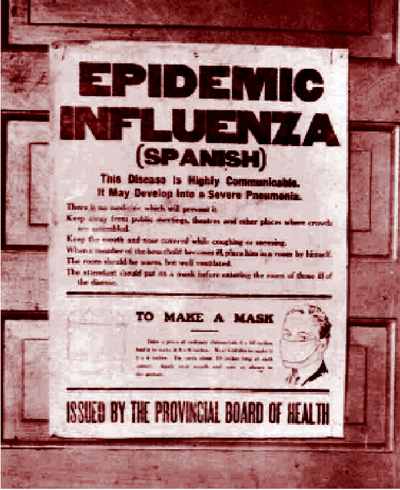
(Photo: 1918 flu poster, Idaho Observer, October 2005)

Veratect's Twitter Feed
James Wilson (Veratect) Blog

Houston Health and Human Services reported that a Mexican child died of swine flu while visiting relatives in the US.

A Mexican toddler died of swine flu while visiting relatives in the United States earlier this week, officials confirmed Wednesday.

The 23-month-old child died at a Houston hospital Monday evening.

A spokesperson for the Houston Health and Human Services Department said the child had been visiting relatives in Brownsville, Texas.

Dr. Richard Besser, acting director of the U.S. Centers for Disease Control and Prevention, confirmed the child's death from swine flu on Wednesday.

This sort of falls into the "technically, a US death" category. Young children are one of the two demographics hardest hit by seasonal, as well as pandemic, influenza. This toddler almost certainly developed the disease while in Mexico but succumbed in Houston while visiting relatives in Brownsville.

Generally speaking, news flow on swine flu seems to be down today. The Mexican health authorities have reduced the number of deaths confirmed to be from the flu from twenty to seven while upgrading the probable number of cases to almost 2500, more than half of whom have been hospitalized.

That ratio is probably significant. Everywhere but Mexico we're seeing mild (or at least non-life-threatening) cases, many of which probably wouldn't even be noticed if it weren't for the special surveillance associated with the pandemic risk. Certainly less than half of the non-Mexican cases require hospitalization. It's probable that there are many (many!) more Mexican cases which don't require hospitalization or which are so mild as to fly beneath the radar. In some ways, the more cases there already are in Mexico the better, because more cases means a more developed spread and a lower mortality rate. That's not a comfort for those severely afflicted, but it might suggest that this is a less dangerous situation than we might otherwise assume.
There's more...

Tuesday, April 28, 2009

"Containment is not a feasible option"

(Photo: 1918 flu poster, Idaho Observer, October 2005)

Veratect's Twitter Feed
James Wilson (Veratect) Blog

Cases
Argentina -- Ten suspected cases
Australia -- 70 suspected cases under investigation
Australia:Australian Capital -- Five suspected cases
Australia:New South Wales -- Five new suspected Cases
Australia:Queensland -- Six new suspected cases; total 16
Australia:South Australia -- 14 suspected cases
Australia:Tasmania -- One new suspected case
Australia:Western Australia -- Three new suspected cases
Austria:Steyr -- One new suspected case
Canada:Ottawa -- Five suspected cases
Chile -- Nine total suspected cases
Czech Republic -- One new suspected case
France -- Total of 20 suspected cases
Honduras -- Two new suspected cases
Hong Kong -- Four new suspected cases; Three of yesterday's dismissed
Israel -- Two confirmed cases
Mexico:Juarez -- Four suspected cases dismissed
New Zealand -- Four new suspected cases, three confirmed cases
Peru -- Five suspected cases dismissed
Poland -- Two suspected cases in Warsaw, possibly one additional
Spain -- Second case confirmed
Thailand -- One suspected case
Uruguay -- One suspected case
US -- Unconfirmed reports of 50 confirmed cases
US:California -- Two new confirmed cases; total 13
US:El Paso -- Four suspected cases
US:Michigan -- One new suspected case
US:North Carolina -- Two suspected cases in Buncombe County

Quick News
Australia -- Health officials may forcibly detain and disinfect suspected cases
Egypt -- calls to cull all pigs
Hong Kong -- "panic" buying of face masks & Tamiflu
Mexico -- UN inspecting swine production facilities
Mexico:Mexico City -- ~35000 restaurants closed or limited by government order

Travel Restrictions
Argentina, Japan restrict Mexican travel
Canada issues warning for "non-essential" travel to Mexico
US issues warning for "non-essential" travel to Mexico

News
Media Matters has a piece on how the right wing in America is trying to make the pandemic an immigration (i.e. racism) issue instead of a public health issue. And the conspiracy nuts are out in force.

La Gloria, which may be Ground Zero for this event, is a town of 3000 in Veracruz state which hosts a Smithfield industrial hog farm. There have been health concerns reported to the federal government since February. Smithfield denies any connection to the outbreak, but La Marcha in Veracruz headlined a story "Granjas Carroll, causa de epidemia en La Gloria". Granjas Carroll is a joint venture of Smithfield's in Mexico. They raise almost a million hogs at the La Gloria facility and there is some possibility that flies may have transported infected feces to the human population

WHO raised the alert phase from 3 to 4 yesterday, meaning that there is now "sustained human-to-human transmission". That's what was lacking in the Avian (H5N1) scare. Keiji Fukuda, deputy director general of WHO:
Because the virus is already quite widespread in different locations, containment is not a feasible option
Realistically, containment was never a sustainable option once the disease spread to any major city with a significant transportation hub. Veracruz probably would have done it: Mexico City was perfect.

What's it all mean? It's still an open question whether we're going to see truly widespread mass infection, much less widespread mortality. The serious cases in Mexico are dying but the cases seen elsewhere are so minor that they probably wouldn't be picked up except for the hypervigilance of health services worried about a pandemic. I expect that we'll see either a reduction in new cases or a bloom in the next month or less and that will tell us whether this phase of the scare is over. Even if new cases drop into the background noise, though, that doesn't mean we're out of the woods. The 1918-20 pandemic showed several distinct phases of activity, with significant mortality differences in the phases. We are in the longest (41 years and counting) influenza inter-pandemic of at least the last 160 years.

As so many things are, Modern Technology is a double-edged sword when it comes to influenza pandemics: it allows earlier detection, reporting, identification/diagnosis, and production of a vaccine; but it also allows the disease far more rapid transportation, sometimes in ideal environments (recirculated air, for instance) and faster reporting offers the chance for higher stress levels in the overall population, whether those stress levels are useful or not. In a world without mechanized transport, flu pandemics would have to spread more slowly, but we'd be much harder put to specifically diagnose, identify, and vaccinate against them.

There's more...

Monday, April 27, 2009

Mexican Flu Update

(Photo: 1918 flu poster, Idaho Observer, October 2005)


US:Colorado -- Ouray County possible case
Canada -- Eight cases nationwide
US:California -- 12 samples being tested in Santa Clara County
Australia -- Two suspected cases in Tasmania
US:South Dakota -- Two suspected cases both negative
Costa Rica -- Seven new suspected cases, totaling 21 suspected. Sixteen cases dismissed
US:Arkansas -- Health officials believe flu already spread across state
US -- Santa Cruz one suspected case, family member tested
Belgium -- Six suspected cases test negative
Australia -- Queensland activates pandemic plan
US:New Jersey -- Five possible cases
US:North Carolina -- unspecified number of suspected cases "involuntarily isolate[d]"
US:Idaho -- Four residents with ILI tested
US:Texas -- Dallas County confirms two new cases. State total is six
Switzerland -- Five suspected cases
South Korea -- One suspected case
Brazil -- Three suspected cases in Belo Horizonte
Netherlands -- "Rules out" any suspected cases
Singapore -- Two suspected cases test negative
New Zealand -- 56 suspected cases nationwide
Mexico -- 30 suspected cases in Jalisco
US:Texas -- School closure in Rio Grande City

WHO raised the pandemic alert level (phase) to 4
Swine flu factsheet from The Age
Swine flu cases and precautions around the world
There's more...

"It feels like the Apocalypse" as earthquake hits Mexico.

(Photo: 1918 flu poster, Idaho Observer, October 2005)

Jose Angel Cordova Villalobos, Mexican Secretary of Health, reports 149 confirmed dead and almost 2000 hospitalized cases of "grave pneumonia".

The news is moving faster than the web can track. Britain's Daily Mail, in a story datelined 6:26 pm today (about 35 minutes ago as I write this) reported Villalobos as saying 103 deaths and 1614 suspected cases. Keep your eyes on the Veratect twitter feed for up-to-date information.

To add insult to injury, a 6.0 magnitude earthquake hit about 150 miles south of Mexico City in Guerrero state, near Tixtla. No reports of injury or damage, but office workers poured into the otherwise empty streets of Mexico City as tall buildings magnified the earth motion. NBC says 5.6 magnitude.

Sarai Luna Pajas, a social services worker was standing outside her office building after the quake:

I'm scared ... We Mexicans are not used to living with so much fear, but all that is happening -- the economic crisis, the illnesses and now this -- it feels like the Apocalypse.
There's more...

NYTimes Flu Graphic

(Graphic: New York Times, Understanding Swine Flu)

Alongside the Veratect Twitter and Biosurveillance Blog, this looks like a useful tool for keeping up on what's happening with the Mexican flu.
There's more...