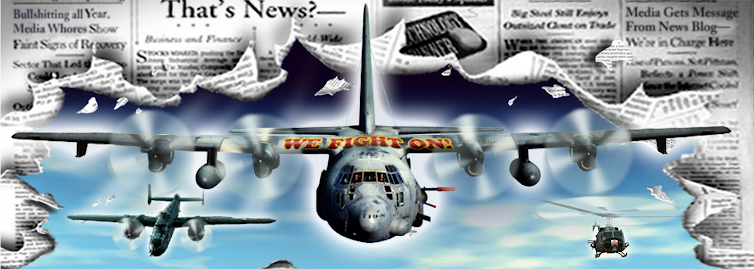
The Cost The United States of America spends 56% of total government military spending on Planet Earth, with a published FY2008 military budget of $623 billion* (in 2008 dollars). China is a distant second at 6% with an estimated 2004 military budget of $65 billion. The entire "Axis of Evil" (with Pakistan thrown in for good measure) spends barely 1% at less than $15 billion.
* This is the official defense budget, and does not include "supplementary" funding for the war(s). In 2006, supplementary funding for the Iraq and Afghan conflicts was just over $100 billion. Total supplementary funding over the Iraq and Afghan conflicts has been roughly $450 billion.
What does the US get for that $623 billion?
- 1,285,400* Army
- 642,766 Navy
- 217,600 Marines
- 705,200 Air Force
* Numbers include active service, mobilized guard and reserve, national guard, selected reserve, and civilian contractors
That's a total of just under 3 million men and women under arms, 5% (about 140,000) of whom
are immigrants. We spend about $210,000 annually per soldier or about $2000 annually per US resident.
The MissionIn the "early days of the Cold War", the US military was required to be capable of responding to
2 1/2 wars (e.g.: direct theatre-level conflict between NATO and the Warsaw Pact in Europe plus a similar war with China in Asia and a "half-war" with a regional state such as Vietnam). During the first Bush administration (GHW Bush, 1988 - 1992), General Colin Powell developed the idea of the Base Force, emphasizing
regional conflict over global conflict, and reducing the size of the standing forces. Between 1993 and 2001, the US military had an overall strategic objective of being able to fight two major strategic conflicts (theatre level wars) simultaneously. Since 2001, when Don Rumsfeld approved new "
terms of reference", the US military has been tasked with four missions:
- Defend US territory
- Prevent aggressors from taking hostile action for fear of US retaliation using forces staged outside the US in Europe, the Middle East, SW Asia, NE Asia, and the East Asian rim
- "Win decisively" one major conflict
- Conduct "small-scale contingencies of limited duration" in other areas of the world
If you compare the current scope of required military action with that of the Cold War, the US military has much less "on it's plate" now. The "one major conflict" (say, with Iraq) really matches up with the "half war" of the Cold War era, so we've taken two global sized wars off the table.
Historical Manpower

Obviously the US military has been growing smaller since Vietnam, with a significant blip upward in 2008 (unfortunately, I can't find good data right this moment for the last couple of years). Post 2000, it's logical to assume that some of the draw down is being taken up by private contractors (Blackwater, etc.).
Historical Budget
 (normalized to 2006 dollars)
Since the end of WWII, we see a variable trend upward in US military budget. It appears that there is a "normal" military budget of a bit over $300 billion with bumps for Korea, Vietnam, and GWII. GWI is a more diffuse bump -- possibly because we're seeing a substantial change in the military's mission and posture during the changeover to the Base Force.
No doubt, though, there's a huge jump in the last few years (once again, I don't have continuous data for the last couple of years). We are now at a post-WWII high and at nearly double the "normal" baseline.
Historical Cost per Soldier
 (normalized to 2006 dollars)
Equally obviously, the historical trend in the US is to increase spending on a per-soldier basis. This doesn't argue that each soldier gets paid this much or uses this much equipment, but demonstrates that spending is increasing faster than the size of the US military (which we see above isn't actually increasing over time except very recently).
AnalysisIn a business we'd look at these three graphs and immediately see something obvious: this company has a slight downturn in headcount, a large increase in budget and an overall increase in spending per employee. The hope is that we're seeing capital spending increases designed to improve productivity. An alternative might be that we're seeing a company retooling for a completely new function -- building planes instead of cars, for instance.
GWI was a fast war of maneuver, with tanks and helos and fixed-wing aircraft slicing decisively into enemy formations and destroying them. Rather like we imagined what we would do if
we went rolling through the Fulda Gap instead of the Warsaw Pact trying to. GWII started out the same way, and that phase of it ended the same way too -- with our mobile forces crushing everything they could find. This was what the US military was designed to do against the Soviets or the Chinese in one of those "theatre-level" conflicts of the Cold War. In a sense, GWI was the last hurrah of the Cold War US military machine.
GWII is the first hurrah of a new US military
designed by Don Rumsfeld, which uses
technology to increase "productivity" -- effectively providing the
same effect using fewer soldiers:
To maintain this position of strength, the Bush administration seeks to exploit US prowess in science and technology to ensure that American weapons, offensive and defensive, are always a generation or two ahead of those of any potential adversaries. This follows the thinking of US strategists who favour a "revolution in military affairs" (RMA) which aims to redefine war through the procurement of advanced weapons - self-guiding munitions, advanced satellites, airborne sensors, unmanned aerial vehicles (UAVs), robot-controlled gun systems, "low-yield" nuclear munitions and the famous NMD anti-ballistic system.
Unfortunately, the "revolution in military affairs" people forgot something:
technological improvement cuts both ways.
That's the background and some basic analysis -- sort of a primer of information you need at your fingertips if you want to talk about the US military.
There's more...