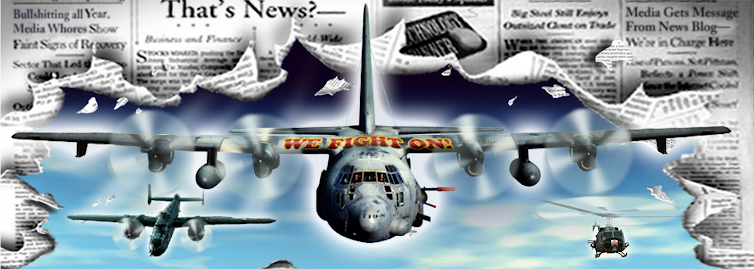

Riding Along In A Handbasket
Peace is a way of life, a series of cultural choices which build on each other long before conflict appears on the horizon. It's a life that America does very badly, if at all. We have been colonizers, genocidal artists, and bullies since the onset.
Even so, the Bush Years took this appetite for aggression to its ultimate extreme. We are now seeing, reaping, the results of eight years of no foreign policy aside from threats and belligerence.
You label an isolated, paranoid nation as part of the "Axis of Evil", you have to expect they'll live up to your smear. Male adolescent immaturity makes the roads a dangerous place to be, and is partly compensated for by higher insurance rates. Where was our version of State Farm when it came to dealings with other countries? Yep, I'm scared by North Korea exploding a bomb on Memorial Day weekend (no accident in that symbolism). But I'm just as scared about Pakistan having the capability we handed them. And more scared about the fact that Obama explicitly said he would not remove nuclear options from his playbook. We are the chief danger to the world, especially when we deny that fact.
Any approach at all is better than Rumsfeld/Cheney/Wolfowitz/Rice, et al. However, that's a ludicrous standard to beat. Obama and Clinton are both hawks. As my mother used to say, when it comes to militaristic roles in foreign policy, you could throw 'em both in a gunnysack and there's no tellin' which of 'em would crawl out first.
This is where we're going to need serious leadership of the liberal variety, not middle-of-the-road pragmatism. We have to push as hard as we can here, if we're to have any chance of bringing in future approaches which will not shy away from saying no to the Right in all its permutations.
Fear and distance are not environments where our brain's abilities shine. Start there, with your own visceral response. Clean house and get ready to help us think our way out of this mess. It's time for Something Completely Different.
-----------------------------
I woke up this morning remembering this poem I wrote. It's been published somewhere, can't find the journal title right now.
PERIMETER
The last two times we’ve slid to war
I was awake and saw it start
I watched alone, with just a cat
And wept in what I think was rage
I would have called on god except
God’s name was already in use
And I was pretty sure the chore
Was ours. Rage was no help at all
I did pray in those blasted dawns
For innocents beneath the drop
But also for the souls of those
Who made the choice to cause a death
My chance to sit at home and watch
Is luck, more than a righteous heart
We buy all honor with a myth
And if I lie down free of ghosts
As I close my eyes and stretch
My long-bone muscles into peace
I name my luck and pray for you
It isn’t much, but it spins forth
A filament from then to here
A rosined thread that god can pluck
A way out of the labyrinth
A bind I need as much as you
©Maggie Jochild, written 11:05 p.m., 8 October 2004

Monday, May 25, 2009
Riding Along In A Handbasket
Friday, January 16, 2009
Closure
(Holly Near singing "Two Good Arms" at the Philadelphia Folk Festival in 1987)
Closure
In 1977, Charlie King wrote a song about Sacco and Vanzetti called "Two Good Arms". The chorus uses lines from letters they wrote trying to prove their innocence, and the title comes from a phrase in one of those letters. Holly Near eventually recorded this song on one of her albums, but before that she sang it at concerts. As a teenager, I had read "Justice Denied in Massachusetts", the very famous poem about Sacco and Vanzetti by Edna St. Vincent Millay, who used her influence as a poet and Nobel Prize winner to try to keep these innocent men from being executed. I was devastated by this wrong which had been done before I was born.
Later, when as an adult I heard Holly's rendition of "Two Good Arms", I felt the same emotions of grief and outrage come up in me. I was singing along one day when my daughter, still very young, came into the room. I had tears on my cheeks and my voice was pulsating with feeling. She asked me what the song was about. I hesitated, but I told her. She begged me to say Sacco and Vanzetti had not been killed, that no one would have coldbloodedly sent them to their death. I saw, in that moment, the reality of capital punishment land in her consciousness, the immorality of killing to punish murder. I wanted to take it back, to give her a chance at living in a world where we had other methods of dealing with extremely damaged people.
(Photograph of a protest against the Briggs Initiative organized by the Metropolitan Community Church, located in their "In Our Own Words" History Project -- date, location, and photographer unknown, but likely 1978 and Bay Area)
When I moved to San Francisco in March of 1978, I immediately plunged into radical political organizing. There was a lot to choose from, but most of the lesbians I knew or wanted to know were focused on two main issues at that time: Defeat of the Briggs Initiative (Proposition 6), and defeat of expanding the death penalty (Prop 7).
The Briggs Initiative would have removed gays and lesbians from school teaching. The way it was written, it was also a club that could have been used against straight teachers, and that angle was successfully exploited by the grassroots work of Lesbian Schoolworkers (the group which got my attention) and BACABI (Bay Area Coalition Against The Briggs Initiative). The mainstream gay organizations (predominantly white, male, non-working-class) put everything they had into defeating the Briggs Initiative. But when it came to the death penalty effort, I found myself surrounded by working folks, people of color, and/or political dykes.
The preceding June, two-thirds of California's electorate had passed Prop 13, which began the decline in California's school funding that continues today. For the past few years, measures against lesbian and gay rights had been passing in state after state. These were the first lapping wavelets of conservative rise to power, portending a tsunami (Ronnie Raygun) on its way. It's important to remember they were trying out several planks: Hate queers. End public funding of essential community services. Build more prisons and kill more prisoners. This is an interrelated ideology, and taking on only one of their toxic tentacles made no sense to me.
On the evening of 7 November, 1978, I and my friends were part of a huge crowd on Castro Street listening to the election results come in. When it was clear Prop 6 had gone down, a massive party began. But I didn't join the celebration. Prop 7 had vastly expanded the death penalty in this newly adopted state of mine, golden California, the land of freedom and promise. I went home, crawled into bed, and wept.
Prop 6 was defeated by 58% of the electorate. An almost identical percentage voted for the death penalty expansion. I had a lot to think about. (Matthew Shepard)
On the morning of Sunday, October 18, 1998, I attended Meeting For Worship at the Friends' Meeting House in Austin, as I did most Sundays. Worship was silent for the first half hour that morning, with no one rising to speak. I was sitting on the south side of the room so I could see the trees out the high windows on the north wall. But I was also in a perfect position to see the face of a young man I'll call Sullivan (to protect his confidentiality) when he rose from his chair opposite me to speak during the second half of worship.
His standing created an immediate air of anticipation in the room. Sullivan was openly gay, partnered with Antonio, another man in meeting; they were both admired for their hard work. I had never seen Sullivan speak in Meeting; indeed, I'd seldom heard him speak anywhere. He clasped his hands that morning, but I could see they were shaking. He stared at the floor for a minute, gathering himself.
Six days earlier, Matthew Shepard had been murdered.
I'll do my best to repeat exactly what I heard Sullivan eventually say, in a strained, halting voice:
"It's been a hard week...When I heard the news, I wished Antonio were home. I had trouble waiting for him to come home, so we could talk. Finally, I did what I often do when I need help. I opened the Midrash and began reading.
"I turned to a section about when the Israelites fled Egypt in search of freedom. When they fled across the Sea of Reeds, in a way opened by Yahweh, the Midrash tells of how the angels in heaven were gathered around G*d, watching the events unfold. They were filled with fear as Pharaoh's army came after the Israelites, chasing them into the gap, closing on them. But when the Israelites reached dry ground and the waters behind them closed over the chasing soldiers, all the angels broke into gleeful celebration. As they cheered and danced, one of them noticed that G*d was sitting slumped, tremendous sorrow on his face. The angel asked 'Why are you not happy that Your people reached safety?'
"G*d replied, 'How can I be happy, when My people are drowning?'"
Sullivan stood a few seconds more, as shock reverberated around the room, then sat down, twisting his hands together. More than one of us burst into tears. (Curved Corridor, Island No. 3, Ellis Island 1998, gelatin silver print by Stephen Wilkes)
Last June, a divided Supreme Court ruled out use of the death penalty in this country for anything except first-degree murder, even child rape. The New York Times article reporting the decision stated it was "the third in the last six years to place a categorical limitation on capital punishment. In 2002, the court barred the execution of mentally retarded defendants. In 2005, it ruled that the Constitution bars the death penalty for crimes committed before the age of 18." The article went on to insist "there was no suggestion from the majority that the court was moving toward the abolition of capital punishment." Not from this Supreme Court, no, I wouldn't expect a movement toward joining most of the rest of the world in re-examining the meaning of justice and punishment.
We are, for the time being, still held sway by John Walsh notions of retribution, of seeking some amorphous definition of "closure" when violence intrudes into our personal lives and takes away something irreplaceable. When I hear family members claiming they want the death of someone who murdered one of their own because it will bring them "peace", I always suspect they are mistaking closure for denial. If a murderer is dead, it's easier to shut away the emotions and thoughts attached to the murder. The problem is, capital punishment not only doesn't work as a deterrent, not for most of the people who commit murder -- it actually, over time, creates a culture where we are desensitized to the value of human life.
I know what it is to live with this kind of loss. I myself have felt homicidal in response to seeing irreparable damage and death of those I love, administered by the hands of people who need to be stopped. But I hold myself to a different standard, and I'd like to live in a society where our highest goals are perhaps beyond our everyday reach, yet we do not abandon them as goals. (Hammer and Nails glass sculpture by Hans Godo Frabel)
Several years ago, I was close friends with a couple of dykes who were building their own house on 70 acres near Hamilton Pool, west of Austin. They lived hand to mouth and were in dire need of other carpentry-skilled hands to help them, so they created a series of weekend workshops to teach women the basic trade, in exchange for a small fee and the chance to camp out on their land. I signed up for one weekend, driving back and forth each day because it was hotter'n'hell and I liked to sleep without fireants around.
Also, to be honest, it was a vegetarian weekend, with one woman attending whom the rest of us called The Vegan Cop behind her back because she was so militant about trying to govern the eating habits of others. Friday afternoon, on the way out there, I'd passed by a favorite barbecue joint and stopped to buy two chopped meat sandwiches with a big RC and a side of slaw -- eating my dinner in advance so I could fore go the uncertain potluck later. After I'd eaten, I got worried about my breath smelling like carne, and had brushed my teeth beside my car, drawing the stares of cowboys in pickups.
Each workshop involved a special project, and our weekend task was to build a large deck on a rocky ridge overlying the Pedernales River valley. Late afternoon on Sunday, we were to the point of nailing down the plywood decking, having completed the frame, steps, and railings. Laney, the main carpenter, had instructed us to drive the nails fast and hard, with the intention of making the nail head bite down into the wood on the final blow, leaving nothing to stick up above the level surface. There were about a dozen of us spread out over the large deck, whaling away with great volume and vigor, an exhilarating end to a hard-working weekend. I had started a nail and kept my spread hand on the wood next to it, a couple of inches away for safety. But I allowed myself to become distracted by the conversation of a couple nearby, whose incessant bickering made it fairly certain they were in the throes of breaking up. My brain, without my direct guidance, decided what I really wanted to do with my right-handed hammer swing was connect to my left hand instead of that measly nail. The blow came down on my left index finger with all the force my biceps could muster. The end of my finger burst like a ripe tomato.
It didn't hurt for a few seconds. The shock was in the appearance. I held up my finger stupidly and said to the nearest woman, "What happened?"
She was a clipped-of-speech butch who worked as a prison guard. She said "Put something cold on it" and went back to hammering. When I didn't move -- her sentence didn't really make sense to me, I was in such shock -- she got up irritably and went to the nearby cooler. But all the ice had melted, and the only thing left was a Pepsi in a can. She brought that back to me and said "This is still cold, hold it again your finger."
As if sleepwalking, I did what she said. It didn't help, and contact with the ruptured flesh finally registered as pain. I cried out "Oh my god, oh my fucking god." This got the attention of others, and Laney rushed over, her back and breasts covered in sweat, her workpants stiff with sawdust.
"Come on" she said. "Let's walk you back to the house." She helped me stand and led me gently through the mesquite, a direct path instead of by the dirt road, so we'd get there faster. Once we were out of sight of the work crew, she stopped and lifted my chin, looking kindly into my eyes.
"That must hurt like the end of the world" she said. "You don't have to pretend to be all tough with me, and those other butch wanna-bees can't see you now, you can let go."
I did. I promptly dropped to the ground and began wailing as if I was three years old. She was startled, but squatted beside me and rubbed my neck as I cried my heart out. When I was done, I felt better and worse -- I wasn't in shock any more, but the throbbing in my finger was all-consuming.
At the house, I washed the wound myself and bit onto a towel while Laney poured peroxide over it. I should have gone to an ER and gotten stitches -- the scar is still very visible and utterly numb -- but I didn't want to do it by myself and no one else was available. She wrapped a thick bandage around it and recommended I hold my hand in the air, to keep the swelling down. When the others arrived for dinner, I sat a little apart, afraid someone would jostle me, while I picked at my tofu pasta salad. Before it got inky dark, I left, determined to drive home. I don't remember the trip. In particular, I don't remember negotiating the two bob-wire-and-post cattle fences I had to get out and open, drive through, and loop shut again before reaching the main road.
The next day I tried to work but could not type, of course. My supervisor, a buddy, sent me home but first he explained to me about the concept of closure: How if you don't tell the brain what to while you are in motion, and if it does not have muscle memory to direct it, the brain will search for closure on its own. What it knew best was where my other hand was, so it closed the circuit for me. He said this is why when you stub a toe, you'll often keep stubbing that same toe: Your mind is now hyper aware of an injured part and if you don't pay attention while you're walking, closure will involve making contact with that wounded part of the body again.
It was a great lesson. Ever since, when I've begun doing something new with my body, I've reminded myself "closure" which means "pay attention, or else some other part of you will be making the decisions". (Homecoming by Herlinda Spahr)
When one becomes a pacifist, an opponent to the taking of human life under any circumstances, it's not a final destination you reach and set up a comfortable home. It requires constant thought and work to stop wearing your sword.
The airwaves are now filled with stories related to the US Airways story: 150 passengers, 3 flight attendants, and 2 pilots walking away from a controlled crash landing in the Hudson River. It's pre-empting everything right now, including (and seemingly especially) Bush's departure. More than one blogger has pointed out it's a return of the wheel, with implicit redemption offered, i.e., fratboy fuckup allows terrorists to fly planes into New York's most vigorous symbols and never catches the perpetrator behind it, instead using all his power and influence to dismantle the economy, military, and culture whose best qualities were what the terrorists objected to in the first place. (Like he forced hugs on all those Katrina victims.) But now, with hope standing in the wings, we return to what us most proud about being American: Competence, genuine compassion (not the mealymouthed judgement-poisoned kind of conservatism), and community response.
I agree, we're responding as a culture to the symbolism. One literary/arts blog (Dykes To Watch Out For) has a fascinating thread about how many of us are weeping over this story without clear comprehension. But I think the relief and catharsis we're experiencing has its roots much farther in time. I'm remembering the jeering campaign slogan Reagan used for re-election: Are you better off than than you were four years ago?
It was shocking to hear this coming out of the TV screen. It was a dogwhistle for the middle class (and those who aspired to it), who wanted to claim moral superiority over dirty working people whose obvious failings (not being white, not being married, not being Christian) were what was keeping them/us from individual financial prosperity. It was permission to begin the polarizing hatred that is the ultimate conservative weapon against dismantling pluralism, tolerance, and shared prosperity -- which the fundies hate every bit as much as Osama Bin Laden does, and for the same reason (terror of modernity).
[In a related vein, I recommend you read Sara Robinson's essay at Campaign for America's Future on how Their use of the phrase "moral clarity" does not mean what we mean when we say it, found here.]
After catharsis, we have an opportunity to think freshly about the nature of the world and our place in it, as those passengers on US Airways Flight 1549 are undoubtedly doing this weekend. What will justice and closure mean for us, as we click shut the door on Bush? I for one make a distinction between punishment (tempting as that is) and accountability. I'm willing to give up on holding accountable all those of you who voted for Bush, once or twice. You're already being punished for your mistake, and though it is likely whatever you're suffering is not as severe as those in other parts of the world because of his having been granted the power to shit on the planet, still, I'm hoping for more learning to come out of this nearly incomprehensible mess. For me and for you.
I'm not willing to relinquish accountability for those who sought public office, however, and claimed our trust. When I separate out the feelings that push me toward wanting vengeance -- when I assert my intellect and deny my lizard brain the right to make decisions (beware your fingers) -- then I'm clear: Only those who still dream of a place in the system as it was would be deluded by the "hope" that perhaps we can leave the culprits free to go on doing more of what they've already done. I believe in rehabilitation, but it must be demonstrated, not declared as an intention. Or, as we say in 12-step circles, action not words. And, since we're dealing with the spree of a dry drunk, that is especially apt.
Real hope resides in a vision which steps outside of the system as it has existed and seeks complete disclosure of all that has remained concealed, with a belief that we'll know how to respond when we have that information. Restore transparency, fully empower investigation, and trust our process (our once and future process) to set us back on the path of being a force for good in this world. I do believe everything else will follow, if we begin there. The wheel will turn again without a jarring lurch, because for me, closure is remembering all which has happened without letting pain determine my future place on the spinning rim.
Tuesday, September 16, 2008
My (Tardy) Self-Introduction

My (Tardy) Self-Introduction
James Taylor was on Good Morning America live at the Red Lion Inn in Stockbridge, Massachusetts today. He sang "Sweet Baby James" and drew a roar from the crowd at the line you can all guess. I once got to sing that same line on a visit to two dear friends while we were on "the turnpike from Stockbridge to Boston". He talked about how he had written "Fire and Rain" within a few hundred yards of where he was sitting 40 years ago almost exactly.
"Fire and Rain" is possibly the most important song of my adolescence. When I was 14, I wrote my first book, an extremely bad sci-fi effort called "The Invasion". My second book, at 15, was an attempt to combine The Catcher in the Rye with S.E. Hinton, and I named it "Sweet Dreams and Flying Machines" after a line from "Fire and Rain". (In pieces on the ground...) It was also an atrocious piece of writing, although it would probably be successful as a "pretty white kids with problems" series on the CW, and I can see in it subtle hints of what would become my real voice decades later.
James Taylor and Carole King were the songwriters I listened to every day. Aside from them, there were the three J's (Joni, Judy, and Joan), Linda Ronstadt, the Supremes, Gilbert O'Sullivan, Janis Ian, and Aretha Franklin. Mostly I gravitated toward what was called, in the sexism of the times, "girl with guitar", although there was the occasional guy with guitar. Like James. Because I ran around with a group of teenaged boys, I of course heard Steppenwolf and The Doors on our 8-tracks, and my little brother was a complete head-banger. But I preferred lyrics and melody over noise.
As I watched sweet baby James sing this morning, filled with the unrequited yearning of a 14-year-old, the camera panned the crowd -- mostly grey-hairs like me. But one of them held a sign up to the lens: Alaskans for Obama. And the decades fused a complete circuit, the tail of the lizard found its mouth, and I felt a jolt of energy.
Jesse asked us newcomers to GNB to write an introductory post, telling you who we are. I'm very late in fulfilling this request. Mostly I didn't know where to begin, where to find ground not already covered elsewhere. Almost all the writing I do is autobiographical. I can't seem to create without memoir and elegy folded into the process. I think that is my poor white Southern legacy infiltrated with lesbian-feminist honesty: Speak for yourself, own where you are coming from, but make a good story out of it.
Here are some pieces: I've never once voted for an increase in police or prison spending. I've never once voted against a tax increase. I voted for Shirley Chisholm and Jesse Jackson, making this the third time I will cast my vote for an African-American for President. I never believed a single word Ronald Reagan uttered. I was not taken in by Bill Clinton's rhetoric, either, but I did believe he would more liberal than he turned out to be, which left me with a permanent cynicism, exhorting me to value action over speechifying. (Well, I also learned that from recovery programs: Action, not words.)
I am not an addict but a lot of the people I've loved the most have been and I think addiction governs our culture.
I am the only member of the family I was born into who is still alive.
I began writing poetry at age nine, the same season that I came out to myself as a lesbian (in 1965). I kept both identities to myself until I was a teenager, when the writings of lesbian-feminists reached even my extremely rural North Texas county and gave me a reason to keep from killing myself. I have never had sex with a male. I've had a lot of good, often extraordinary sex; when I went into recovery from being an incest survivor, I overcame sexual compulsion and learned trust, which made sex simultaneously much better and no longer a driving force in my life.
From the age of eight or nine months until four years, I lived in Kolkata, India. I began speaking English (with a slight British accent) and Hindi at nine months. I spent my days on the streets of Kolkata with Nilmoni, the woman hired by my parents as my ayah (nanny). Nilmoni had gone to school with and remained close friends with girls who became sisters in the Missionaries of Charity order during those mid 1950's years. We followed them around as they (including Mother Teresa) fed the poorest people on earth, bathed them, tended lepers, and lived among them as human beings. It shaped me in ways I cannot describe. When I was four, my parents gave up their overseas job to return to deeply racist 1959 Southern Louisiana, where I discovered who my real people were supposed to be. As we slowly sank back into poverty (though not Kolkata style poverty), I decided saving my family would be my life's work. I was badly misinformed about my own resources, but in many respects it was still a good decision. I failed at it, of course -- you cannot save anyone but yourself. They are all dead now, and I have myself to save still, which I do with joy and anticipation on a daily basis. It turns out that saving myself involves loving the world, so I'm back to square one.
My mother Jo as a teenager during World War II fell in love with another girl, her best friend, and intended to spend her life with Mary Nell. When Mary Nell succumbed to lesbian panic, Mama decided to stick with men because "they couldn't break my heart". She was wrong about that -- there are more ways to break someone than through heartstrings, and my father found them all. She warned me against lesbianism when I was 17 and about to persuade my high school history teacher to leave her husband for me. I ignored Mama, embarked on a five-year relationship with the woman who was the mother of my daughter, and became a parent at age 17. The parenting decision was one of the smartest things I ever did.
During the 30's, I found out that Mama's mother, Hettie, had also been in love with a woman, Nora, who was a distant cousin. Nora moved away from the same county where Mama and I went to high school, went to the city and found a job in an office during 1918. Hettie couldn't find the courage to follow, and instead eventually married Bill, my grandfather, because he was a decent guy who made her laugh. She died when Mama was not quite a year old, and Bill died a few years later. Mama was orphaned at the beginning of the Depression, but found a good home with her aunt and uncle. Her siblings were not so lucky, and landed in terrible situations.
Thus, I am third generation lesbian. I do not, however, believe this is genetic. I absolutely do not believe sexual preference is in our DNA (not ANY version of sexual preference). I believe culture shapes us, and not only reconfigures our brains as we go along, but also rewires our DNA in a single generation -- a belief being born out by epigenetics. I find tremendous hope and political power in this reality.
Likewise, I believe gender is a construct, just as race. For every behavior or tendency we in our view claim is "masculine" or "feminine", you can find a culture in the world where, at some point in time, those things were identified as the opposite on the gender binary. This either means that those other people were not "real human beings" or that what we think as gender-linked traits are entirely mutable. The latter is what makes sense to me, given that the history of humanity has been tinkering with identity expression in every way possible. I believe biological determinism is a viewpoint born of despair, and it arises during times of severe repression as a popular excuse for giving up on radical (at the roots) change.
I think America was founded on institutional racism and classism, as well as gender exploitation, and in order to create a genuinely free society, we have to be willing to examine and alter every single truth we hold most self-evident.
My people arrived at Jamestown in 1609. Since then, every generation in my lineage has been Southern, and most of them have been poor. (I am a genealogist, I've dug deep.) I claim my mother's worst fear, poor white trash, with humor and pride. In every one of the 12 generations we've been invaders and eventually children of this soil, I've located ancestors who had visions of liberty and peace, who did whatever they could to improve the world around them. Their efforts created me, and I don't think I'm unique. I speak for my people, and hope to lead them to redemption. During my early 20s, living in San Francisco, I carried a gun with me in my pocket most places. I expected the revolution to break out at any point, and I intended to be a footsoldier in it. Within a few years, however, the Quakers got their hands on me, and I slowly became a pacifist. I trained myself to listen. I came to understand, in a new way, the meaning of Che Guevara's statement "At the risk of seeming ridiculous, let me say that a true revolutionary is guided by great feelings of love." I stopped being a separatist, I returned to Texas in order to work among my people, and I returned to deism after three decades of atheism (although I keep complete respect for all those former states of being and have no desire to "convert" others.)
I also became slowly, increasingly disabled, poor, and isolated as a result. But my voice as a writer expanded.
There's volumes more about my story available at my blog or in my poetry, if you're interested. I'll close with the event that pushed me over the edge into pacifism, a possibly apocryphal story told in Quaker circles: George Fox, the founder of the Society of Friends, was approached by William Penn, who helped bring Quakerism to the United States. Many of the Quakers in Pennsylvania and the Carolinas (among whom were my ancestors, including the Boones) were increasingly finding themselves wanting to join the armed struggle which would soon become the American Revolution. The cause was so right, so necessary, they felt it overwhelmed their pacifist beliefs. Penn wondered what to tell these people. Fox's reply was that they should "wear your sword as long as you are able". The meaning in this was that if you are still able to be seduced by a cause into taking up arms, you might as well admit it and be true to that part of yourself, rather than assume a false pacifism. Genuine pacifism alters you so completely that you are unable to wear a sword under any circumstances.
To live by any ideal, including pacifism, means thinking far ahead and anticipating what challenges will come at you, what structures and beliefs you must put into place now so you will have the resource to deal with those challenges. It means building from the ground up and living as best you can in the new structure. When I lay down my sword, I entered a new vulnerability which has informed all my decisions since. To quote Terry Galloway, "It's a good life if you can stand it."


