Showing posts with label Memoir. Show all posts

Tuesday, September 7, 2010

What's Going On


I am great in emergencies. I not only can think of the right thing to do, I can instantly come up with a creative solution particular to that crisis. I have been through serious car wrecks where I was the rescuer, blood stauncher, counselor, and advocate all at once, on the spot. I once found the emergency kill switch on a Sears escalator when a toddler riding on it got his foot caught and mangled in the stair-fold mechanism, holding that child and keeping his mother from hysterics as we waited for the paramedics. (Which is why I avoid escalators now.)

I think much of my skill comes from growing up poor. You face the unfaceable and stay thinking or things go much, much worse for you. I count as my kind the folks from the Cypress Street Projects, one of the poorest and "most dangerous" neighborhoods in Oakland, who poured out of their homes when the 580 freeway beside them collapsed onto itself in the 1989 Loma Prieta quake. They assembled makeshift ladders, ropes, anything they could use to clamber up 30 feet of concrete pillars into the narrow gap where crushed cars filled with screaming people were starting to burn. By the time official first responders were able to find a way to the wreck of a roadway, those folks from the projects had already saved most of the survivors, getting them to relative safety, comforting traumatized children, giving drinks of water, starting to joke about how scared shitless they had been. Nobody took their names or did a news feature on these heros, because they were too poor, too black, some of them too clearly high and pissed off. But I know what they did and how they did it. It was much like any other day, really.

But as well as being a child of my origins, I am also a class traitor. I have sought out and absorbed the intelligent remnants maintained by other classes, I have loved and made allies across the divide, and one thing I have learned is that living in adrenaline mode kills you fast. So when I have a breather, even if it is only ten seconds long, I have tried to take it, make the most of it.

Thus, after the paramedics hauled away that sobbing toddler and his mother from Sears, with her looking beseechingly back at me as if I was part of their family and should be accompanying them, I had to sit down on that Berkeley sidewalk because my legs would no longer hold me up. I sobbed and shivered violently, letting myself feel what I had just witnessed, "processing" as my little brother Bill would say with such intense scorn. Bill who died at 42 because the male raised-poor approach finally ran out of any rope at all.

I began running out of rope myself in 2005, and as resource after resource dried up, I eventually, finally, became hopeless. A few folks hung in there with me, although nobody knew how really bad it was for me. Now the pendulum is swinging the other direction, and I am (tiredly, dutifully) using my out-of-immediate-danger time to face how close to immolation I came. I'd much rather eat sugar and watch Youtube and write cryptic poetry that doesn't pass my own Tell test.

But living to be old means I clean up what I can when I have a chance. And the trail of mess goes all the way back to infancy, to betraying my mama by admitting how she failed me, to betraying my family by telling their nastiest secrets, to facing those of you who are clean and educated and making good choices with the hope that I am worthy of you choosing me, too. Fake it til you make it.

Because sometimes you can't save yourself, and you'll have to say yes to others crawling through the debris to reach you. And you have to love yourself to say yes. Loving yourself is the ultimate revolution. You can't do it and live in fear or isolation.

And, you know me -- I write about it as I go along. Tell until your lips are chapped, that's my credo. Thank you for listening.
There's more...

Thursday, May 20, 2010

The Maryland Club Coffee Can Story


During the young years of their marriage, my parents moved often to small towns all over Texas and Louisiana, following my father's job. They had some money then, driving a late-model Chevy and using their vacation time to journey even more, visiting family here and there. But my father refused to shell out for restaurant food, so my mother packed sandwiches, pickles and pie to last the trip.

Daddy also hated to stop except when the car needed gas. He believed learning to "hold it" built character. Once my older brother passed the diaper stage, however, Mama pointed out a toddler simply wasn't capable of controlling their bodily functions for four hours at a stretch. Daddy's soluton was an empty Maryland Club coffee can in the back floorboard, that could be emptied at the next gas stop.

This practice was put to an unexpected test on a trip from Houma to Bowie when my parents were driving my grandmother Sook back home after an extended visit. Sook had a short fuse for nastiness, as she called it. When my brother had to use the can that afternoon, it turned into a #2 voiding, Mama assisting him in the back seat.

But it was winter and with the car windows rolled up, the odor from that can spread throughout the car. Sook, sitting in the front passenger seat, demanded my father find a place to pull over so it could be emptied, and my father kept refusing. Finally Sook rolled down her window, they thought to freeze out Daddy and force him to comply. Daddy set his jaw and ignored her, focusing on speeding up to pass a tractor-trailer rig.

Sook showed surprising agility by leaning over the seat, grabbing the offending can, and pivoting to hurl its contents out her open window without splashback. Unfortunately, she didn't notice the tractor-trailer rig now to her right and far enough behind our Chevy to take all of the coffee can's load -- so to speak -- full on the truck's windshield.

"Oops" said Sook. Mama, who told this story often, swore she would never forget the truckdriver's enraged face as he spit out his Skoal and pushed the accelerator to the floor while taking his first swerve at the Chevy. For the next half hour, Daddy tested the combustion ability of that newish car engine while Mama clung to my weeping brother and Sook leaned out the window trying to convey her apology via a sign language that Daddy said the truckdriver clearly interpreted as further derision.

They were finally rescued by the appearance of a rare hill on that two-lane blacktop, which slowed down the rig enough to allow Daddy to get far ahead. At the next town, he dove deep into a residential area and located a gas station on the outskirts, where everyone in the car used the facilites and Daddy restored his shot nerves with an unfiltered Camel followed by a bottle of Coke with Tom's peanuts poured into the neck.

After that, Daddy stopped when we had to go the restroom. He grumbled about it, but he pulled over.
There's more...

Friday, March 12, 2010

Breaking The Fast

(I wrote a shorter version of this after midnight today at my Facebook page, but decided to bring it here because processing through my recent near-death is what has stopped the dark-of-night panic attacks: Memoir as noticing what is good in the present moment.)

I was reading Konagod's blog just now and his jonesing for french fries because it's been over a week since he had solid foo. I thought to myself "I went 10 days without food during the gut explosion incident." I had to go look at a calendar to make sure I wasn't mythologizing myself.

I got a grocery delivery the early evening of Sunday, Oct. 11. I was anticipating its arrival because I was hungry, had gone more than a day without food, because I had no money and no way to go get food on my own. The first thing I did was sit down and eat a handful of tortilla strips with some spinach dip and a glass of orange juice -- enough to give me quick, healthy energy. I saved the rest of my hunger for a real meal and began trying to haul the bags of groceries to my kitchen. That is when the final hernia rupture took place. I left perishables on the dining room floor and went to lie down from the sudden pain, hoping it would subside as it had before over the preceding year.

And, of course, the reason why these episodes of severe abdominal pain and vomiting had gone untreated by me for a year is because I had no insurance, no money to pay for an office visit or even to get transportation to a health facility. I didn't know what was wrong with me, had guessed it might be my gall bladder and so was trying to address it with a diet revision. I had not an inkling that it was two hernias slowly extruding through abdominal muscle and strangling my colon -- nor of the carcinoid tumor sitting like a time bomb in my appendix.

Lying down didn't help. I began puking every 15 minutes, and at midnight gave up on working a shift that night but couldn't get to my computer or phone to call in. I had water and gatorade by my bed, and tried to stay hydrated by sipping at it periodically, but vomited back up anything I swallowed.

Things get hazy after that. All my memories are of agony in the dark, but it couldn't have been dark all the time those two days. I know for a fact that I called EMS at 2 a.m. on Wednesday, Oct. 14, and since I had to get to my phone anyhow, I composed an email to Jesse giving all my passwords, emergency info, etc -- don't know how I did that, either, but the email is there.

I think I called Jesse, too, but I don't remember talking to him. Somehow I found and put on clothes that were nearby. I couldn't get to underwear or my shoes, so I greeted the paramedics without those items. Didn't have my wallet, either, but I was on sheer mercy by that point. The only thing in my pocket was my front door key. I didn't say goodbye to Dinah. I had no idea I'd be gone three weeks -- time had stopped for me.

Why I finally called the paramedics, instead of dying in the dark, is that I prayed to my mama. I had been trying to find a position where the pain would let up just a fraction, enough to give me a minute of rest. I think I said out loud "I'm in trouble this time, Mama. You gotta help me." And instantaneously the pain got much, much worse. I interpreted this as her saying "I can't help you, you have to ask somebody else." So I did.

I was at the ER by 3 a.m., where the angelic Lisa gave me Zofran and Dilaudid, erasing my agony within seconds. I remember being transferred to the 2nd floor only because of the nurse who was there, who kept calling me baby girl. That nurse is who tried to pass a nasogastric tube through my right nostril. Her attempts were not working, and when my right side was bloodied amd she was switching to my left nostril, I took the tube from her and did it myself. A feat I'm not likely to ever repeat, but it earned me a lot of street cred on that floor.

The NG tube began pumping out copious amounts of green gunk, more than seemed possible. I had an internal lake of backlogged bile from my halted alimentary canal, and removing it vastly helped my nausea. But they decided to let that process have a little time to work, keeping me on a push IV. The NG tube and oyxgen began drying out my mucous membranes. I remember I had five tubes and/or monitors in me because Jesse and I joked about me being "Five-Line Girl".

They gave me a tightly rationed amount of ice chips as my mouth and lips dried out. It became difficult for me to talk, and my lips began cracking. I wanted liquid, but I was vehemently not hungry at that point. It was fine with me if I never ate again. Eating meant vomiting. You never quite appreciate the miracle of your digestive system until it completely quits on you.

I had a couple of Dilaudid days because I also can verify I didn't have surgery until the early morning of Friday the 16th. I have a crystal clear memory of being prepped in the surgical suite, the older and extremely competent nurses around me, feeling beyond fear because it was get fixed or die. I also remember waking up, a calm dykey looking nurse telling me "All good, you wanna call anyone?" and me moving my body to see if there was any pain, but she was right, it was all good. More ice chips until I passed gas, then had a BM, which took three days.

The dryness of my mouth started making me miserable despite the Dilaudid. I was also hallucinating my ass off for a couple of days, which I kept to myself, not even telling Jesse. I saw ghosts in my ICU room 24/7, walking in and out the walls, and I decided they were hallucinations, not real ghosts, because one of them was a little girl in a long dress and a bonnet but that hospital was too modern to have an old-fashioned ghost like that, so it was all in my head. They were some sort of company and I didn't mind them much.

Once I started having BMs, though, the ice chips and IV were not enough, I was craving water, milk, juice, soup. It was on Wednesday the 21st that the tech finally got permission to give me something besides ice chips. Veronica, that was Veronica, I adored her. Hard-bitten and expert, teased me a lot because, as she put it, I was the only one in that ICU section who wasn't out of my mind. She came into the room holding a massive rainbow-striped popsicle, all artificial colors and fake sugar, the kind of thing I'd never buy for myself. But it looked like glory at that moment. She unwrapped it for me and I took one bite, then moaned, which embarrassed us both. She sneaked me another one before her shift ended.

I got sick of the popsicles within two days, so it was at least another two days before I got progressed on to lemon jello for a day, then finally beef broth which was truly excellent, they made it from scratch there in a real kitchen. Anyhow, it was 10 days without anything but ice chips, and another five days before I got the beef broth. But I was on Dilaudid most of that time, which makes it a lot easier, Konagod. You have my sympathy fer sure.


[To read Jesse's posts here as this all unfolded, beginning on October 14th, read Maggie Jochild In Hospital For Major Abdominal Surgery and then proceed forward. Eventually I was able to write as well and Jesse took those posts as dictation, got them up for me. Then Liza sent me a netbook at the hospital and I was back online -- that netbook is my lifeline in bed now, is what I use to write this and everything else. I have food and meds, rent and utilities, only because people send me money each month. Most days, I find joy in being around. Thank you for keeping me.]
There's more...

Tuesday, January 26, 2010

The Quality of Meter


(Splash photo by Paul Hoksenar)

One of my most prized possessions is a complete collection of Shakespeare that was given to my mother as her high school valedictorian present by her book-loving father, the year before he died. It was printed as World War II raged, and hence it demonstrates the paper and ink rationing of the times: The pages are tisue-thin, the print reduced, the margins scant. But it is still elegant and compleat, and Mama found room to underline or make comments in her copperplate handwriting, using peacock-blue fountain pen ink in delicate lines.

I began reading from it every night when I turned 12 and we moved to Brasil, with no TV and either the volumes on our shelves or a few English-language murder mysteries in the bibliotecas all we had as print material. Long after my parents were asleep, I'd lie in the tropical swelter of my room, watching the geckoes in each corner who kept mosquitoes at bay, flipping between lines of iambic pentameter to footnotes and glossary, trying to suck out all the meaning he packed into each phrase. A good way to cope with hormones hitting my bloodstream like galloping mares.

I once heard that the average English sentence produced in everyday conversation by a native speaker tends to run ten syllables in alternating beats. In other words, iambic pentameter sounds like "ordinary talk" to us -- overlay metaphor and epic ideas, and you've got poetry no one can forget because it settles into the grooves of our brains.

I wonder if that's still true any more.

The ratio of allowable Twitter characters to allowable Facebook characters is 1:3. There is no poetry in that decision. The only way around mathematically brutal elision is to cheat by adding a picture or link -- fodder for the ADD crowd who will actually go to prominent writers' blogs and complain about having to read "paragraphs."

So Mama's generation understood how to retain the entirety of a thing while avoiding waste. How would we now reduce the following to a FB friendly discrete chunk -- and what feverish possibilities would be thus lost for a future pubescent looking for doorways to the world?

The quality of mercy is not strained.
It droppeth as the gentle rain from heaven
Upon the place beneath. It is twice blest:
It blesseth him that gives and him that takes.
Tis mightiest in the mightiest; it becomes
The throned monarch better than his crown.
His scepter shows the force of temporal power,
The attribute to awe and majesty,
Wherein doth sit the dread and fear of kings.
But mercy is above this sceptered sway;
It is enthroned in the hearts of kings.
It is an attribute of God himself;
And earthly power doth then show like God's
When mercy seasons justice.
There's more...

Tuesday, November 10, 2009

Focus, Trinity

(Bill David Barnett, age 2.5, and Maggie, age 5, trailer park in Pecos, Texas, summer 1961)

Today my little brother Bill would have turned 51.

Which means he's been dead almost 9 years. Can't quite understand that.

He was waiting for health insurance to kick in at his new job: We'd watched how medical costs had starved our family when we were kids. So instead of being saddled with a "pre-existing condition", he lay down alone on that green-and-white striped couch and watched TV as a heart attack rolled on into cardiac tamponade and he bled out into his chest.

Universal health care for every human being, no questions asked, without profit linked to medical choices. Now. Get rid of any leader who caves, no matter what other distractions they toss up. The alternative is ongoing pointless death.

[Cross-posted at Meta Watershed.]
There's more...

Thursday, November 5, 2009

TOO LONG FOR TWITTER AGAIN

(Maggie and Nilmoni cropped from larger photo, 1958 Kolkata, India)

Too long for Twitter, again: Dinah prowled and wailed every half hour all night long. I'd call to her and she'd come at a trot, need extensive contact to stop vocalizing. I had an endless fount of reassurance. I can hardly take in how painful this separation must have been for her. Finally, mid morning, she slept on my chest and then slept two feet away on the bed. Whenever I noticed her eyes opening, I'd tell her how much I love her, need her, missed her.

I found a long-lost cat toy near my bed, which nearly broke my heart -- I can imagine her trying to bring it to me, only to remember I was gone. We played with it for a while. Also have had regular dispensing of treats. Despite her food bowl being empty, she's not lost weight, and she's eaten from the refilled bowl but not ravenously. I think she figured out the big bag of cat food here by my desk was not sealed tight and helped herself, which is a relief.

Early afternoon the news about the shootings at Fort Hood broke into Rachael Ray locally and I followed that off and on, except when KBH or Chris Matthews were on the screen. I can't access wifi in my bedroom on my little netbook and don't have a cord to reach into my study where my main PC is, but at the moment the solitude -- or rather, being alone with Dinah -- is still an enormous pleasure. I need to sleep and dream a lot more. Scenes from Ginny Bates, past and not yet written, keep breezing through my head. They are some kind of palate cleanser for the hospital experience, I think.

I am lucky as Myra (the main character based on me in Ginny Bates, who wins the lottery as well as love). I know much of my luck has faces, names, heartbeats. I am reminded of the poem by my bed, written about in a post of mine at Meta from March 2008:

THE UNDERTAKING

The darkness lifts, imagine, in your lifetime.
There you are - cased in clean bark you drift
through weaving rushes, fields flooded with cotton.
You are free. The river films with lilies,
shrubs appear, shoots thicken into palm. And now
all fear gives way: the light
looks after you, you feel the waves' goodwill
as arms widen over the water; Love

the key is turned. Extend yourself -
it is the Nile, the sun is shining,
everywhere you turn is luck.


(by Louise Glück, from The House on Marshland)

(Dinah above my computer, May 2005)
There's more...

Wednesday, November 4, 2009

Going Home Today

(Mary Jo Atkins Barnett and Maggie, 1955, passport photo for going to India)

When I woke up from the RT shakiing my shoulder at 7 a.m., the Roches were singing in my head "We're going away to Ireland soon" with muted glee. It's been three weeks today since I was admitted, and I cannot account for a lot of that time. My Narrative has defiinitely been interrupted. A lot of memories wade in and out like scenes from a bad 60's "message movie".

Everytime I think about getting out of here, my chest relaxes a little and I breathe better. It will be hellishly hard on my own but no one will be opening my front door without my choice, and no more small talk, which is to conversation as WalMart is to small town main street commerce. Pajamas and keyboard, that's enough for me. (grin)

One thing that has emerged as my attention returned is that my attraction to folks who are looking for a place to tell their troubles has spread up and down the hall, apparently. I'm a better listener than I am storyteller, but at home I have a stopcock to control who dips into my well. Yesterday I earnestly told Erlinda, the tech of techs, how much everyone here admires her quick learning and leadership. She was clocking out for the day, but stayed at my bedside for half an hour to tell me what it was like raising her three abandoned nieces the past 9 years. Honestly, it's a tale I'm honored to have heard, altered my appreciation for others ever upward -- but what is it I do that inspires others to confide in me? In Erlinda's case, I wanted to hear. Otherwise, I am not even watching the daily reruns on cable of "Grey's Anatomy" -- my own body and midstream ordeal is swallowing the lion's share of my focus right now, and as Stuart Smalley would say, "That's okay."

Yesterday as I was warshing up (as one tech says it), I examined the altered corpus Maggie carefully. The blown IV sites and JP drain scab will go away entirely, I think. But the contours of my front are permanently rearranged -- large capstone bulge gone, everything listed to the right, and a wicked ruck from just below my breasts through my navel like the Hayward Fault when viewed from Mount Diablo. There'll be no problem saying "Yep, that's her" if I wind up mangled on some CSI slab.

Surgeons go directly to the source of an issue and tend not to deal with the aftereffects. This is seen as more efficient, as all versions of Henry Ford compartmentalization are now revered as most productive. I always question this ethic but especially now, as I hear the muttered resentment techs have toward nurses (who say "call a tech" for ass wiping) and the sullen obeisance nurses display toward doctors who breeze in and out far more obliviously than even the most gritty TV drama depicts. When we added making a profit to the work of caregiving -- and especially Reagan's permission to be greedy as an America ethic -- we created the monster that our government is currently too feckless to tame.

Thanks to Jill Cozzi, by the way, for reminding me of the excellent meaning of that word, feckless.

In contrast, a Quaker man, Sean Carroll, is arranging for a CarShare to get me home after my discharge today, since he doesn't own a vehicle. He's already done all the shopping I need to be safe-ish at home , except for the correct size diapers, which will arrive via FedEx tomorrow -- although at least 1/3 of all American women weigh 200 lb. or more, this hospital doesn't stock diapers that go beyond that size, nor would they research finding them for me. Thank g*d I was alert enough and able to get online to meet my own basic dignity needs.

You know, lesbian-feminism of the early 1970s is where I first encountered the concept of political correctness, and it's never been a joke to me. At bedrock, political correctness is about striving to express respect and kindness according to cultural values which may vary from the ones you were raised with. Respect, privacy, pluralism: arch enemies of the fear-based Right.

I don't know why, but for the last 24 hours a particular memory has been popping into my head, as it did just now. It's my first memory, and occurred when I was around one year age. We were living in Kolkata and I was out for the day with Nilmoni, my ayah. We were in what my mother called a rickshah, which was in fact a horse-drawn cart with a single horse. We turned into a street clogged with a mob. Nilmoni began shouting at the cart driver to get us out of there, but we were already being surrounded and horses have to be turned, there is no reverse gear. I was in her lap, held tight, and she put one hand over my face to block my vision. I tugged at her fingers ineffectually, then discovered if I opened my eyes I could see between her slightly spread fingers. I went still, watching with interest.

The crowd was all Indian, which was normal to me, I thought I was too. It was all male, and they were angry, but I wasn't worried because I was with Nilmoni. They were holding aloft, above their outstretched arms, two items: a round of bread and a man, passing them toward one side of the street. The man was struggling, wild-eyed, shirtless. It was intriguing to see an adult passed around as easily as I was.

At the side of the street was a two-story building with outside stairs to an upper landing. The stairs had no railing but the landing had a wooden frame around it. A rivulet of the mob swirled up the stairs and the flailing man was passed upward from arm to arm. Someone on the landing had a rope which was tied to the porch. As the man reached the landing, the other end of the rope was knotted around his neck. With a roaring surge, matched by Nilmoni's shrieks at our cart driver, the shirtless man was thrown over the railing in a small arc. He slammed against the side of the building and a seond later reached rope's end. He scrabbled frantically at the stucco wall with fingernails and feet to find a purchase. Before he could, our cart finally turned out of view. I tried to turn my head to watch but Nilmoni held me fast.

I didn't understand what had happened, and there is no negative emotion in this memory, only excitement about curious adult behavior. It is vivid -- the bright sun with dust in the air, hoarse shouting, Nilmoni's smell, and the look on the face of the shirtless man, his dark sweaty skin and the visible ribs on his torso. Years later, when I was six or so, I began telling my mother about the memory to ask her what it all meant; I thought of it often. She sat down heavily in her kitchen chair, her face horrified, repeating "My god, my god."

She knew the incident. Nilmoni had told her about it when we got home that day. They were both reassured by their belief I hadn't seen anything, and did not want to discuss it with me. Mama said the man was from the untouchable class, still a strong practice in 1956, and he had stolen the round of bread.

Now I have two versions of the memory, my original and the unspeakable horror of what actually occurred as Mama gently explained it to me later.

Sorting out this cacophony we call life takes up all our time. I'm going away to Ireland soon, will be home tonight, and can resume my sift in solitude. Aching, incontinent, exhausted, in a mess of a house, but with just me and Dinah to accommodate. There is peace and wonder to be found in any situation, even death, they tell us. I'll write again as soon as I can.

The Roches singing "The Troubles" in 1983

[Cross-posted at Meta Watershed.]
There's more...

Sunday, November 1, 2009

Happy New Year


(Trail through grass, photo by R. Planck -- my current desktop image.)

In the house of long life
there I wander.
In the house of happyness,
there I wander.
Beauty before me,
with it I wander.
Beauty behind me,
with it I wander.
Beauty below me,
with it I wander.
Beauty above me,
with it I wander.
Beauty all arround me,
with it I wander.
In old age traveling,
with it I wander.
On the beautiful trail I am,
with it I wander.


In the culture of the majority of my ancestors (Scots, Welsh, Irish), today is the New Year. Here in Central Texas, it is Dia de Los Muertos. Since I am bound and cannot go even to Friends Meeting, I am repeating the Dine morning prayer to myself and contemplating the treat of a bagel for brex. If they'll let me have it and if it comes with a schmear. Onion or garlic if I'm very lucky.

I was at Shungopovi for the Antelope Dances the last time I spoke with my mother. I camped on Second Mesa and had to drive a ways to find a phone to call her. Something unexplainable happened that day at the dances; I try to write about it but can't tell it right. The next day I went to Canyon de Chelly, and the following afternoon she died in the blink of an eye, finally having escaped my tether.

I don't know the connection yet, but since awakening that old Alix Dobkin song "OKOY" has been playing in my head:

Maybe time alone will soothe our bones
And clo-o-ose the wounds


I'm angry that I don't have the language of my ancestors, maybe Gaelic has tenses or vocabulary to tell the stories lodged in me. I'm angry at how far the the edge I slid, toward my mama and brother's path despite swearing to myself (and Martha) that I would not. I'm angry that my values and choices mean poverty in this culture, and that poverty is not simply limiting but interpreted by institutions and much of Christianity (founded by a man who chose poverty) as dishonorable.

I'm angry about Steve Gilliard's death on a whole new level, as if he were my little brother.

I'm right at the edge of being able to go home and fend for myself. A man with whom I sat in Friends Meeting here for decades, Sean Carroll, contacted Jesse to help me in town. He has been shopping for the DME, household supplies, and good food I'll need to return home -- using money y'all sent. He doesn't own a vehicle but keeps borrowing one or arranging for CarShare to run errands, and has offered to be my ride home when I am discharged. He is bedrock that arose from the waves. He keeps thanking me and Jesse for the opportunity to be of service.

I know how he feels, that's the thing.

I'm terrified about how hard the next two months of recovery will be, even as time and good will closes the ruptures of this year. The only way to face it, this new year, is to remember I walk in beauty and to rest in the altered manner taught to me yesterday by Heather the PT -- who also grew up poor and decisively called me on what Mama always said: "Use it up / Wear it out / Make it do / Or do without." A bad adage when it comes to bodies, although the poor and working classes often have no choice about it.

I just stopped to order breakfast -- yes to the toasted bagel with cream cheese.

I am the only person left to tell the stories of my people in a way so they quilt together with your own stories. I was born and raised to do this. I'm not done yet. Narrative may be our most persistent delusion, but it's how we recognize one another in the dark and this introvert really does want to be with you all, as long as I can have a room of my own too. More to come.

[Cross-posted at Meta Watershed and Group News Blog.]
There's more...

Monday, August 24, 2009

Too Long For Twitter, Part One

(Agate Beach at Patrick's Point; photo by Neil Mikulenka)

In 1978 or 1979, I first went to Patrick's Point State Park near Trinidad in Northern California. It's one of those spots where I instantly felt connection to the sacred. Later I learned it was, indeed, an ancient gathering place for the Yurok people, with whom I have some sort of inexplicable deep connection. Their name for it is Sumig, which was translated to me roughly as the place where the spirit of dolphins went to die when human beings began to populate the earth.

I returned to Sumig as often as I could, and had lots of wildlife/nature experiences there. It's where I also developed a consuming fear of sasquatch. But the story I want to tell today is about when I went with my friend Mary, who had come to visit me in San Francisco from Texas. Mary was/is deeply spiritual, beginning as a Christian Scientist and proceeding through a number of ideologies, including rebirthing and Sai Baba. Each of her new belief systems was authentic and fascinating as she embodied them.

Our second day camping at Sumig, we went for a hike along the cliffs, intending to walk down the extremely steep trail which led to driftwood-stacked Agate Beach and, if you went on along the strand, to Agate Lagoon. Halfway down the switchback trail, we looked out at the Pacific and saw three or four California Grey Whales directly approaching the surf off the beach.

We stopped to gape and wonder what was happening. Only ten yards off shore, one of these whales turned parallel to the waves and began rolling in the wash, seemingly helpless in the surf. I cried out "Oh g*d no, they're beaching themselves!" and began sprinting down the trail. Mary followed on my heels, with her camera.

A few other bystanders had gathered on the beach, and had come to the same conclusion. I stood there in agony, unable to bear the prospect of watching these magnificent animals die before my eyes -- no doubt because of some human-induced interference with their normal function. I turned to Mary and said "I'm going to save them."

"What do you mean?" she asked in alarm.

"I have to try to communicate with them" I said, unbuckling my overalls. "If I put my hands on their side and send images via energy transference, maybe I can get them to swim back out to sea."

Mary had a fit, declaring I would instead be crushed beneath them, I was insane to think I could mind-meld with a whale. But I kept stripping, taking off my Vasq boots and asking Mary to look after my small black dog, who was shivering in the cold wet wind. The other bystanders took a few steps away from me but watched avidly. Mary finally gave up trying to talk sense into me and got her camera ready.

I had stepped into the frigid water, wearing only my Rubyfruit Jungle t-shirt and a baggy pair of cotton underwear, when we heard shouting from the trail. It was a park ranger, running our way at full speed. I stopped and returned to the relative warmth of the sand. When he reached us, he was out of breath and had to lean over, gasping, for a minute before he could speak.

"The whales -- they do this -- they're not beaching" he said, staring at my hairy legs. "There's a steep underwater bench right there, rocky. They come in to scrap off their sea lice."

Mary had to sit down, she was laughing so hard. I began donning my overalls. The park ranger asked "What the hell were you about to do?"

I didn't answer, but Mary told him with what I felt was unseemly pleasure. He laughed, but also took down the number of our campsite. He said every time the whales came in during their migration to use the local facilities, as it were, he had to rush for the beach to keep visitors from going bananas. He added that I was the first to think I could wade out and save them.

Maybe it's a lesbian thing. There's an unnatural preponderance of us among marine biologists.

That night, over our campfire, Mary and I had a long, not-quite-acrimonious fight about our respective approaches to nature. I was carrying with me everywhere a set of guide books that I'd bought, to not only birds and trees but berries, ferns, shells, a walking library. I was forever stopping to (1) use my asthma inhaler and (2) look up the name of whatever I had just seen. At that point in my life, and in particular as a lesbian-feminist, naming was an act of power I could not stop myself from performing as often as was possible.

Mary felt I was missing out on the moment, on experiencing nature as it presented itself, without names or scientific background. She thought someone who believed they could talk with whales through their palms might try ditching the guidebooks and commune with salal berries on a more primal level.

We were both right, of course. It needn't have been the argument that it was, except we were both at a time in our lives when our approaches to things had distinctly diverged, we loved each other and wanted to be together, and we were not quite old enough to let the difference sit as a richness in our connection.

A few years later, my mother died and I came into a deeper comprehension of Mary's approach to the world. Some things make no real sense, even named, and you have to accept them as is.

But the power of naming is still important for us to retain, to not relinquish this power to those who use it to maintain the imbalance which all but blinds us. Language is the tool we use most often to convert information given to us by our senses into metaphor, and our brains only learn through metaphor. I think dreaming is our nightly sorting time, when our brains feverishly hold up everything we experienced that day and says "Now what does this remind me of?" before stashing it away in a drawer of memory. (Well, several drawers of memory, since every experience gets divided up into many bits that only our individual synapses know how to reconstitute again into a single memory.)

Thus, I just spent three hours creating a series of names for the fish eaten by characters in my current sci-fi novel, on a waterworld where English is no longer the dominant language. Because names matter, the words we use shape how we see things, like it or not. And having acknowledged that, I can try to move beyond the terms to an imaginary landscape where the names lose relevance again.

So long, and thanks for all the fish.


[N.B. The first poem I wrote after my mother died is titled "Naming", and it's much better as a journal entry than poetry. But if you want to read it, it's here.)

There's more...

Wednesday, August 5, 2009

Mama's Giant Leap

(Footprint on the moon, July 1969. Photo from NASA. Click to enlarge.)

I can tell you in detail what I was doing this morning 40 years ago. It's the recent Moon Landing anniversary, and other hallmarks, which make it possible to be so precise. Plus my freaky memory, of course.

The previous Christmas, we had returned from a year in Aracaju, Brazil to spend holidays with family in North Texas and Southern Oklahoma before leaving for another year on my father's overseas contract, this second year to be in Singapore. The week between Christmas and New Year was spent in Stoneburg, Texas, where my mother (and many generations before her) had grown up, in the home of her adoptive mother, my grandmother Zura. Zura was in her 80s by that time, living alone in a crumbling farmhouse, and I think that is the reason my mother decided we -- her, me and my little brother Bill -- would stay in Stoneburg through the spring semester while Daddy went on to Singapore, taking his time in finding us a place to live.

Staying with my grandmother was not a good idea. She was hard to get along with and her house, for example, had no hot water. My parents were lucky to discover that a house kept by the local school for teachers was not occupied that semester, and its fence actually abutted my grandmother's land. In fact, she and her husband had built it as two-room cabin during the early 1900s. It had been modernized and expanded, now with three bedrooms and most conveniences. Daddy bought a load of cheap furniture with his overseas bonus, we moved in, and he happily took off for Singapore.

I was not happy with this plan, although I wasn't looking forward to going to Singapore, either. I thought Stoneburg was a hick town and at age 13 I was sick of hearing from every stranger I met that I was the spitting image of my mother. But that school and that place turned out to save my life and shape me inexpressibly. I had deep roots there I'd never really felt before -- a lot of the kids in school were distant cousins. There were a few extraordinary teachers, and the school was so tiny -- an average of 8 students per class -- that teacher attention was very available.

In my 8th grade class, that first day, I met a fat boy with yellow hair and light blue eyes who introduced himself as Loren. It turned out, not only were we related, but his mother has been my mother's best friend all through school, and his grandfather Tobe had been my grandfather Bill's best friend all their lives, including through World War I. Loren and I were basheert. By April, he had confessed to me that he thought he was gay, and I had confessed back to him that I only liked girls. We promised to stick by each other, marrying each other for cover if we had to.

A month before the end of school, I came home one day and, sitting on the counter of that rent house while Mama did dishes, I asked her if there wasn't a way we could stay in Stoneburg so I could go all the way through high school there. I pointed out moving around during high school had really messed up my older brother, and this way she could be close to her mother. Since that high school was also where Mama had graduated valedictorian, and her mother ditto before that, she wanted to give me, her beloved daughter, an equal chance.

But not going to Singapore at all was not something my father would tolerate. It would mean divorce. It would meant splitting up our family. I didn't know that when I asked it. I didn't know it until only ten years ago, and I found it out accidentally in a conversation with Daddy, who never put the pieces together for himself. Just as well.

Mama decided to stay in Stoneburg. I was thrilled, and as soon as school was out, I began spending much of each day at Bowie Lake with Loren and other friends. I had a crush on a girl who was giving me signals back. (She eventually became my first lover, but that's another story.) Mama was told by the school she had to move out of that rent house, and the only other dwelling available for rent in Stoneburg was the old Holihan place, barely habitable. It had one bathroom, accessible through what would be Bill's bedroom, and all its water came from a windmill. Which meant if the wind didn't blow (which it often does not during Texas summers), we'd run out of water. There was no heating, not an issue at the moment but a real problem come winter. There was also no air conditioning. But it was in Stoneburg, and that's all I cared about.

Mama had been hoarding the bonus money Daddy left with her for the spring and our travel to Singapore. She hired some teenaged boys to move our furniture, spent days cleaning up the empty old house, and shelled out for a window unit to go in her room at the front, which was really the living room. Our TV was a used 10-inch black and white, and our car was a rattletrap aged Buick meant to last us only a few months.

So, Mama, Bill and I watched the Moon Landing in the old Holihan house, volume up loud to compete with the shuddering air conditioner, huddled together on her bed despite the heat because it was so incredible, so impossible. Mama cried and cried.

But the other reason I wanted my body in contact with her is that she had been complaining of chest pain for almost a month. She said it was indigestion, and she was not eating regular meals with us. She looked pale and seemed to often have trouble breathing. I was starting to get scared. She wouldn't go to the doctor, said it would pass. What I didn't know is that we only had enough money to last, sorta, through the end of August. In August she'd have to tell Daddy we weren't coming to Singapore at all, not just staying in Stoneburg for the summer but permanently. She'd have to tell him she was leaving him.

The previous November, the Beatles had released their White Album. I couldn't afford to buy a copy, but I had borrowed it from one of my new friends and played it incessantly. Unless you were a teenager during that time, I don't believe you can comprehend the revolution each new Beatles release caused in our collective and individual psyches.

I was especially mesmerized by "Ob-La-Di, Ob-La-Da" because there were lines in it (a mistake which was retained by John Lennon) hinting at gender role reversal. You know: "Desmond stays at home and does his pretty face" while "Molly has the children lend a hand." There were worlds of possibility in that simple flip.

So, on this morning 40 years ago, I was sitting in my hot bedroom, also at the front of house, with broken windows covered by cardboard and holding only a bed and dresser, listening to my record player (on the dresser) scratch out "La-la-la-la life goes on." Mama knocked at my door and came in with her hands held behind her back. I grinned at her, turning down (but not off) the music. I'd been expecting her ever since I woke up. It was my 14th birthday.

But her face looked ashamed, underneath the grin. She started with telling me what a blessing I was to her, how my birth had been her reason for existence. I liked hearing it, but I began getting scared again. Then she said there was no money for presents. She would make me a chocolate cake --

I interrupted to tell her, as I had other times in my life, that I didn't care about presents, what mattered was being with the people I loved. (My g*d, how true that has become, now that I don't have any of them any more.) I got up and went to her, hugging her. I wanted to stop the pain I saw on her face, and I didn't know how.

She pulled from behind her several books of S&H Green Stamps, 11 and a half, to be exact. She'd been saving them ever since we got back from Brazil, only shopping at stores that gave them out free with a purchase. She told me there was some neat stuff in the S&H catalogue and I could order anything I wanted, 11 books was a decent amount.

She and I both knew she was lying. The stuff in their catalogues was mostly poor people crap, or for grandmothers, and 11 books would not get much. Maybe a mass-cast plaster statue of the Pieta, or a plastic tablecloth in a flower print. But I made a production over the stamp books, thanking her and hugging her repeatedly. She cried then, and even now, it fucking kills me to remember the look on her face. If there is one moment in time I could go back and erase, that might be it. Erase it from her memory, not mine. Her humiliation was (and remains) unbearable.

Working class and poor kids will do almost anything to rescue their parents' dignity. That's why we have such a headwind against us, dealing with generations of conservative hate among the lower classes: To acknowledge your parents were dupes and dead wrong about most of that they taught you, it's asking someone to betray family. Often family that's no longer around.

I stayed home from the lake that day, looking through the catalogue and watching soap operas with Mama on her bed. I eventually ordered a card table, which I said I needed to write on in privacy. And, in fact, I did write on it, all throughout high school.

The next week, school started. Bill and I had no new clothes, and last year's notebooks, but I acted like it didn't matter to keep Mama from feeling bad. (It did matter: Starting your freshman year, even in that forgiving school, wearing a dress from last spring that was too small -- it was tough. Nobody said anything, which made it worse.)

After dropping me and Bill off, Mama drove ten miles into Bowie and finally went to the old drunkard doctor who, with his brother, also a drunk doctor, offered the only medical care in half the county. He was sober enough to immediately call an ambulance and had her rushed to the hospital. She'd had a massive coronary at least six weeks before and was now in the process of dying.

A neighbor woman was standing in front of the school when I got out. She told me Mama was in the hospital with a heart attack and my Aunt Sarah had been called. Aunt Sarah was Mama's older sister, lived in Dallas, and she was figuring out a way to track down Daddy. The neighbor woman said me and Bill were to stay with them until Daddy got back, and there was no use for us to go visit Mama because she was unconscious and in the ICU. They wouldn't let us kids in.

I slept in a twin bed that night with this kind woman's 10-year-old daughter while Bill was put on the couch. I'd rather have shared the couch with Bill. We were both scared mute. The next morning, we were given breakfast and driven to school, where everybody was very nice and didn't have any reassurance that could penetrate.

Aunt Sarah didn't drive, and her husband, my Uncle Stuart, was a traveling salesman currently out on the road. She had a daughter at home, my cousin four months older than me, and a grown daughter already married. Still, somehow, Aunt Sarah got from Dallas to Bowie that day, and she told the neighbor lady to bring us to the hospital no matter what once school was over.

It was a tiny hospital. The waiting room was only an alcove with a single couch, no TV. Aunt Sarah apologized to Bill, whom she adored, that he was too little to possibly go in and see Mama. She promised we'd be back soon. She hooked her arm through mine and began pulling me down the hall.

I was terrified to see Mama, honestly. Aunt Sarah whispered to me "Let me handle this" and added "She's not waking up. She's going to die if she doesn't wake up." Nurses tried to stop us but Aunt Sarah literally pushed them aside like a blocker and shoved me ahead of her into the room where Mama lay. Mama was grey as ship paint, her mouth gaping open, her eyes closed. There was no door to shut out the nurses, but they gave up and said only "Five minutes."

Aunt Sarah took my hand and put it on Mama's hand, below the vicious-looking IV. Mama was cold and clammy. I wanted to pull away. Aunt Sarah leaned in to Mama's face and said coaxingly "Mary Jo? Jo, Margaret's here. Margaret needs you, Jo. Wake up and look at Margaret." She motioned me in, and I imitated her, saying hoarsely "Mama? I'm here. I love you."

Be damned if her eyes didn't flutter open. She looked horrible, unfocused, in pain, but she said my name and then asked after Bill. I told her where we were staying, that we were just fine (lie, lie, lie), and at that point nurses flooded in, realizing she'd regained consciousness. We were pushed out of the room, Aunt Sarah yelling over her shoulder "Hang on, Jo, I'll bring her back tomorrow." Triumphantly, we returned to Bill and Aunt Sarah pounded my back with a clenched fist, saying in a grim whisper "I knew it would work. I knew you could do it." Then she began crying, something we'd never seen her do before. I had no clue what to do except sit beside Bill and tell him Daddy would be home soon.

As if that was going to help. Mama was the one who kept everything going.

But two days later, Daddy was back, and in the meantime, Mama had started to rally. Aunt Sarah got me in for daily visits, more or less living at the hospital, I guess. The doctor told Daddy he couldn't move us around any more or it would kill Mama, and I think Aunt Sarah plus Uncle Stuart (who arrived by the weekend) backed that up. Daddy sold his small amount of company stock when he gave notice and bought us a house trailer, which we parked on family land in Stoneburg. And I finished high school there. Despite Daddy's fury at having lost his chance to leave us all behind, despite Mama having two more heart attacks, despite coming out with a terrible, abusive lover -- despite all that, those years in Stoneburg were the making of me.

When Mama finally died, 14 years later, I sat next to Aunt Sarah at the funeral, my arm locked through hers again, counting on her to keep me from dying of a broken heart. After it was over, back at the house, she put one hand on each of my shoulders and, looking intently into my eyes, she said "I'm your momma now."

There is no substitute for the loss of a mother like mine. But I accepted Aunt Sarah's offer as very much the next best thing, and I leaned on her non-stop until she died on 16 July 1999. I miss her, like Mama, every day. Especially this unendingly hot, painful summer.

Lalalala, life goes on.


(No video, only stills of the Beatles, but the song is the point anyhow.)

There's more...

Monday, June 22, 2009

Matchless Valour

Wind In The Willows four friends preparing to retake Toad Hall
When I was in fourth grade, our beloved teacher, Frances Wilmeth, told us about a new program which would provide free school lunches for anyone who needed them. In that small South Texas town, each grade in elementary school comprised an A class and a B class totaling about 60 students altogether. The A class held whatever white children there were (around 8-15) and Latino children who were not from migrant families, who had arrived at first grade able to speak some English, and/or were the children of "important people". All the other Latino children were in the B classes.

Yeah, it was that overt.

Children who registered for first grade without being able to speak English were held back for a year to be taught by an elderly white man whom every one of us knew was the meanest teacher in any grade. We heard him screaming at his kids all day long, interspersed with whacks from his wooden ruler on terrified small hands and shoulders.

My family, new to town, was at the very bottom of the white social register. This meant one of the unspoken rules that we cling fast to our whiteness, not associate with any brown children, and try to prove our worth by being "good poor". Mama herself was conflicted by these pressures, facing ends of month (each month) when there wasn't quite enough to feed us, and her not eating didn't close the gap. I responded by becoming anorexic, which only upset her more. My only refuge was in books and learning. This made me a favorite among teachers, not so much other kids.

We ate mostly beans and rice at home, whatever vegetables Mama could grow, lots of macaroni and homemade red plum jam which I complained about but I'd give anything for one of those jars now. These sorts of meals didn't translate readily into lunches Mama could pack in a metal box. (This is before the days of Tupperware.) Bread, bologna and bananas cost money at the grocery store. Thus, each Monday morning was a tinderbox of tension as Mama tried to find enough change to send us off with the 1.20 cents it cost to eat in the cafeteria for a week. My brothers stayed out of her way. I didn't. I was already making the choice to allow her to dump on me rather than face our situation alone.

Once every two weeks, Daddy came home with a paycheck and, usually, steaks or chicken he'd bought along the way. I didn't enjoy those feasts, because I understood instinctively what came out of his pocket for the steaks would have to be made up by us after he was gone.

So, Miz Wilmeth's offer of free lunches arrived like a hand from g*d. I carefully folded the mimeographed sheet she handed out to every one of us and took it home after school with enormous excitement.

Mama was in the kitchen, trying to make rice and beans into something different. She was a consummate cook, and often succeeded. I stood out of her path and opened the hand-out. "How much money does Daddy make each month?" I asked. "Is it less than $250?"

"Shit yes" said Mama, distracted, giving a bitter laugh. Then she realized who was asking and focused on me. "What do you have there?"

I began explaining. I can still recall my extreme joy: I'd found a way to help. Painfully skinny and shy, asthmatic, only nine years old, I was at last going to be able to contribute something to the survival of my family.

She snatched the sheet from my hands and read it swiftly, disbelief on her face. "This is about that goddamned government program Johnson signed off on!" she shouted at me. "This is charity, do you understand what charity means? Ever la-di-da shitass in this town will be able to spit on us if we take charity!" She ripped up the paper and threw it on the floor. "Don't you EVER bring home one of these goddamned forms again, you hear me?"

However, by the following year, the school had become smarter in handling the issue. Not only were free lunches offered, but also free breakfast and a free mid-morning bottle of milk. Families were given a form where they could apply for a "discount", and enough folks did that there was no longer such a stigma attached to it. Furthermore, it was done privately, at the principal's office, not through the teacher collecting lunch fees at the start of every Monday.

The difference this make can hardly be described. Kids stopped falling asleep in class by 10 a.m. Boys having fist-fights virtually stopped. Test scores climbed. I'm crying as I write this, because it is graphic proof of how much hunger there was in that small town, and how many children were suffering.

In fifth grade, we passed from everybody's favorite, Miz Wilmeth, to the care of Eula Farmer, who was reputed to be strict but fair. That is, those of us in the A class did. All the B class teachers were allegedly mean and bad-tempered. Miz Farmer was as tall and lean as Miz Wilmeth had been short and round. She was grey, hair color, eyes, clothing, even her skin seemed to be slightly metallic. But she was a fabulous teacher, it turned out.

She worked us hard in the mornings. After lunch and a raucous recess, however, she had us lie our heads on our desks and she read aloud to us from a book. I think she probably instituted this practice after decades of teaching hungry children who might have had their first meal of the day half an hour earlier and needed a chance to let their systems crash in relief.

Some of the kids did, in fact, take a nap on their desktops, without shame or reprisal. But a lot of us lay with closed eyes listening to Miz Farmer's surprisingly expressive voice take us magical places. That first semester, she read us The Wind In The Willows. It remains one of my favorite books of all time. The second semester, she read us Magnificent Joe and made blazing animal rights activists out of us all.

But back to The Wind In The Willows: I imagined the four friends, Ratty, Mole, Badger, and Toad, as leading the kind of all-one-gender unmarried lifestyle I dreamed of having one day. Messing about in boats, having picnics, keeping each other in good spirits. They had plenty to eat and community respect. It was all I dared allow myself to want.

Toad was a problem, of course. Impulsive and unable to learn from his mistakes, he was like Daddy, but Badger and Ratty had a handle on the situation. It looked grim when weasels and stoats moved into Toad Hall. But I can still remember the afternoon when the four friends used one of Badger's mysterious tunnels to come up under the Hall itself, burst in and retake the place. Nobody napped that day; we were all sitting upright in our desks, fidgeting with tension, then giving a loud spontaneous cheer when at last the vile vermin were handcuffed, beaten senseless, or driven away into the Deep Woods.

I was reminded of that satisfaction today when I read Lance Mannion's post Everything I Know About Writing, I Learned From Beatrix Potter (hat-tip to Batocchio at Mike's Blog Round-Up, who published the link). Mannion writes about Pat Buchanan's scorn of Sonia Sotomayor learning English from stellar children's books, how misplaced his sneering is, and only a thin veneer for woman-hating and racism.

I realized we've been cheated, in this country, from the redemption we'd feel at our own taking of Toad Hall -- in our instance, reclaiming the Constitution and real American values. We need to see Rummy in handcuffs, Rove frog-marched to the stationhouse, Cheney rained about the head and shoulders with Ratty's cudgel, and Mole confiscating all their weapons for none to use again. I'm not talking about revenge, I'm talking about simple justice and setting the house to rights.

Think about what a difference that would make.

Or lay your heads down on your desks and follow the words of Kenneth Grahame himself. We'll start in the middle of Chapter XII, "The Return of Ulysses", where the four friends have prepared themselves and plunged into Badger's dark tunnel, following him in the direction of Toad Hall:

So they groped and shuffled along, with their ears pricked up and their paws on their pistols, till at last the Badger said, `We ought by now to be pretty nearly under the Hall.'

Then suddenly they heard, far away as it might be, and yet apparently nearly over their heads, a confused murmur of sound, as if people were shouting and cheering and stamping on the floor and hammering on tables. The Toad's nervous terrors all returned, but the Badger only remarked placidly, `They are going it, the Weasels!'

The passage now began to slope upwards; they groped onward a little further, and then the noise broke out again, quite distinct this time, and very close above them.

`Ooo-ray-ooray-oo-ray-ooray!' they heard, and the stamping of little feet on the floor, and the clinking of glasses as little fists pounded on the table. `What a time they're having!' said the Badger. `Come on!' They hurried along the passage till it came to a full stop, and they found themselves standing under the trap-door that led up into the butler's pantry.

Such a tremendous noise was going on in the banqueting-hall that there was little danger of their being overheard. The Badger said, `Now, boys, all together!' and the four of them put their shoulders to the trap-door and heaved it back.

Hoisting each other up, they found themselves standing in the pantry, with only a door between them and the banqueting-hall, where their unconscious enemies were carousing.

The noise, as they emerged from the passage, was simply deafening. At last, as the cheering and hammering slowly subsided, a voice could be made out saying, `Well, I do not propose to detain you much longer' -- (great applause) -- `but before I resume my seat' -- (renewed cheering) -- `I should like to say one word about our kind host, Mr. Toad. We all know Toad!' -- (great laughter) -- `Good Toad, modest Toad, honest Toad!' (shrieks of merriment).

`Only just let me get at him!' muttered Toad, grinding his teeth.

`Hold hard a minute!' said the Badger, restraining him with difficulty. `Get ready, all of you!'

` -- Let me sing you a little song,' went on the voice, `which I have composed on the subject of Toad' -- (prolonged applause).

Then the Chief Weasel -- for it was he -- began in a high, squeaky voice --

`Toad he went a-pleasuring
Gaily down the street -- '

The Badger drew himself up, took a firm grip of his stick with both paws, glanced round at his comrades, and cried --

`The hour is come! Follow me!'

And flung the door open wide.

My! What a squealing and a squeaking and a screeching filled the air!

Well might the terrified weasels dive under the tables and spring madly up at the windows! Well might the ferrets rush wildly for the fireplace and get hopelessly jammed in the chimney! Well might tables and chairs be upset, and glass and china be sent crashing on the floor, in the panic of that terrible moment when the four Heroes strode wrathfully into the room! The mighty Badger, his whiskers bristling, his great cudgel whistling through the air; Mole, black and grim, brandishing his stick and shouting his awful war-cry, `A Mole! A Mole!' Rat; desperate and determined, his belt bulging with weapons of every age and every variety; Toad, frenzied with excitement and injured pride, swollen to twice his ordinary size, leaping into the air and emitting Toad-whoops that chilled them to the marrow!

`Toad he went a-pleasuring!' he yelled. `I'll pleasure 'em!' and he went straight for the Chief Weasel. They were but four in all, but to the panic-stricken weasels the hall seemed full of monstrous animals, grey, black, brown and yellow, whooping and flourishing enormous cudgels; and they broke and fled with squeals of terror and dismay, this way and that, through the windows, up the chimney, anywhere to get out of reach of those terrible sticks.

The affair was soon over. Up and down, the whole length of the hall, strode the four Friends, whacking with their sticks at every head that showed itself; and in five minutes the room was cleared. Through the broken windows the shrieks of terrified weasels escaping across the lawn were borne faintly to their ears; on the floor lay prostrate some dozen or so of the enemy, on whom the Mole was busily engaged in fitting handcuffs. The Badger, resting from his labours, leant on his stick and wiped his honest brow.

`Mole,' he said,' `you're the best of fellows! Just cut along outside and look after those stoat-sentries of yours, and see what they're doing. I've an idea that, thanks to you, we shan't have much trouble from them to-night!'

The Mole vanished promptly through a window; and the Badger bade the other two set a table on its legs again, pick up knives and forks and plates and glasses from the debris on the floor, and see if they could find materials for a supper. `I want some grub, I do,' he said, in that rather common way he had of speaking. `Stir your stumps, Toad, and look lively! We've got your house back for you, and you don't offer us so much as a sandwich.' Toad felt rather hurt that the Badger didn't say pleasant things to him, as he had to the Mole, and tell him what a fine fellow he was, and how splendidly he had fought; for he was rather particularly pleased with himself and the way he had gone for the Chief Weasel and sent him flying across the table with one blow of his stick. But he bustled about, and so did the Rat, and soon they found some guava jelly in a glass dish, and a cold chicken, a tongue that had hardly been touched, some trifle, and quite a lot of lobster salad; and in the pantry they came upon a basketful of French rolls and any quantity of cheese, butter, and celery. They were just about to sit down when the Mole clambered in through the window, chuckling, with an armful of rifles.

`It's all over,' he reported. `From what I can make out, as soon as the stoats, who were very nervous and jumpy already, heard the shrieks and the yells and the uproar inside the hall, some of them threw down their rifles and fled. The others stood fast for a bit, but when the weasels came rushing out upon them they thought they were betrayed; and the stoats grappled with the weasels, and the weasels fought to get away, and they wrestled and wriggled and punched each other, and rolled over and over, till most of 'em rolled into the river! They've all disappeared by now, one way or another; and I've got their rifles. So that's all right!'

`Excellent and deserving animal!' said the Badger, his mouth full of chicken and trifle. `Now, there's just one more thing I want you to do, Mole, before you sit down to your supper along of us; and I wouldn't trouble you only I know I can trust you to see a thing done, and I wish I could say the same of every one I know. I'd send Rat, if he wasn't a poet. I want you to take those fellows on the floor there upstairs with you, and have some bedrooms cleaned out and tidied up and made really comfortable. See that they sweep under the beds, and put clean sheets and pillow-cases on, and turn down one corner of the bed-clothes, just as you know it ought to be done; and have a can of hot water, and clean towels, and fresh cakes of soap, put in each room. And then you can give them a licking a-piece, if it's any satisfaction to you, and put them out by the back-door, and we shan't see any more of them, I fancy. And then come along and have some of this cold tongue. It's first rate. I'm very pleased with you, Mole!'

The goodnatured Mole picked up a stick, formed his prisoners up in a line on the floor, gave them the order `Quick march!' and led his squad off to the upper floor. After a time, he appeared again, smiling, and said that every room was ready, and as clean as a new pin. `And I didn't have to lick them, either,' he added. `I thought, on the whole, they had had licking enough for one night, and the weasels, when I put the point to them, quite agreed with me, and said they wouldn't think of troubling me. They were very penitent, and said they were extremely sorry for what they had done. but it was all the fault of the Chief Weasel and the stoats, and if ever they could do anything for us at any time to make up, we had only got to mention it. So I gave them a roll a-piece, and let them out at the back, and off they ran, as hard as they could!'

Then the Mole pulled his chair up to the table, and pitched into the cold tongue; and Toad, like the gentleman he was, put all his jealousy from him, and said heartily, `Thank you kindly, dear Mole, for all your pains and trouble tonight, and especially for your cleverness this morning!' The Badger was pleased at that, and said, `There spoke my brave Toad!' So they finished their supper in great joy and contentment, and presently retired to rest between clean sheets, safe in Toad's ancestral home, won back by matchless valour, consummate strategy, and a proper handling of sticks.

There's more...

Sunday, June 7, 2009

Women Among Us: Terry Galloway

Terry Galloway
Women Among Us: Terry Galloway

Terry L. Galloway is a deaf writer (poetry, essays, memoir, and plays), director, dramaturg, and performance artist who has an international reputation for scandalous humor combined with incisive insight. Her latest memoir, Mean Little Deaf Queer, has been described as "Running with Scissors meets The Liar's Club" and has just been published by Beacon Press. At this moment Terry is in London doing readings, but will soon return to the U.S. to continue her book tour in many cities.

She's the founder of Actual Lives theater troupe (for disabled adults), cofounder of the Mickee Faust Alternative Performance Club in Tallahassee, Florida, one of the founders of Esther's Follies in Austin, Texas, and a celebrated alumnus of Shakespeare at Winedale. From cabaret to the Bard, she's sunk her enthusiastic teeth into every aspect of theatrical expression and wrestled it into new life. I once saw her perform Allan Ginsberg's "Howl" dressed as a dog, and she had us alternatively convulsing with laughter and weeping from the sudden revealed meaning in Ginsberg's lines.

She was born in 1950 to military parents stationed in Germany. Her mother was treated with experimental antibiotics during her pregnancy with Terry, resulting in Terry being born with profound hearing impairment, some visual deficit, and other fetal nervous system damage. Medical mishap was followed by cultural suppression, as Terry was kept from learning sign language because the thinking of the times was that ASL was not a "real language" and lip-reading offered children a chance to be "normal". We now know this choice can rob a baby of any ability to develop language at all.

This calamity is exactly what happened to my Uncle Joseph, who was removed from my grandparents when he was a toddler and sent to the Texas State School because he had begun acting out in rage at his inability to communicate with others. He and the other children there developed their own pidgin form of sign language, a desperate attempt to break their isolation. Joseph was taught a rudimentary trade (shoe repair), married another girl from the school, and never learned ASL or English. He was estranged from most of the family except my mother and father, who made any effort it took to stay in touch with him and converse across the vicious barrier imposed on him by stupid theorists and administrators.

Terry Galloway's middle name should be overcompensation, because she not only became brilliant in the written and oral use of English, she went into theater. But she is no Johnny Belinda, no nice-girl-making-good. She is full-throttle Falstaff with an education and dyke smarts. And to tell you the whole of how I know this, I'll have to tell you something about myself as well.

On July 25, 2000, I had my left knee replaced. I had a great job, savings and sick time set aside, lots of friends to help me, and a good sports medicine surgeon. I made what I believed was an informed decision. I expected to be out of the hospital and into the rehab unit in a couple of days, home five days after that, walking again more or less normally in six weeks.

But a perfect storm of complications nearly killed me, at first outright and then by degrees. I had a period of anoxia during the surgery that went unnoticed. When I came out of anesthesia, I was on a morphine drip that everyone assumed was responsible for my altered mental state. I was not sure where I was, what was happening around me, or sometimes who were people I know have known well. My kidneys failed, a rare side effect to the anticlotting drug I was on left me unable to eat or drink, and I began having a period again despite having reached menopause. Mostly, though, I could not tell anyone what was going on inside my head. My ability to connect my thoughts to language had been hammered. And nobody noticed.

Well, one nurse did. But the doctors argued it was the morphine, and everybody treated me like I was being overemotional when I tried to get past the roadblock in my neurons.

I hope you never know the kind of terror I felt. I hope nobody ever does.

My third night in the hospital, I was physically abused by the overworked nurse on duty. When the evidence was discovered on my body the following afternoon by another nurse, she called in a coworker and they flat out stated to each other what had occurred, but they didn't document it or tell anyone else, just dressed the wound and told me I wouldn't be left in the care of that nurse again. I began refusing to cooperate with anyone, which got me in more trouble. The physical therapist trying to get me walking up and down the monstrously unfamiliar hallway actually screamed at me that I was going to wind up in a wheelchair and die if I didn't follow her instructions. Finally they shipped me to rehab, several days late, and I decided to work my ass off, get out of there and to safety -- anywhere else felt like safety.

But home turned out to be just as strange and frightening, because of my continuing inability to communicate. I had an 18 inch wound in my leg closed with staples. I couldn't wipe myself, I couldn't hear the phone ring, I couldn't write my name, I couldn't read, and a lot of TV sounded like it wasn't in English. My insurance didn't cover in-home care except for a daily 20 minute visit by a nurse or a PT, so one of my friends came once a day to make me a meal, help me clean up, and do a few essentials. Otherwise I was alone. People were calling me but I couldn't hear the phone and thus was not answering.

Mostly I slept, because when I was asleep, I wasn't terrified.

Three days after I was discharged, I returned to my surgeon's office to have my staples removed. Here's a tip: If you are not an athlete, don't choose a sports medicine specialist as your surgeon. They will not have a realistic set of expectations for you. And they're not likely to be what you'd call empathetic. A friend drove me to the office visit and stayed in the room with me while I got x-rayed, but looked away when the doc pulled out my staples. It didn't hurt, so I did watch. And thus I witnessed eight inches of my wound gradually reopening before my eyes, my skin parting in slow motion to a depth of two inches. The surgeon said "Uh-oh" and left the room. After half a minute, so did my friend. It was the doctor's assistant who explained I had a skin condition called dehiscence, which means wounds tend to not stay closed. Since I'd never had surgery before, we were just finding out about it.

I asked him how much longer I'd be in the hospital. He explained, kindly, that this was not considered enough of a problem to require hospitalization. Instead, I'd be bandaged and sent home. The wound would heal from the inside out -- they call it healing by secondary intention, and if you think I haven't tried to write a poem with that fabulously symbolic phrase in it, you don't know me very well. It would take months, and alter my physical therapy program. He added, as an afterthought, that the risk of infection was now very high, so I'd have to go to see the wound care nurse on my way home.

I was given a wheelchair and sent away. Getting in and out of the chair, the car, had now become even more problematic. My friend coped with it silently, tensely. When she wheeled me into the wound care room, I looked into the face of the physical therapist who had screamed at me in the hospital. We both froze.

I was able, by that time, to articulate in a vague what was going on with me, though mostly I still thought it was a reaction to the morphine. To the PT's credit, she apologized for her behavior and turned out to give me a lot of information I needed. Wound care is a euphemism for teaching you how to take care of your own wound when you're not in the hospital. I'll spare you the details. Let's just say I learned to do things I never would have believed I could. She packed up supplies, wished me luck, and I went back home, where my friend got me to my bed and rushed away because she was late for something.

Two days after that, I called another friend, Mack. She told me she'd been hired to videotape a theater project that was being taught by Terry Galloway. I knew about Terry Galloway, had attended every performance of her in Austin for years, some of them several times. I adored her work. Mack said the new project was called Actual Lives: A group of adults with various disabilities met every day for a week, learning theater and writing an individual performance piece about their life, with Terry's hands-on training. On the seventh day, they would perform their work for the public on stage. Mack said she could maybe get me into the group, but I'd have to go that night.

I told her I needed her to come and get me. She crabbed about it -- I lived at the opposite end of Austin from where she was and where the group was meeting. Finally she said I'd have to be ready and waiting on her. I agreed. I got my wheelchair out the front door and sat on my patio half an hour before she pulled up.

I couldn't tell if Terry recognized me from my many attendances at her plays -- I was too overwhelmed by being out of anything close to familiar, with all the clamor of that particular environment, and with feeling like maybe I wasn't a "real" disabled person. I hadn't eaten dinner, either. In the group were two blind women and two people with TBI. Terry was deaf but not a signer, so everything anyone said had to be repeated to her by someone whose lips she could read, plus all action had to be conveyed to the blind women by a visual interpreter. This simultaneous, exhausting translation was hard on the frail and those with cognitive hits on their attention span. There was more than one meltdown that night. But Terry kept pushing each of us, refusing to treat us with pity or keep a distance. She was in our faces -- literally, if she could read our lips -- assuming if we had shown up for this, we had something to say and she was going to make damned well sure we did it artistically, honestly, and with respect for our audience. We were not going to be "see how the poor crips kinda do a play", not on her watch.

I don't remember saying anything that first night with Actual Lives. I know for certain I didn't tell any of them what I was actually contending with. Mostly I remember watching, still in terror but there was a glimmer of hope on the horizon. At the end of the evening, Terry told us we had to go home and write a paragraph on something, I can't remember what the assignment was. I wheeled over to her and, eventually, got across to her that I couldn't write yet.

"Yes you can" she shouted at me. She didn't mean to shout, that much I understood. "You can write two fucking lines, I don't care what it is. I expect you to bring it tomorrow." Then she put her hand on my shoulder and said "No excuses."

I had to wait on Mack because she was gathering up her gear. There were several people in line to use the only wheelchair accessible bathroom in that place, and I stayed at the end of the line because I didn't want anyone to offer to help, to see the huge bandage on my leg. By the time I got into the stall, I'd pissed myself. Mack found a plastic bag in the back of her car and put it on her seat before I got in. Once at home, I told her I could deal with cleaning myself up and she left.

Eventually, I walkered to my computer and turned it on, the first time since I'd been home. Thank god I had the password written out on a piece of paper next to the monitor. It took me 15 minutes to get a fresh document opened, sitting there in front of me. It was another two hours before, drenched in sweat, I'd managed to type out three sentences. It was extremely bad writing, not quite making sense and certainly not what I wanted to say. But it was enough. I printed it out and went to bed.

I honestly believe Actual Lives saved me. Mostly, it was Terry Galloway. She got to know me, each of us, so she could coax, lead, or hector us into doing the utmost of which we were capable. Over the next couple of years, I lost my job, my savings, most of my friends, and any financial security I'd had. The cat I lived for, my little brother, two of my oldest friends, and my beloved aunts died. I became absolutely a real crip, no doubt about it. But I met it all with courage and humor, instead of being mowed down, because Terry insisted (and modeled) that reality was what you made of it and art is the best transformative tool she knows.
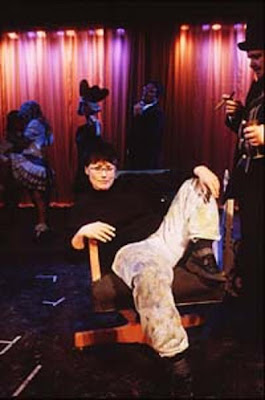
Terry Galloway (Terry Galloway with Rude Mechanicals Theater Group in Austin, Texas; photo by Kenny Braun.)

Early on, I tried to write about what happened to me in the hospital and rehab center. It was grim, desperate stuff. Terry was visibly affected by it, as she usually was by our stories. She weeps easily. She gives her heart away at a moment's notice. But one piece of writing she handed back to me, the account of a nightmarish night when I'd needed a tampon changed in the rehab unit and the staff who showed up had never used a tampon themselves. She told me to rewrite it as comedy. I can clearly remember that my immediate response, inside my head, was "Fuck you." Probably that showed on my face as well, because she leaned in to say, a little too loud, "It could be hysterical, if you give up wanting somebody to feel sorry for you."

I did rewrite it, over and over, until it became the second-best performance I ever created. It brought audiences to their knees, howling with laughter, and at the same time conveyed -- far more effectively than a straight approach would -- the intimate horror of that episode. Terry has recently staged it with her performance troupe in Tallahassee. If you want to read the final script, it's at the end of the post titled My Knees (Part Two -- Surgery and Rehab).

I trust Terry completely. She's never let me down. And from her shove back into writing, I went on to form my own writing group, to find other mentors, and to realize my voice as a writer.

In 2002, we both attended the first (and so far, only) Queer Disability Conference in San Francisco. We had rooms in the same dorm, on the same floor, and this incident happened repeatedly: I'd be in my dorm room when I'd hear a pounding on the door and Terry shouting "Maggie! Maggie! Are you in there?" I'd get painstakingly to my feet, lean on my quad cane and move slowly to the door. But once I got it open, I'd see Terry chugging impatiently down the hall toward her own room, her back to me. At which point I'd stupidly shout after her "Terry! Hey, Terry!" Then I'd smack my head, remembering she's DEAF, you dummy.

That itself would make a hilarious little vignette on stage, I think.

In the late 1990s, before Terry became a friend and mentor, I started a group studying the herstory of lesbian activism in Austin during the 1970s. Eventually I made a documentary about this era, interviewing many women about that period in their lives. One of the names which always came up was that of Terry Galloway, who despite being powerful and socially active appears to have made no enemies along the way. Extremely rare for dykes bent on revolution. I was highly entertained when two different women that I interviewed confided in me, off camera, that they were proud of having been "the woman who brought out Terry Galloway". I was even more entertained years later when I told Terry about it, and she snorted in reply "Neither one of them was my first lover!"

Terry's biography at Beacon Press reads:

Terry Galloway is a deaf, queer writer and performer, who tours her one-woman shows as a cheap way of seeing the world. She has performed her solo shows "Out All Night and Lost My Shoes" and "Lardo Weeping," in venues ranging from the American Place theater in New York to the Zap Club in Brighton, England. In Austin, Texas she gained a reputation for playing comic male roles as a student and Research Associate for the University of Texas' alternative Summer Theater Festival, Shakespeare at Winedale.

She's also known as one of the founding members of Austin's wildly popular 6th street cabaret Esther's Follies and as the founder of Actual Lives, a writing and performance workshop for adults with and without disabilities. In Tallahassee, Florida she is the Head Cheese of the Mickee Faust Academy for the REALLY Dramatic Arts and the co-founder of the Mickee Faust Club, a performance group responsible for the award-winning video parodies, "Annie Dearest, The Real Miracle Worker, " featuring lots and lots of wah-wah, and "The Scary Lewis Yell-a-thon," featuring a Jerry Lewis look-alike and a bevy of inspirational cripples. She writes as well as performs and you can find her articles, monologues, poems and performances texts in, among other publications, Sleepaway: Writings on Summer Camp, Cast Out: Queer Lives in Theater, Out of Character- Rants, Raves and Monologues from Today's Top Performance Artists, Plays from the Women's Project, Texas Monthly Magazine, Austin Chronicle, American Voice, The Dolphin Reader, and numerous anthologies about queerness, deafness, disability, theater, and Elvis.

She has been a Visiting Artist at the California Institute of the Arts, Florida State University, and the University of Texas at Austin. She's won a variety of awards including an NEA, a J. Frank Dobie Fellowship from the Texas Institute of Letters, grants from the Texas Commission of the Arts and the Florida Divisions of Cultural Affairs, five Corporation for Public Broadcasting Awards, three Prindi National Public Radio Commentary Awards, and a Best Swimmer Award from the Lions Camp for Crippled Children.

She splits her time between Austin Texas, and Tallahassee, Florida where she lives with her long-time love Donna Marie Nudd, a professor at Florida State University, and their cat Tweety.

Donna Nudd and Terry Galloway Donna Marie Nudd and Terry Galloway, Dobie Paisano Ranch outside Austin, Texas, March 2008, photo ©Marsha Miller, University of Texas at Austin.

SELECTED WORK BY TERRY GALLOWAY:
Mean Little Deaf Queer, Beacon Press, 2009.

Out All Night and Lost My Shoes, play edited by Barbara Hamby, Tallahassee: Apalachee, l993.

In The House Of The Moles, unpublished play.

Lardo Weeding, unpublished play.

Deaf As A Post/Tough as Nails, performance at Queer Disability Conference, San Francisco, June 2002.

Out All Night And Lost My Shoes (solo amalgam performance, includes "Mr. Handchops"), performance at Queer Disability Conference, San Francisco, June 2002.

"Heart of a Dog" In The Women’s Project 2, edited by Julia Miles. New York: Performing Arts Journal, l984.

“Taken: The Philosophically Sexy Transformations Engendered in a Woman by Playing Male Roles in Shakespeare", Text and Performance Quarterly 17.1 (1997): 94-100.

What We Carried Away from Winedale, article in the Austin Chronicle, 23 July 2004

Go to the website for her book at Mean Little Deaf Queer , scroll down the page to the Contents and click on "The Performance of Drowning" to hear an MP3 of Terry reading her essay about winning a swimming award at the Lions Camp for Crippled Children. HIGHLY recommended.

One of Terry Galloway's screenplays and directorial efforts is the short Annie Dearest, by produced by Faust Films and Diane Wilkins. This is a video parody of the classic film The Miracle Worker, which originally starred Patty Duke as deaf/blind Helen Keller and Anne Bancroft as Anne Sullivan, Helen's mentor and tormentor. Disability World heralded Annie Dearest as one of the 25 most outstanding disability films in the last five years. This reveals Terry Galloway's trenchant humor at its best and limns her philosophy of refusing to be the inspirational sort of "good cripple". Co-creator Donna Nudd also stars in the video as "Annie Dearest".


ARTICLES ABOUT TERRY GALLOWAY:
Highly illuminating essay by Donna Marie Nudd, Terry's partner, titled Feminists As Invisible Dramaturgs: A Case Study of Terry Galloway's Lardo Weeping.

Two Generations, One Art by Robert Faires in the Austin Chronicle, 25 February 2000

QUOTES BY TERRY GALLOWAY:
“Deafness has left me acutely aware of both the duplicity that language is capable of and the many expressions the body cannot hide.”

"Reality which so often intimidates us is exposed as just another fiction. Ours for the rewriting." -- from "Deaf as a Post/Tough as Nails" performed for Queer Disability Conference, San Francisco, California 2002

QUOTES ABOUT TERRY GALLOWAY:
"This is not your mother's triumph-of-the-human-spirit memoir. Yes, Terry Galloway is resilient. But she's also caustic, depraved, utterly disinhibited, and somehow sweetly bubbly, a beguiling raconteuse who periodically leaps onto the dinner table and stabs you with her fork. Her story will fascinate, it will hurt, and you will like it." -- Alison Bechdel, author of FUN HOME

“This is a damn fine piece of work which is unbelievably powerful. This story is true and passionate and fearless and funny as hell when it is not heartbreaking. I expect this book to charm the hell out of great numbers of people, piss off a few, and give hope to many more...” -- Dorothy Allison

Donna Marie Nudd and Terry Galloway, Dobie Paisano Ranch outside Austin, Texas, March 2008, photo ©Marsha Miller, University of Texas at Austin.
There's more...